Filippa Lundin, Timo Stettner, Peter Falus, Andrea Balducci, Aleksandar Matic
{"title":"Effect of Water on Local Structure and Dynamics in a Protic Ionic Liquid-Based Electrolyte","authors":"Filippa Lundin, Timo Stettner, Peter Falus, Andrea Balducci, Aleksandar Matic","doi":"10.1002/cssc.202402753","DOIUrl":null,"url":null,"abstract":"<p>Ionic liquids (ILs) are promising candidates for electrolytes for next-generation energy storage and conversion systems. However, a high viscosity of the IL, hampering the ion transport, has led to strategies based on the dilution of the IL with a low-viscosity solvent. Herein, the influence of the addition of water to a protic IL to form a hybrid electrolyte suggested for supercapacitor applications is reported. The experiments directly test predictions from previous molecular dynamics simulations on this and other protic IL/water hybrid electrolytes. From small-angle X-ray scattering and infrared spectroscopy, it is shown that water is inserted in the ionic matrix both as single molecules and in small aggregates. Water molecules hydrogen bonds to the available proton on the IL cation and effectively separates the ion pairs, resulting in an increase in the charge correlation distance. The change in the local structure is also reflected in the local dynamics probed by neutron spin-echo spectroscopy. A local diffusive-type process is revealed that correlates well with macroscopic ion transport, for example, the ionic conductivity. The results from neutron scattering also infer that the different local environments created by the addition of water have a relatively short lifetime.</p>","PeriodicalId":149,"journal":{"name":"ChemSusChem","volume":"18 13","pages":""},"PeriodicalIF":6.6000,"publicationDate":"2025-04-08","publicationTypes":"Journal Article","fieldsOfStudy":null,"isOpenAccess":false,"openAccessPdf":"https://onlinelibrary.wiley.com/doi/epdf/10.1002/cssc.202402753","citationCount":"0","resultStr":null,"platform":"Semanticscholar","paperid":null,"PeriodicalName":"ChemSusChem","FirstCategoryId":"92","ListUrlMain":"https://chemistry-europe.onlinelibrary.wiley.com/doi/10.1002/cssc.202402753","RegionNum":2,"RegionCategory":"化学","ArticlePicture":[],"TitleCN":null,"AbstractTextCN":null,"PMCID":null,"EPubDate":"","PubModel":"","JCR":"Q1","JCRName":"CHEMISTRY, MULTIDISCIPLINARY","Score":null,"Total":0}
引用次数: 0
Abstract
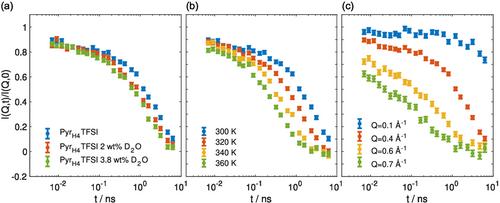
Ionic liquids (ILs) are promising candidates for electrolytes for next-generation energy storage and conversion systems. However, a high viscosity of the IL, hampering the ion transport, has led to strategies based on the dilution of the IL with a low-viscosity solvent. Herein, the influence of the addition of water to a protic IL to form a hybrid electrolyte suggested for supercapacitor applications is reported. The experiments directly test predictions from previous molecular dynamics simulations on this and other protic IL/water hybrid electrolytes. From small-angle X-ray scattering and infrared spectroscopy, it is shown that water is inserted in the ionic matrix both as single molecules and in small aggregates. Water molecules hydrogen bonds to the available proton on the IL cation and effectively separates the ion pairs, resulting in an increase in the charge correlation distance. The change in the local structure is also reflected in the local dynamics probed by neutron spin-echo spectroscopy. A local diffusive-type process is revealed that correlates well with macroscopic ion transport, for example, the ionic conductivity. The results from neutron scattering also infer that the different local environments created by the addition of water have a relatively short lifetime.
期刊介绍:
ChemSusChem
Impact Factor (2016): 7.226
Scope:
Interdisciplinary journal
Focuses on research at the interface of chemistry and sustainability
Features the best research on sustainability and energy
Areas Covered:
Chemistry
Materials Science
Chemical Engineering
Biotechnology





 京公网安备 11010802042870号
京ICP备2023020795号-1
京公网安备 11010802042870号
京ICP备2023020795号-1

 分享
分享
 求助内容:
求助内容: 应助结果提醒方式:
 扫码关注我们
