Bo Zhou, Xiaofeng Li, Wei Yang, Miao He, Na Chen, Wei Lu, Hui Tang, Weiqin Shao, Ge Zhu, Hang Gong, Nian Chen, Mengjiao Liu, Jianping Long, Anjun Hu
{"title":"Salt-Based Electrolyte Additives for Regulating the Interface Chemistry of Zinc Metal Anodes in High-Performance Aqueous Zinc Batteries","authors":"Bo Zhou, Xiaofeng Li, Wei Yang, Miao He, Na Chen, Wei Lu, Hui Tang, Weiqin Shao, Ge Zhu, Hang Gong, Nian Chen, Mengjiao Liu, Jianping Long, Anjun Hu","doi":"10.1002/cssc.202500423","DOIUrl":null,"url":null,"abstract":"<p>Aqueous zinc–metal batteries (AZMBs) are emerging as a promising green and low-cost energy storage solution, distinguished by their high safety and environmental friendliness. However, the industrialization of AZMBs is currently hindered by significant challenges, particularly uncontrollable dendritic growth and side reactions at the zinc metal anode interface, which severely limit their large-scale application. To address these issues, salt-based electrolyte additives have emerged as a straightforward, economical, and practical solution. This review systematically classifies and analyzes the working mechanisms of inorganic, organic, and ammonium salt-based additives, elucidating their roles in regulating solvation structures, hydrogen bond networks, pH levels, interfacial protective layers, electric fields, and Zn<sup>2+</sup> deposition behaviors. These additives enhance anode stability and mitigate side reactions, thereby improving overall electrochemical performance. Additionally, the review offers valuable insights into future directions for the development of salt-based electrolyte additives, providing essential guidance for advancing research in this field.</p>","PeriodicalId":149,"journal":{"name":"ChemSusChem","volume":"18 13","pages":""},"PeriodicalIF":6.6000,"publicationDate":"2025-04-09","publicationTypes":"Journal Article","fieldsOfStudy":null,"isOpenAccess":false,"openAccessPdf":"","citationCount":"0","resultStr":null,"platform":"Semanticscholar","paperid":null,"PeriodicalName":"ChemSusChem","FirstCategoryId":"92","ListUrlMain":"https://chemistry-europe.onlinelibrary.wiley.com/doi/10.1002/cssc.202500423","RegionNum":2,"RegionCategory":"化学","ArticlePicture":[],"TitleCN":null,"AbstractTextCN":null,"PMCID":null,"EPubDate":"","PubModel":"","JCR":"Q1","JCRName":"CHEMISTRY, MULTIDISCIPLINARY","Score":null,"Total":0}
引用次数: 0
Abstract
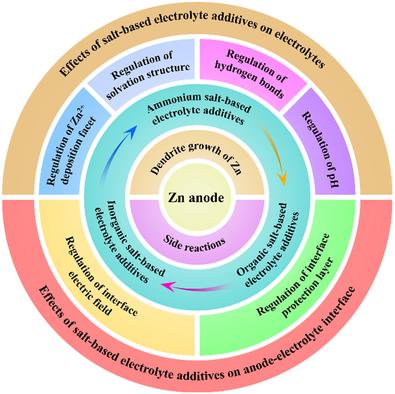
Aqueous zinc–metal batteries (AZMBs) are emerging as a promising green and low-cost energy storage solution, distinguished by their high safety and environmental friendliness. However, the industrialization of AZMBs is currently hindered by significant challenges, particularly uncontrollable dendritic growth and side reactions at the zinc metal anode interface, which severely limit their large-scale application. To address these issues, salt-based electrolyte additives have emerged as a straightforward, economical, and practical solution. This review systematically classifies and analyzes the working mechanisms of inorganic, organic, and ammonium salt-based additives, elucidating their roles in regulating solvation structures, hydrogen bond networks, pH levels, interfacial protective layers, electric fields, and Zn2+ deposition behaviors. These additives enhance anode stability and mitigate side reactions, thereby improving overall electrochemical performance. Additionally, the review offers valuable insights into future directions for the development of salt-based electrolyte additives, providing essential guidance for advancing research in this field.
期刊介绍:
ChemSusChem
Impact Factor (2016): 7.226
Scope:
Interdisciplinary journal
Focuses on research at the interface of chemistry and sustainability
Features the best research on sustainability and energy
Areas Covered:
Chemistry
Materials Science
Chemical Engineering
Biotechnology





 京公网安备 11010802042870号
京ICP备2023020795号-1
京公网安备 11010802042870号
京ICP备2023020795号-1

 分享
分享
 求助内容:
求助内容: 应助结果提醒方式:
 扫码关注我们
