Community-level mental health screening and referral using task-sharing with student volunteers in Kerala, India: a scalable model for low and middle income countries.
Saju Madavanakadu Devassy, Lorane Scaria, Shyba Babu, Rajeev S P, Lijo K J, Amal Tom Jose, Kiran Thampi, Robin E Gearing
{"title":"Community-level mental health screening and referral using task-sharing with student volunteers in Kerala, India: a scalable model for low and middle income countries.","authors":"Saju Madavanakadu Devassy, Lorane Scaria, Shyba Babu, Rajeev S P, Lijo K J, Amal Tom Jose, Kiran Thampi, Robin E Gearing","doi":"10.1186/s12888-025-06773-9","DOIUrl":null,"url":null,"abstract":"<p><strong>Background: </strong>Untreated mental illness poses a significant threat to achieving global mental health targets. The increasing incidence of common mental disorders in India exacerbates the treatment gap. Structural fragmentation prevents effective screening and treatment, despite several policies and programs. The study presents a culturally tailored mental health campaign developed within a service design paradigm for mental health screening.</p><p><strong>Methods: </strong>The campaign had three phases: formation of a multidisciplinary service design team, modelling of an intervention, and implementing activities across three levels- macro, meso, and micro- to be implemented by educated youth, utilizing task-sharing strategies. Additionally, the study tested the feasibility of a mental health screening using student volunteers through a cross-sectional door-knock survey that assessed the prevalence of depression, alcohol consumption, and drug abuse among 2,263 community residents from randomly selected geographical locations in Kerala, India. Standardized scales were used to measure the variables.</p><p><strong>Results: </strong>The youth-led community screening is promising, as the detected incidence rate was comparable to that of screening performed by experts. Participants (n = 2263) from the cross-sectional survey comprised 52% males and 48% females. The study revealed the prevalence rates of moderate and above depression (9.1%), harmful alcohol use, including alcohol use disorder (6.2%), and drug abuse (8.9%). Lower economic attainment was a vulnerability for mental disorders in both genders, with females demonstrating a higher incidence of depression and males with higher alcohol and drug abuse. Compared to males from Above Poverty Line (APL) households, females from Below Poverty Line (BPL) households had an 80% higher likelihood of depression.</p><p><strong>Conclusion: </strong>The service design team, representing a microcosm of the population, developed culturally appropriate mental health campaigns. The act-reflect-act framework within the Service Design Model integrated need-based services to bring together multiple healthcare stakeholders and ecosystem tiers, facilitated by public private partnership (PPP) to improve coverage and address barriers to accessing public mental health services. The stability of the referral model was ensured through long term initiatives, including establishment of mental health clinics and senior daycare centres.</p>","PeriodicalId":9029,"journal":{"name":"BMC Psychiatry","volume":"25 1","pages":"352"},"PeriodicalIF":3.4000,"publicationDate":"2025-04-08","publicationTypes":"Journal Article","fieldsOfStudy":null,"isOpenAccess":false,"openAccessPdf":"https://www.ncbi.nlm.nih.gov/pmc/articles/PMC11980065/pdf/","citationCount":"0","resultStr":null,"platform":"Semanticscholar","paperid":null,"PeriodicalName":"BMC Psychiatry","FirstCategoryId":"3","ListUrlMain":"https://doi.org/10.1186/s12888-025-06773-9","RegionNum":2,"RegionCategory":"医学","ArticlePicture":[],"TitleCN":null,"AbstractTextCN":null,"PMCID":null,"EPubDate":"","PubModel":"","JCR":"Q2","JCRName":"PSYCHIATRY","Score":null,"Total":0}
引用次数: 0
Abstract
Background: Untreated mental illness poses a significant threat to achieving global mental health targets. The increasing incidence of common mental disorders in India exacerbates the treatment gap. Structural fragmentation prevents effective screening and treatment, despite several policies and programs. The study presents a culturally tailored mental health campaign developed within a service design paradigm for mental health screening.
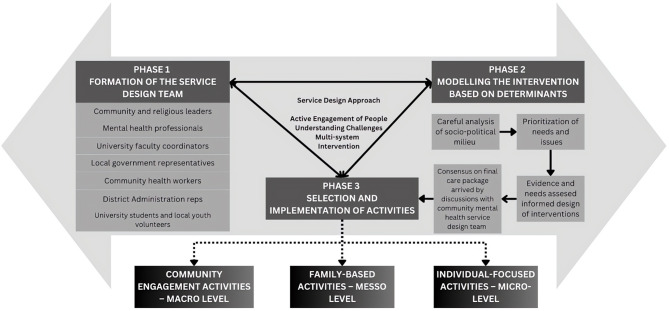
Methods: The campaign had three phases: formation of a multidisciplinary service design team, modelling of an intervention, and implementing activities across three levels- macro, meso, and micro- to be implemented by educated youth, utilizing task-sharing strategies. Additionally, the study tested the feasibility of a mental health screening using student volunteers through a cross-sectional door-knock survey that assessed the prevalence of depression, alcohol consumption, and drug abuse among 2,263 community residents from randomly selected geographical locations in Kerala, India. Standardized scales were used to measure the variables.
Results: The youth-led community screening is promising, as the detected incidence rate was comparable to that of screening performed by experts. Participants (n = 2263) from the cross-sectional survey comprised 52% males and 48% females. The study revealed the prevalence rates of moderate and above depression (9.1%), harmful alcohol use, including alcohol use disorder (6.2%), and drug abuse (8.9%). Lower economic attainment was a vulnerability for mental disorders in both genders, with females demonstrating a higher incidence of depression and males with higher alcohol and drug abuse. Compared to males from Above Poverty Line (APL) households, females from Below Poverty Line (BPL) households had an 80% higher likelihood of depression.
Conclusion: The service design team, representing a microcosm of the population, developed culturally appropriate mental health campaigns. The act-reflect-act framework within the Service Design Model integrated need-based services to bring together multiple healthcare stakeholders and ecosystem tiers, facilitated by public private partnership (PPP) to improve coverage and address barriers to accessing public mental health services. The stability of the referral model was ensured through long term initiatives, including establishment of mental health clinics and senior daycare centres.
期刊介绍:
BMC Psychiatry is an open access, peer-reviewed journal that considers articles on all aspects of the prevention, diagnosis and management of psychiatric disorders, as well as related molecular genetics, pathophysiology, and epidemiology.



 京公网安备 11010802042870号
京ICP备2023020795号-1
京公网安备 11010802042870号
京ICP备2023020795号-1

 分享
分享
 求助内容:
求助内容: 应助结果提醒方式:
 扫码关注我们
