Ida Erngren, Aina Vaivade, Henrik Carlsson, Asma Al-Grety, Torbjörn Åkerfeldt, Ingrid Kockum, Anna Karin Hedström, Lars Alfredsson, Tomas Olsson, Joachim Burman, Kim Kultima
{"title":"Bile acid metabolism in multiple sclerosis is perturbed and associated with the risk of confirmed disability worsening.","authors":"Ida Erngren, Aina Vaivade, Henrik Carlsson, Asma Al-Grety, Torbjörn Åkerfeldt, Ingrid Kockum, Anna Karin Hedström, Lars Alfredsson, Tomas Olsson, Joachim Burman, Kim Kultima","doi":"10.1186/s12916-025-04041-x","DOIUrl":null,"url":null,"abstract":"<p><strong>Background: </strong>Bile acids (BAs) have emerged as important mediators in neuroinflammation and neurodegeneration, important features of multiple sclerosis (MS). This study aimed to examine serum BA levels in newly diagnosed people with MS (pwMS) and explore their association with disability worsening.</p><p><strong>Methods: </strong>The study included 907 pwMS and 907 matched controls from the Swedish population-based EIMS cohort, with clinical follow-up data from the Swedish MS Registry. Serum BA levels were analyzed using liquid chromatography-high-resolution mass spectrometry. Differential expression analysis was used to study differences in BAs between pwMS and controls. Cox proportional-hazard models were used to assess associations between BA concentrations and confirmed disability worsening (CDW) and the risk of reaching EDSS milestones 4.0 and 6.0.</p><p><strong>Results: </strong>PwMS had lower concentrations of the primary conjugated BA, glycochenodeoxycholic acid (GCDCA, log<sub>2</sub> FC - 0.29, p = 0.009) compared to controls. In relapsing-remitting MS compared to controls, lower concentrations of primary conjugated BAs (log2 FC - 0.30, p = 8.40E - 5), secondary conjugated BAs (log2 FC - 0.18, p = 0.007), and total BAs (log2 FC - 0.22, p = 2.99E - 4) were found. Sex-specific differences were also found, with male pwMS showing more substantial BA alterations. Elevated total BA levels were associated with increased risk for CDW (HR 1.22, 95% CI 1.08-1.39), driven mainly by primary conjugated (HR 1.19, 95% CI 1.06-1.33) and secondary conjugated BAs (HR 1.21, 95% CI 1.08-1.39).</p><p><strong>Conclusions: </strong>This study identified alterations in serum BA profiles in pwMS compared to controls, with strong associations between conjugated BAs and the risk of disability worsening. These findings underscore the potential role of BAs in MS pathogenesis and disability worsening, suggesting they may be promising targets for future therapeutic interventions. Further research is warranted to clarify the underlying mechanisms of these associations.</p>","PeriodicalId":9188,"journal":{"name":"BMC Medicine","volume":"23 1","pages":"212"},"PeriodicalIF":8.3000,"publicationDate":"2025-04-09","publicationTypes":"Journal Article","fieldsOfStudy":null,"isOpenAccess":false,"openAccessPdf":"https://www.ncbi.nlm.nih.gov/pmc/articles/PMC11980154/pdf/","citationCount":"0","resultStr":null,"platform":"Semanticscholar","paperid":null,"PeriodicalName":"BMC Medicine","FirstCategoryId":"3","ListUrlMain":"https://doi.org/10.1186/s12916-025-04041-x","RegionNum":1,"RegionCategory":"医学","ArticlePicture":[],"TitleCN":null,"AbstractTextCN":null,"PMCID":null,"EPubDate":"","PubModel":"","JCR":"Q1","JCRName":"MEDICINE, GENERAL & INTERNAL","Score":null,"Total":0}
引用次数: 0
Abstract
Background: Bile acids (BAs) have emerged as important mediators in neuroinflammation and neurodegeneration, important features of multiple sclerosis (MS). This study aimed to examine serum BA levels in newly diagnosed people with MS (pwMS) and explore their association with disability worsening.
Methods: The study included 907 pwMS and 907 matched controls from the Swedish population-based EIMS cohort, with clinical follow-up data from the Swedish MS Registry. Serum BA levels were analyzed using liquid chromatography-high-resolution mass spectrometry. Differential expression analysis was used to study differences in BAs between pwMS and controls. Cox proportional-hazard models were used to assess associations between BA concentrations and confirmed disability worsening (CDW) and the risk of reaching EDSS milestones 4.0 and 6.0.
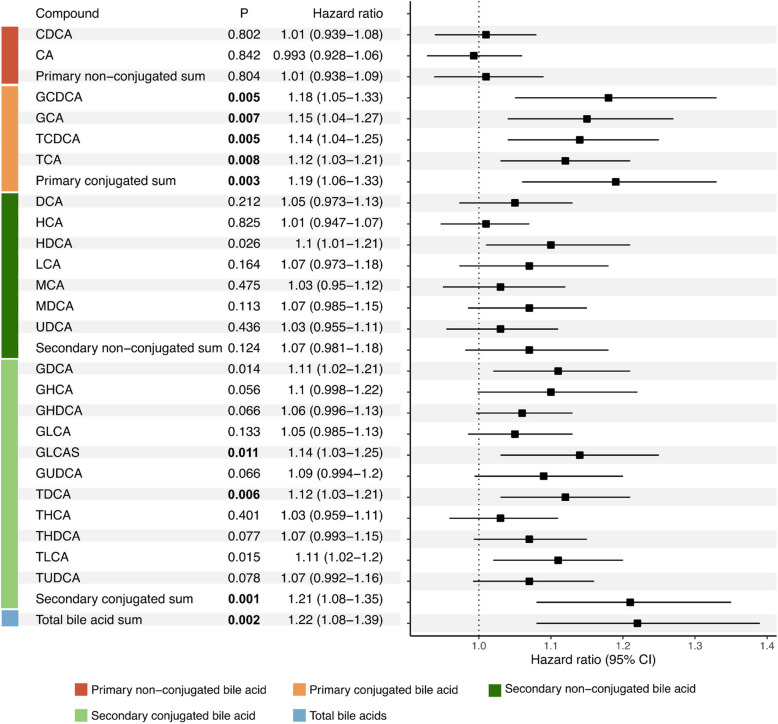
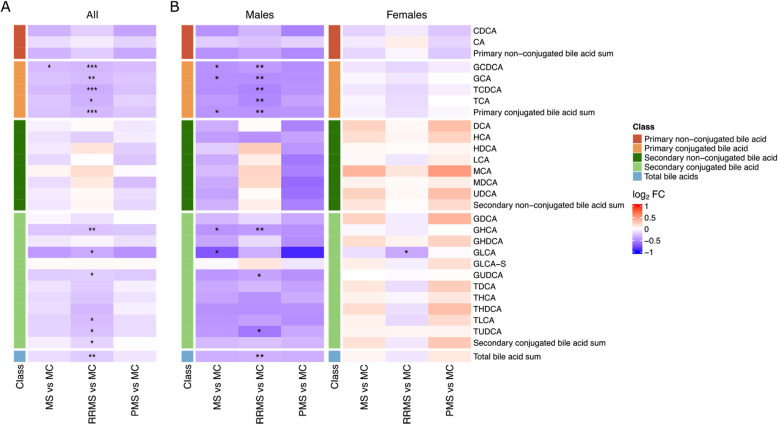
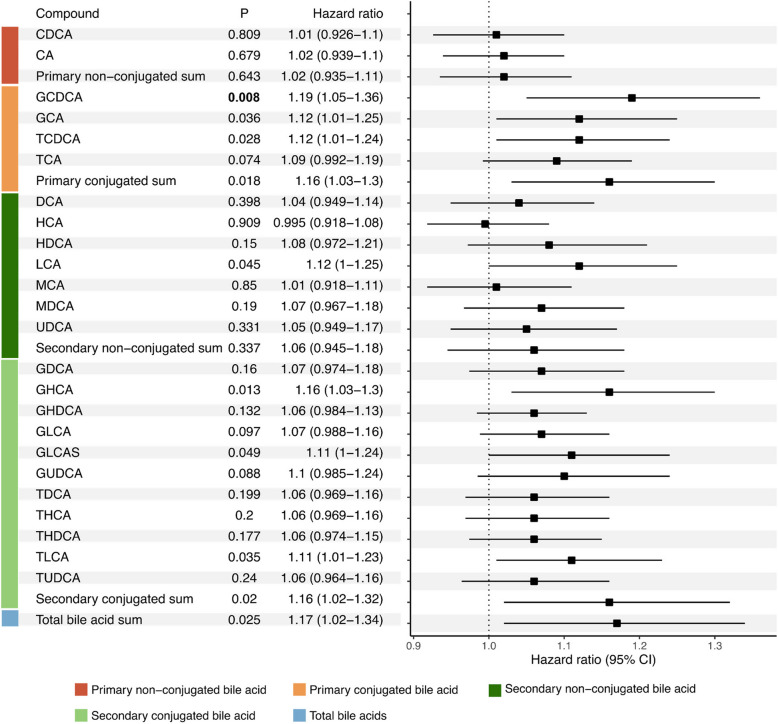
Results: PwMS had lower concentrations of the primary conjugated BA, glycochenodeoxycholic acid (GCDCA, log2 FC - 0.29, p = 0.009) compared to controls. In relapsing-remitting MS compared to controls, lower concentrations of primary conjugated BAs (log2 FC - 0.30, p = 8.40E - 5), secondary conjugated BAs (log2 FC - 0.18, p = 0.007), and total BAs (log2 FC - 0.22, p = 2.99E - 4) were found. Sex-specific differences were also found, with male pwMS showing more substantial BA alterations. Elevated total BA levels were associated with increased risk for CDW (HR 1.22, 95% CI 1.08-1.39), driven mainly by primary conjugated (HR 1.19, 95% CI 1.06-1.33) and secondary conjugated BAs (HR 1.21, 95% CI 1.08-1.39).
Conclusions: This study identified alterations in serum BA profiles in pwMS compared to controls, with strong associations between conjugated BAs and the risk of disability worsening. These findings underscore the potential role of BAs in MS pathogenesis and disability worsening, suggesting they may be promising targets for future therapeutic interventions. Further research is warranted to clarify the underlying mechanisms of these associations.
背景:胆汁酸(BAs)已成为多发性硬化症(MS)的重要特征——神经炎症和神经退行性变的重要介质。本研究旨在检测新诊断的多发性硬化症(pwMS)患者血清BA水平,并探讨其与残疾恶化的关系。方法:该研究包括907名pwMS和907名匹配的对照,来自瑞典基于人群的EIMS队列,临床随访数据来自瑞典MS登记处。采用液相色谱-高分辨率质谱法分析血清BA水平。采用差异表达分析研究小鼠与对照组之间ba的差异。使用Cox比例风险模型来评估BA浓度与确认的残疾恶化(CDW)以及达到EDSS里程碑4.0和6.0的风险之间的关系。结果:与对照组相比,PwMS具有较低的一级共轭BA、糖鹅脱氧胆酸(GCDCA, log2 FC - 0.29, p = 0.009)浓度。在复发缓解型MS中,与对照组相比,初级共轭BAs (log2 FC - 0.30, p = 8.40E - 5)、次级共轭BAs (log2 FC - 0.18, p = 0.007)和总BAs (log2 FC - 0.22, p = 2.99E - 4)的浓度较低。性别特异性差异也被发现,男性pwMS表现出更大的BA变化。总BA水平升高与CDW风险增加相关(HR 1.22, 95% CI 1.08-1.39),主要由初级共轭BA (HR 1.19, 95% CI 1.06-1.33)和次级共轭BA (HR 1.21, 95% CI 1.08-1.39)驱动。结论:该研究确定了与对照组相比,pwMS患者血清BA谱的变化,共轭BA与残疾恶化风险之间存在强烈关联。这些发现强调了BAs在MS发病机制和残疾恶化中的潜在作用,表明它们可能是未来治疗干预的有希望的靶点。需要进一步的研究来阐明这些关联的潜在机制。
期刊介绍:
BMC Medicine is an open access, transparent peer-reviewed general medical journal. It is the flagship journal of the BMC series and publishes outstanding and influential research in various areas including clinical practice, translational medicine, medical and health advances, public health, global health, policy, and general topics of interest to the biomedical and sociomedical professional communities. In addition to research articles, the journal also publishes stimulating debates, reviews, unique forum articles, and concise tutorials. All articles published in BMC Medicine are included in various databases such as Biological Abstracts, BIOSIS, CAS, Citebase, Current contents, DOAJ, Embase, MEDLINE, PubMed, Science Citation Index Expanded, OAIster, SCImago, Scopus, SOCOLAR, and Zetoc.




 京公网安备 11010802042870号
京ICP备2023020795号-1
京公网安备 11010802042870号
京ICP备2023020795号-1

 分享
分享
 求助内容:
求助内容: 应助结果提醒方式:
 扫码关注我们
