Huan Wang, Hai Xiang Yang, Yi Ning Xu, Huai Qin Fu, Xin Yan Li, Jing Jing He, Qiang Niu, Jia Chen Wu, Hai Yang Yuan, Peng Fei Liu, Hua Gui Yang
{"title":"Retained Oxygen Regulation in Oxide-Derived Copper for Promoted CO2 Electroreduction Toward Multicarbon Products","authors":"Huan Wang, Hai Xiang Yang, Yi Ning Xu, Huai Qin Fu, Xin Yan Li, Jing Jing He, Qiang Niu, Jia Chen Wu, Hai Yang Yuan, Peng Fei Liu, Hua Gui Yang","doi":"10.1002/anie.202423889","DOIUrl":null,"url":null,"abstract":"<p>Electrochemical CO<sub>2</sub> reduction to multicarbon products provides an attractive route to store intermittent renewable electricity as high value-added chemicals. Oxide-derived Cu (OD-Cu) has been widely investigated for its tunable selectivity toward multicarbon (C<sub>2+</sub>) products; however, it still remains a challenge to understand and regulate the retained oxygen of OD-Cu in the complex reconstruction process. In this work, we investigate thickness determined residual oxygen in OD-Cu, using CuO nanosheets as prototype precatalysts. When the thickness of CuO precatalyst decreased to 1.6 nm, the enhancement of the ability to retain oxygen are achieved, leading to selective C<sub>2+</sub> production with Faradaic efficiency of around 80% over a wide current density range of 300–700 mA cm<sup>−2</sup> with a peak value of 84.6% at 700 mA cm<sup>−2</sup>. Long-time molecular dynamics simulations reveal the enhanced stability of Cu–CuO structure with the layers of removed oxygen increased, favoring *CHO formation and *OC-CHO coupling toward C<sub>2+</sub> products; structural characterizations and electrochemical results further demonstrate the reconstructed stacked nanosheets with high oxygen retention capacity and easily reoxidized metallic Cu sites. This work underscores the crucial role of the retained oxygen for the OD-Cu performance and provides insights into designing OD-Cu with oxygen retention to enhance C<sub>2+</sub> products formation.</p>","PeriodicalId":125,"journal":{"name":"Angewandte Chemie International Edition","volume":"64 25","pages":""},"PeriodicalIF":16.9000,"publicationDate":"2025-04-09","publicationTypes":"Journal Article","fieldsOfStudy":null,"isOpenAccess":false,"openAccessPdf":"","citationCount":"0","resultStr":null,"platform":"Semanticscholar","paperid":null,"PeriodicalName":"Angewandte Chemie International Edition","FirstCategoryId":"92","ListUrlMain":"https://onlinelibrary.wiley.com/doi/10.1002/anie.202423889","RegionNum":1,"RegionCategory":"化学","ArticlePicture":[],"TitleCN":null,"AbstractTextCN":null,"PMCID":null,"EPubDate":"","PubModel":"","JCR":"Q1","JCRName":"CHEMISTRY, MULTIDISCIPLINARY","Score":null,"Total":0}
引用次数: 0
Abstract
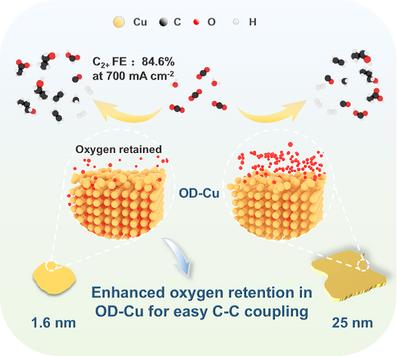
Electrochemical CO2 reduction to multicarbon products provides an attractive route to store intermittent renewable electricity as high value-added chemicals. Oxide-derived Cu (OD-Cu) has been widely investigated for its tunable selectivity toward multicarbon (C2+) products; however, it still remains a challenge to understand and regulate the retained oxygen of OD-Cu in the complex reconstruction process. In this work, we investigate thickness determined residual oxygen in OD-Cu, using CuO nanosheets as prototype precatalysts. When the thickness of CuO precatalyst decreased to 1.6 nm, the enhancement of the ability to retain oxygen are achieved, leading to selective C2+ production with Faradaic efficiency of around 80% over a wide current density range of 300–700 mA cm−2 with a peak value of 84.6% at 700 mA cm−2. Long-time molecular dynamics simulations reveal the enhanced stability of Cu–CuO structure with the layers of removed oxygen increased, favoring *CHO formation and *OC-CHO coupling toward C2+ products; structural characterizations and electrochemical results further demonstrate the reconstructed stacked nanosheets with high oxygen retention capacity and easily reoxidized metallic Cu sites. This work underscores the crucial role of the retained oxygen for the OD-Cu performance and provides insights into designing OD-Cu with oxygen retention to enhance C2+ products formation.
电化学CO2还原成多碳产品为间歇性可再生电力作为高附加值化学品的存储提供了一条有吸引力的途径。氧化物衍生铜(OD-Cu)因其对多碳(C2+)产物的选择性可调而被广泛研究;然而,在复杂的还原过程中,如何理解和调控OD-Cu的保留氧仍然是一个挑战。在这项工作中,我们研究了厚度决定OD-Cu中残余氧,使用CuO纳米片作为原型预催化剂。当CuO预催化剂的厚度减小到1.6 nm时,保留氧的能力得到增强,在300-700 mA cm-2的宽电流密度范围内选择性生成C2+,法拉第效率约为80%,在700 mA cm-2时峰值为84.6%。长时间的分子动力学模拟表明,随着脱氧层数的增加,Cu-CuO结构的稳定性增强,有利于*CHO的形成和*OC-CHO对C2+产物的耦合;结构表征和电化学结果进一步证明了重构的叠层纳米片具有高氧保留能力和易于再氧化的金属Cu位点。这项工作强调了保留氧对OD-Cu性能的关键作用,并为设计带有氧保留的OD-Cu以促进C2+产物的形成提供了见解。
期刊介绍:
Angewandte Chemie, a journal of the German Chemical Society (GDCh), maintains a leading position among scholarly journals in general chemistry with an impressive Impact Factor of 16.6 (2022 Journal Citation Reports, Clarivate, 2023). Published weekly in a reader-friendly format, it features new articles almost every day. Established in 1887, Angewandte Chemie is a prominent chemistry journal, offering a dynamic blend of Review-type articles, Highlights, Communications, and Research Articles on a weekly basis, making it unique in the field.



 京公网安备 11010802042870号
京ICP备2023020795号-1
京公网安备 11010802042870号
京ICP备2023020795号-1

 分享
分享
 求助内容:
求助内容: 应助结果提醒方式:
 扫码关注我们
