{"title":"Greater prevalence of anaemia and heavy menstrual bleeding reported in women of reproductive age in the United Kingdom compared to Australia","authors":"Beth MacLean, Jess Fuller, Jayne Lim, Cory Dugan, Toby Richards","doi":"10.1111/bjh.20075","DOIUrl":null,"url":null,"abstract":"<p>Heavy periods are a common cause of anaemia in women of reproductive age. We compare the prevalence of anaemia and heavy menstrual bleeding (HMB) among women in the United Kingdom and Australia. Women aged 15–50 years were recruited through screening events conducted in the United Kingdom and Australia from 2016 to 2024. In these cross-sectional studies, self-report questionnaires screened for HMB and finger prick haemoglobin concentration (Hb) identified anaemia (Hb < 120 g/L). Of 1937 women (United Kingdom = 333, Australia = 1604), the mean age was 28.5 ± 9.2 years and 33.7% reported HMB. In the United Kingdom, the mean Hb was 129.2 ± 12.0 g/L and 19.2% were anaemic, of which 59.4% had HMB. In Australia, the mean Hb was higher (134.4 ± 12.2 g/L; <i>p</i> < 0.001), with fewer women being anaemic (9.7%; <i>p</i> < 0.001), and fewer anaemic women had HMB (30.3%; <i>p</i> < 0.001). Logistic regression analysis found that women in the United Kingdom were at a greater risk of being anaemic (AOR: 2.144; 95%CI:1.545, 2.946; <i>p</i> < 0.001). HMB was more common in the United Kingdom (45.9% vs. 31.2%; <i>p</i> < 0.001). In Australia, 24.7% (299/1211) reported receiving intravenous iron; while those with prior intravenous iron treatment were less likely to be anaemic (AOR: 0.616; 95%CI: 0.372, 0.982; <i>p</i> = 0.0496). Women in the United Kingdom are more likely to have anaemia and HMB than women in Australia, with HMB presenting a greater risk for anaemia development in the United Kingdom.</p>","PeriodicalId":135,"journal":{"name":"British Journal of Haematology","volume":"206 5","pages":"1479-1484"},"PeriodicalIF":3.8000,"publicationDate":"2025-04-09","publicationTypes":"Journal Article","fieldsOfStudy":null,"isOpenAccess":false,"openAccessPdf":"https://onlinelibrary.wiley.com/doi/epdf/10.1111/bjh.20075","citationCount":"0","resultStr":null,"platform":"Semanticscholar","paperid":null,"PeriodicalName":"British Journal of Haematology","FirstCategoryId":"3","ListUrlMain":"https://onlinelibrary.wiley.com/doi/10.1111/bjh.20075","RegionNum":2,"RegionCategory":"医学","ArticlePicture":[],"TitleCN":null,"AbstractTextCN":null,"PMCID":null,"EPubDate":"","PubModel":"","JCR":"Q1","JCRName":"HEMATOLOGY","Score":null,"Total":0}
引用次数: 0
Abstract
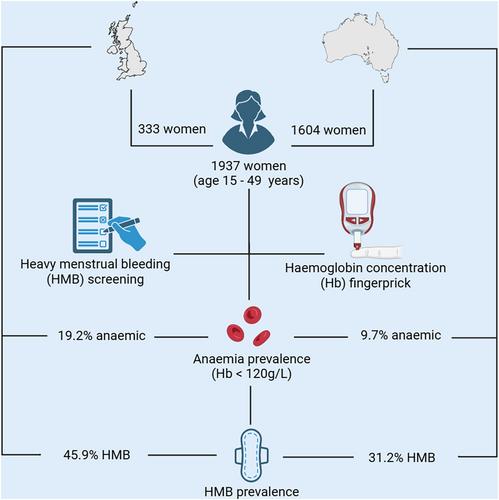
Heavy periods are a common cause of anaemia in women of reproductive age. We compare the prevalence of anaemia and heavy menstrual bleeding (HMB) among women in the United Kingdom and Australia. Women aged 15–50 years were recruited through screening events conducted in the United Kingdom and Australia from 2016 to 2024. In these cross-sectional studies, self-report questionnaires screened for HMB and finger prick haemoglobin concentration (Hb) identified anaemia (Hb < 120 g/L). Of 1937 women (United Kingdom = 333, Australia = 1604), the mean age was 28.5 ± 9.2 years and 33.7% reported HMB. In the United Kingdom, the mean Hb was 129.2 ± 12.0 g/L and 19.2% were anaemic, of which 59.4% had HMB. In Australia, the mean Hb was higher (134.4 ± 12.2 g/L; p < 0.001), with fewer women being anaemic (9.7%; p < 0.001), and fewer anaemic women had HMB (30.3%; p < 0.001). Logistic regression analysis found that women in the United Kingdom were at a greater risk of being anaemic (AOR: 2.144; 95%CI:1.545, 2.946; p < 0.001). HMB was more common in the United Kingdom (45.9% vs. 31.2%; p < 0.001). In Australia, 24.7% (299/1211) reported receiving intravenous iron; while those with prior intravenous iron treatment were less likely to be anaemic (AOR: 0.616; 95%CI: 0.372, 0.982; p = 0.0496). Women in the United Kingdom are more likely to have anaemia and HMB than women in Australia, with HMB presenting a greater risk for anaemia development in the United Kingdom.
期刊介绍:
The British Journal of Haematology publishes original research papers in clinical, laboratory and experimental haematology. The Journal also features annotations, reviews, short reports, images in haematology and Letters to the Editor.



 京公网安备 11010802042870号
京ICP备2023020795号-1
京公网安备 11010802042870号
京ICP备2023020795号-1

 分享
分享
 求助内容:
求助内容: 应助结果提醒方式:
 扫码关注我们
