Comparing umbilical cord arterial blood gas findings in pregnancies with and without gestational diabetes mellitus following elective cesarean section: a multicenter retrospective cohort study in Iran.
{"title":"Comparing umbilical cord arterial blood gas findings in pregnancies with and without gestational diabetes mellitus following elective cesarean section: a multicenter retrospective cohort study in Iran.","authors":"Fatemeh Golshahi, Zufa Iqbal, Zahra Hamidi Madani, Zeynab Zamanpour, Behrokh Sahebdel, Nafiseh Saedi, Somayeh Khanjani, Jafar Golshahi, Mahboobeh Shirazi, Pegah Rashidian, Mohammadamin Parsaei","doi":"10.1186/s12884-025-07522-2","DOIUrl":null,"url":null,"abstract":"<p><strong>Background: </strong>Gestational diabetes mellitus (GDM) is linked to adverse fetal outcomes like macrosomia and neonatal hypoglycemia, with its global incidence increasing. While prior research indicates GDM may impair placental function and fetal oxygen delivery, direct evidence is limited. This study compares umbilical cord arterial blood gas measurements in pregnancies with and without GDM.</p><p><strong>Methods: </strong>This retrospective study analyzed medical records from four hospitals in Tehran, Rasht, Ahvaz, and Isfahan in Iran, focusing on term singleton pregnancies (gestational age ≥ 37 weeks) that underwent elective cesarean sections between January and July 2024. Exclusions included maternal age < 18 or > 45 years, pre-existing diabetes, thyroid, hypertensive, malignant, metabolic, or autoimmune disorders, intrauterine growth restriction, hypertensive disorders of pregnancy, and substance use during pregnancy. GDM was diagnosed using a 75-gram oral glucose tolerance test at 24-28 weeks. Primary outcomes included umbilical cord arterial blood gas measures (potential of hydrogen [pH], partial pressure of carbon dioxide [PCO<sub>2</sub>], partial pressure of oxygen [PO<sub>2</sub>], bicarbonate [HCO<sub>3</sub>], and base deficit). The neonatal outcomes were measured as secondary outcomes. Statistical analyses utilized Chi-square, Fisher's exact, and independent t-tests.</p><p><strong>Results: </strong>Data from 430 pregnancies, including 87 with GDM, were analyzed. Pregnancies with GDM showed significantly lower pH (7.33 ± 0.08 vs. 7.36 ± 0.06, P-value = 0.006) and greater base deficit (-1.82 ± 3.79 vs. -0.50 ± 2.74 mEq/L, P-value = 0.003). However, no significant between-group differences were observed in PCO<sub>2</sub>, PO<sub>2</sub>, or HCO<sub>3</sub> (P-value > 0.05). Furthermore, we observed no significant differences in the mean birthweight, 1-minute, or 5-minute Apgar scores (P-values > 0.05), while neonates in the GDM group required more resuscitation (28.7% vs. 12.0%, P-value < 0.001) and neonatal intensive care unit admissions (34.5% vs. 16.9%, P-value < 0.001).</p><p><strong>Conclusions: </strong>Pregnancies with GDM showed higher umbilical cord blood acidity, indicating impaired placental function and reduced fetal oxygenation. These findings underscore the need for enhanced monitoring, such as regular fetal surveillance and close glycemic control, along with timely interventions like early neonatal resuscitation protocols and preparedness for neonatal intensive care unit admissions, to mitigate impaired fetal oxygenation in GDM.</p><p><strong>Trial registration: </strong>Not applicable.</p>","PeriodicalId":9033,"journal":{"name":"BMC Pregnancy and Childbirth","volume":"25 1","pages":"412"},"PeriodicalIF":2.7000,"publicationDate":"2025-04-09","publicationTypes":"Journal Article","fieldsOfStudy":null,"isOpenAccess":false,"openAccessPdf":"https://www.ncbi.nlm.nih.gov/pmc/articles/PMC11980337/pdf/","citationCount":"0","resultStr":null,"platform":"Semanticscholar","paperid":null,"PeriodicalName":"BMC Pregnancy and Childbirth","FirstCategoryId":"3","ListUrlMain":"https://doi.org/10.1186/s12884-025-07522-2","RegionNum":2,"RegionCategory":"医学","ArticlePicture":[],"TitleCN":null,"AbstractTextCN":null,"PMCID":null,"EPubDate":"","PubModel":"","JCR":"Q1","JCRName":"OBSTETRICS & GYNECOLOGY","Score":null,"Total":0}
引用次数: 0
Abstract
Background: Gestational diabetes mellitus (GDM) is linked to adverse fetal outcomes like macrosomia and neonatal hypoglycemia, with its global incidence increasing. While prior research indicates GDM may impair placental function and fetal oxygen delivery, direct evidence is limited. This study compares umbilical cord arterial blood gas measurements in pregnancies with and without GDM.
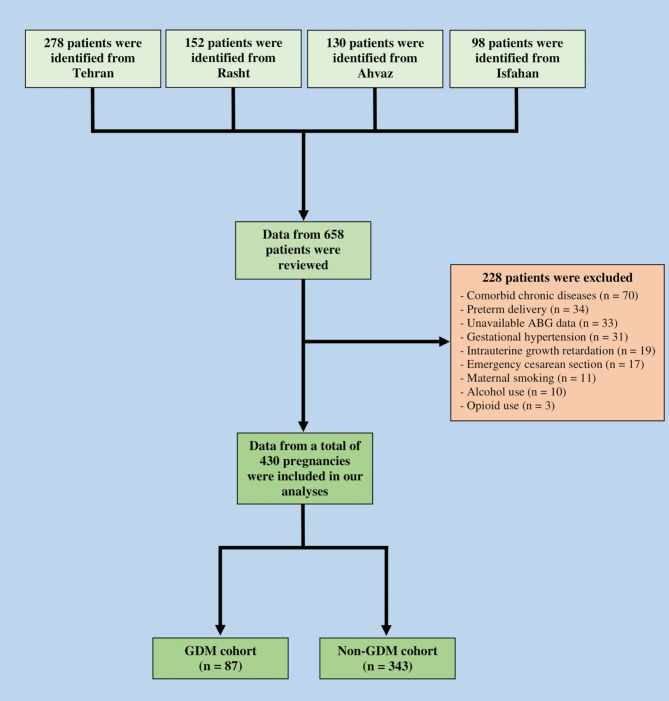
Methods: This retrospective study analyzed medical records from four hospitals in Tehran, Rasht, Ahvaz, and Isfahan in Iran, focusing on term singleton pregnancies (gestational age ≥ 37 weeks) that underwent elective cesarean sections between January and July 2024. Exclusions included maternal age < 18 or > 45 years, pre-existing diabetes, thyroid, hypertensive, malignant, metabolic, or autoimmune disorders, intrauterine growth restriction, hypertensive disorders of pregnancy, and substance use during pregnancy. GDM was diagnosed using a 75-gram oral glucose tolerance test at 24-28 weeks. Primary outcomes included umbilical cord arterial blood gas measures (potential of hydrogen [pH], partial pressure of carbon dioxide [PCO2], partial pressure of oxygen [PO2], bicarbonate [HCO3], and base deficit). The neonatal outcomes were measured as secondary outcomes. Statistical analyses utilized Chi-square, Fisher's exact, and independent t-tests.
Results: Data from 430 pregnancies, including 87 with GDM, were analyzed. Pregnancies with GDM showed significantly lower pH (7.33 ± 0.08 vs. 7.36 ± 0.06, P-value = 0.006) and greater base deficit (-1.82 ± 3.79 vs. -0.50 ± 2.74 mEq/L, P-value = 0.003). However, no significant between-group differences were observed in PCO2, PO2, or HCO3 (P-value > 0.05). Furthermore, we observed no significant differences in the mean birthweight, 1-minute, or 5-minute Apgar scores (P-values > 0.05), while neonates in the GDM group required more resuscitation (28.7% vs. 12.0%, P-value < 0.001) and neonatal intensive care unit admissions (34.5% vs. 16.9%, P-value < 0.001).
Conclusions: Pregnancies with GDM showed higher umbilical cord blood acidity, indicating impaired placental function and reduced fetal oxygenation. These findings underscore the need for enhanced monitoring, such as regular fetal surveillance and close glycemic control, along with timely interventions like early neonatal resuscitation protocols and preparedness for neonatal intensive care unit admissions, to mitigate impaired fetal oxygenation in GDM.
背景:妊娠期糖尿病(GDM)与巨大儿和新生儿低血糖等不良胎儿结局有关,其全球发病率不断上升。虽然先前的研究表明GDM可能损害胎盘功能和胎儿供氧,但直接证据有限。本研究比较了妊娠期伴有和不伴有GDM的脐带动脉血气测量结果。方法:本回顾性研究分析了伊朗德黑兰、拉什特、阿瓦士和伊斯法罕四家医院的医疗记录,重点分析了2024年1月至7月期间进行选择性剖宫产的足月单胎妊娠(胎龄≥37周)。排除包括产妇年龄45岁,既往患有糖尿病、甲状腺、高血压、恶性、代谢性或自身免疫性疾病、宫内生长受限、妊娠期高血压疾病和妊娠期药物使用。在24-28周时通过75克口服葡萄糖耐量试验诊断GDM。主要结果包括脐带动脉血气测量(氢电位[pH]、二氧化碳分压[PCO2]、氧气分压[PO2]、碳酸氢盐[HCO3]和碱亏)。新生儿结局作为次要结局来衡量。统计分析使用卡方检验、费雪精确检验和独立t检验。结果:分析了430例妊娠的数据,其中87例为GDM。妊娠期GDM患者pH值显著降低(7.33±0.08 vs. 7.36±0.06,p值= 0.006),碱基缺陷显著增加(-1.82±3.79 vs. -0.50±2.74 mEq/L, p值= 0.003)。但PCO2、PO2、HCO3组间差异无统计学意义(p值0.05)。此外,我们观察到平均出生体重、1分钟和5分钟Apgar评分无显著差异(p值bb0 0.05),而GDM组新生儿需要更多的复苏(28.7%比12.0%,p值结论:GDM妊娠脐带血酸度较高,表明胎盘功能受损,胎儿氧合减少。这些发现强调了加强监测的必要性,如定期的胎儿监测和严密的血糖控制,以及及时的干预措施,如早期新生儿复苏方案和新生儿重症监护病房入院准备,以减轻GDM胎儿氧合受损。试验注册:不适用。
期刊介绍:
BMC Pregnancy & Childbirth is an open access, peer-reviewed journal that considers articles on all aspects of pregnancy and childbirth. The journal welcomes submissions on the biomedical aspects of pregnancy, breastfeeding, labor, maternal health, maternity care, trends and sociological aspects of pregnancy and childbirth.



 京公网安备 11010802042870号
京ICP备2023020795号-1
京公网安备 11010802042870号
京ICP备2023020795号-1

 分享
分享
 求助内容:
求助内容: 应助结果提醒方式:
 扫码关注我们
