Jiayu Liu, Yankai Xu, Zihan Qiao, Shanshan Li, Xing Ma, Ting Kuang, H. P. Zhang and Wei Wang
{"title":"Quantifying and understanding the tilt of a Pt Janus active colloid near solid walls†","authors":"Jiayu Liu, Yankai Xu, Zihan Qiao, Shanshan Li, Xing Ma, Ting Kuang, H. P. Zhang and Wei Wang","doi":"10.1039/D5SM00073D","DOIUrl":null,"url":null,"abstract":"<p >Active colloids powered by self-generated gradients are influenced by nearby solid boundaries, leading to their reorientation. In this study, the tilt angles (the angle between where an active colloid moves and where it faces) were measured to be 13.3° and −33.9° for 5 μm polystyrene microspheres half coated with 10 nm Pt caps moving in 5% H<small><sub>2</sub></small>O<small><sub>2</sub></small> along the bottom and top glass wall, respectively, indicating that the colloids moved with their PS (forward) caps tilted slightly toward the wall. The speeds and tilt angles of Pt Janus colloids increased consistently with increasing H<small><sub>2</sub></small>O<small><sub>2</sub></small> concentration (0.5 to 10 v/v%) and Pt cap thickness (5 to 50 nm). We propose that the tilt results from a balance between gravitational torque (caused by the Pt cap's weight) and chemical activity-induced torque (from self-generated chemical gradients), qualitatively supported by finite element simulations based on self-electrophoresis. Our findings are useful for understanding how chemically active colloids move in, and interact with, their environment.</p>","PeriodicalId":103,"journal":{"name":"Soft Matter","volume":" 18","pages":" 3515-3526"},"PeriodicalIF":2.8000,"publicationDate":"2025-03-28","publicationTypes":"Journal Article","fieldsOfStudy":null,"isOpenAccess":false,"openAccessPdf":"","citationCount":"0","resultStr":null,"platform":"Semanticscholar","paperid":null,"PeriodicalName":"Soft Matter","FirstCategoryId":"92","ListUrlMain":"https://pubs.rsc.org/en/content/articlelanding/2025/sm/d5sm00073d","RegionNum":3,"RegionCategory":"化学","ArticlePicture":[],"TitleCN":null,"AbstractTextCN":null,"PMCID":null,"EPubDate":"","PubModel":"","JCR":"Q3","JCRName":"CHEMISTRY, PHYSICAL","Score":null,"Total":0}
引用次数: 0
Abstract
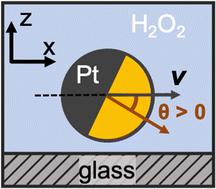
Active colloids powered by self-generated gradients are influenced by nearby solid boundaries, leading to their reorientation. In this study, the tilt angles (the angle between where an active colloid moves and where it faces) were measured to be 13.3° and −33.9° for 5 μm polystyrene microspheres half coated with 10 nm Pt caps moving in 5% H2O2 along the bottom and top glass wall, respectively, indicating that the colloids moved with their PS (forward) caps tilted slightly toward the wall. The speeds and tilt angles of Pt Janus colloids increased consistently with increasing H2O2 concentration (0.5 to 10 v/v%) and Pt cap thickness (5 to 50 nm). We propose that the tilt results from a balance between gravitational torque (caused by the Pt cap's weight) and chemical activity-induced torque (from self-generated chemical gradients), qualitatively supported by finite element simulations based on self-electrophoresis. Our findings are useful for understanding how chemically active colloids move in, and interact with, their environment.
期刊介绍:
Soft Matter is an international journal published by the Royal Society of Chemistry using Engineering-Materials Science: A Synthesis as its research focus. It publishes original research articles, review articles, and synthesis articles related to this field, reporting the latest discoveries in the relevant theoretical, practical, and applied disciplines in a timely manner, and aims to promote the rapid exchange of scientific information in this subject area. The journal is an open access journal. The journal is an open access journal and has not been placed on the alert list in the last three years.




 京公网安备 11010802042870号
京ICP备2023020795号-1
京公网安备 11010802042870号
京ICP备2023020795号-1

 分享
分享
 求助内容:
求助内容: 应助结果提醒方式:
 扫码关注我们
