Factors associated with unintended pregnancies in India among married women over the past one and half decade (2005-2021): a multivariable decomposition analysis.
{"title":"Factors associated with unintended pregnancies in India among married women over the past one and half decade (2005-2021): a multivariable decomposition analysis.","authors":"Sanjiv Singh, Kaushalendra Kumar Singh","doi":"10.1186/s12884-025-07524-0","DOIUrl":null,"url":null,"abstract":"<p><strong>Background: </strong>Along with other low- and middle-income countries unintended pregnancies are a matter of grave concern for India as well as world. Preventing unintended pregnancy can significantly reduce fertility as well as population health.</p><p><strong>Methods: </strong>Our study used data from three recent rounds of national family health survey (NFHS) which were conducted in 2005-06 (NFHS-3), 2015-16 (NFHS-4) and 2019-21 (NFHS-5). In union, currently married and pregnant women who have given birth to at least one child in last five years were taken into consideration for study. Dependent variable was unintended pregnancy (current pregnancy) which included mistimed as well as unwanted pregnancy. Univariate, bivariate analysis with point-to-point change was done to know aboutdependent variable. To know about important covariate of change in unintended pregnancy logistic regression has been used followed by multivariable decomposition analysis.</p><p><strong>Results: </strong>Over all three - survey rounds considered in our study; prevalence of unintended pregnancy declined from 31.76% (NFHS-3) to 15.87% (NFHS-5). Highest percentage decline of 23.02% from NFHS-3 (39.01%) to NFHS-5 (15.99%) in unintended pregnancy was in the women of Muslim religion. Women of rural area have 19% lower chance of unintended pregnancy with adjusted odds ratio 0.81. Odds of having current unintended pregnancy were about 8 times in women whose last birth was unwanted. Women with incorrect knowledge of ovulatory cycle have 20% higher chance of having unintended pregnancy. After analysis it was found that out of total change in unintended pregnancies was proximately 23% due to compositional change and about 77% change was due to behavioural change.</p><p><strong>Conclusions: </strong>Over the time prevalence of unintended pregnancies declining which can be helpful for better health to both child and women. Important factors leading to a decline in unintended pregnancy were young age groups, high education level, unwanted last birth, no and negative fertility gap, no intention to contraceptive use and incorrect knowledge of the ovulatory cycle. Most of decline in unintended pregnancies was due to behavioural change of women considered in our study.</p>","PeriodicalId":9033,"journal":{"name":"BMC Pregnancy and Childbirth","volume":"25 1","pages":"404"},"PeriodicalIF":2.7000,"publicationDate":"2025-04-08","publicationTypes":"Journal Article","fieldsOfStudy":null,"isOpenAccess":false,"openAccessPdf":"https://www.ncbi.nlm.nih.gov/pmc/articles/PMC11980145/pdf/","citationCount":"0","resultStr":null,"platform":"Semanticscholar","paperid":null,"PeriodicalName":"BMC Pregnancy and Childbirth","FirstCategoryId":"3","ListUrlMain":"https://doi.org/10.1186/s12884-025-07524-0","RegionNum":2,"RegionCategory":"医学","ArticlePicture":[],"TitleCN":null,"AbstractTextCN":null,"PMCID":null,"EPubDate":"","PubModel":"","JCR":"Q1","JCRName":"OBSTETRICS & GYNECOLOGY","Score":null,"Total":0}
引用次数: 0
Abstract
Background: Along with other low- and middle-income countries unintended pregnancies are a matter of grave concern for India as well as world. Preventing unintended pregnancy can significantly reduce fertility as well as population health.
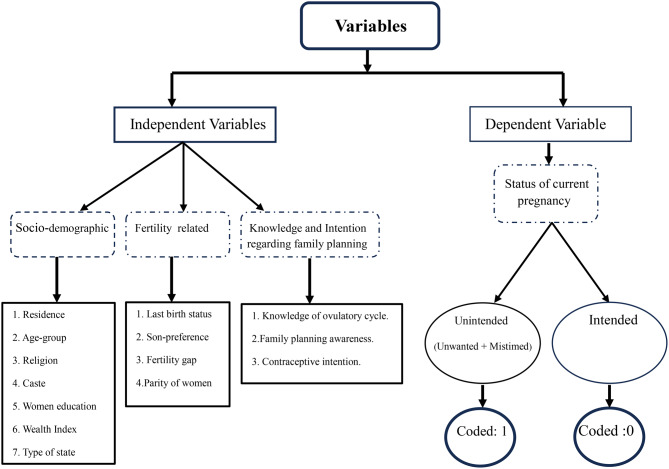
Methods: Our study used data from three recent rounds of national family health survey (NFHS) which were conducted in 2005-06 (NFHS-3), 2015-16 (NFHS-4) and 2019-21 (NFHS-5). In union, currently married and pregnant women who have given birth to at least one child in last five years were taken into consideration for study. Dependent variable was unintended pregnancy (current pregnancy) which included mistimed as well as unwanted pregnancy. Univariate, bivariate analysis with point-to-point change was done to know aboutdependent variable. To know about important covariate of change in unintended pregnancy logistic regression has been used followed by multivariable decomposition analysis.
Results: Over all three - survey rounds considered in our study; prevalence of unintended pregnancy declined from 31.76% (NFHS-3) to 15.87% (NFHS-5). Highest percentage decline of 23.02% from NFHS-3 (39.01%) to NFHS-5 (15.99%) in unintended pregnancy was in the women of Muslim religion. Women of rural area have 19% lower chance of unintended pregnancy with adjusted odds ratio 0.81. Odds of having current unintended pregnancy were about 8 times in women whose last birth was unwanted. Women with incorrect knowledge of ovulatory cycle have 20% higher chance of having unintended pregnancy. After analysis it was found that out of total change in unintended pregnancies was proximately 23% due to compositional change and about 77% change was due to behavioural change.
Conclusions: Over the time prevalence of unintended pregnancies declining which can be helpful for better health to both child and women. Important factors leading to a decline in unintended pregnancy were young age groups, high education level, unwanted last birth, no and negative fertility gap, no intention to contraceptive use and incorrect knowledge of the ovulatory cycle. Most of decline in unintended pregnancies was due to behavioural change of women considered in our study.
期刊介绍:
BMC Pregnancy & Childbirth is an open access, peer-reviewed journal that considers articles on all aspects of pregnancy and childbirth. The journal welcomes submissions on the biomedical aspects of pregnancy, breastfeeding, labor, maternal health, maternity care, trends and sociological aspects of pregnancy and childbirth.




 京公网安备 11010802042870号
京ICP备2023020795号-1
京公网安备 11010802042870号
京ICP备2023020795号-1

 分享
分享
 求助内容:
求助内容: 应助结果提醒方式:
 扫码关注我们
