{"title":"Design of New Anti-Influenza Structures Based on 3D-QSAR, Molecular Docking and Molecular Dynamics Studies","authors":"Reza Mahmoudzadeh Laki, Eslam Pourbasheer","doi":"10.1002/cbdv.202500587","DOIUrl":null,"url":null,"abstract":"<div>\n \n <p>This study aims to design novel inhibitors against influenza A virus by integrating 3D-quantitative structure–activity relationship (QSAR) modeling, molecular docking, and molecular dynamics (MD) simulations. The data set, consisting of 38 compounds, was divided into training and test sets using hierarchical clustering. The most active compound was used as a reference for molecular alignment. Comparative molecular field analysis (CoMFA), CoMFA-Focus, and comparative molecular similarity indices analysis (CoMSIA) models were developed and validated using the partial least squares method. Among them, the CoMSIA model, incorporating steric, hydrophobic, and hydrogen bond donor descriptors, demonstrated the highest predictive performance (<i>q</i><sup>2</sup><sub>LOO</sub> = 0.681, <i>r</i><sup>2</sup><sub>training</sub> = 0.847). Contour maps identified key regions for structural modifications to enhance inhibitory activity. Molecular docking confirmed these findings by highlighting crucial ligand–receptor interactions. Further validation through MD simulations revealed stable ligand binding with hemagglutinin, supported by root mean square deviation (RMSD) and root mean square fluctuation (RMSF) analyses. The radius of gyration analysis indicated a compact ligand conformation, reinforcing its stability and strong binding affinity. Additionally, binding free energy calculations suggested favorable ligand–receptor interactions. On the basis of these insights, nine novel compounds were designed, showing promising potential for experimental validation and further development as anti-influenza A agents.</p>\n </div>","PeriodicalId":9878,"journal":{"name":"Chemistry & Biodiversity","volume":"22 9","pages":""},"PeriodicalIF":2.5000,"publicationDate":"2025-04-09","publicationTypes":"Journal Article","fieldsOfStudy":null,"isOpenAccess":false,"openAccessPdf":"","citationCount":"0","resultStr":null,"platform":"Semanticscholar","paperid":null,"PeriodicalName":"Chemistry & Biodiversity","FirstCategoryId":"92","ListUrlMain":"https://onlinelibrary.wiley.com/doi/10.1002/cbdv.202500587","RegionNum":3,"RegionCategory":"化学","ArticlePicture":[],"TitleCN":null,"AbstractTextCN":null,"PMCID":null,"EPubDate":"","PubModel":"","JCR":"Q3","JCRName":"BIOCHEMISTRY & MOLECULAR BIOLOGY","Score":null,"Total":0}
引用次数: 0
Abstract
This study aims to design novel inhibitors against influenza A virus by integrating 3D-quantitative structure–activity relationship (QSAR) modeling, molecular docking, and molecular dynamics (MD) simulations. The data set, consisting of 38 compounds, was divided into training and test sets using hierarchical clustering. The most active compound was used as a reference for molecular alignment. Comparative molecular field analysis (CoMFA), CoMFA-Focus, and comparative molecular similarity indices analysis (CoMSIA) models were developed and validated using the partial least squares method. Among them, the CoMSIA model, incorporating steric, hydrophobic, and hydrogen bond donor descriptors, demonstrated the highest predictive performance (q2LOO = 0.681, r2training = 0.847). Contour maps identified key regions for structural modifications to enhance inhibitory activity. Molecular docking confirmed these findings by highlighting crucial ligand–receptor interactions. Further validation through MD simulations revealed stable ligand binding with hemagglutinin, supported by root mean square deviation (RMSD) and root mean square fluctuation (RMSF) analyses. The radius of gyration analysis indicated a compact ligand conformation, reinforcing its stability and strong binding affinity. Additionally, binding free energy calculations suggested favorable ligand–receptor interactions. On the basis of these insights, nine novel compounds were designed, showing promising potential for experimental validation and further development as anti-influenza A agents.
期刊介绍:
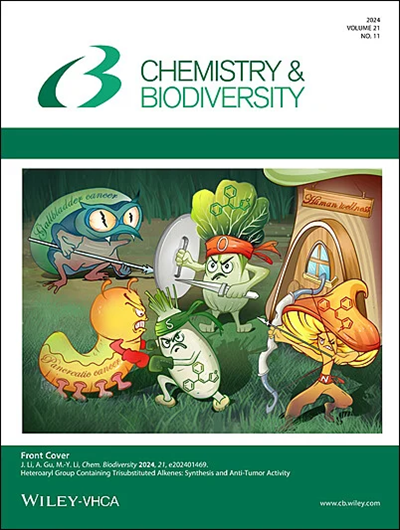
Chemistry & Biodiversity serves as a high-quality publishing forum covering a wide range of biorelevant topics for a truly international audience. This journal publishes both field-specific and interdisciplinary contributions on all aspects of biologically relevant chemistry research in the form of full-length original papers, short communications, invited reviews, and commentaries. It covers all research fields straddling the border between the chemical and biological sciences, with the ultimate goal of broadening our understanding of how nature works at a molecular level.
Since 2017, Chemistry & Biodiversity is published in an online-only format.




 京公网安备 11010802042870号
京ICP备2023020795号-1
京公网安备 11010802042870号
京ICP备2023020795号-1

 分享
分享
 求助内容:
求助内容: 应助结果提醒方式:
 扫码关注我们
