Sae Young Jae, Tae Gu Choi, Hyun Jeong Kim, Setor K Kunutsor
{"title":"Comparison of inspiratory muscle strength and aerobic exercise training and detraining on blood pressure in hypertensive patients.","authors":"Sae Young Jae, Tae Gu Choi, Hyun Jeong Kim, Setor K Kunutsor","doi":"10.5646/ch.2025.31.e15","DOIUrl":null,"url":null,"abstract":"<p><strong>Background: </strong>This study evaluated the effectiveness of inspiratory muscle strength training (IMST) as a time-efficient alternative to widely recommended aerobic exercise (AE) for reducing and maintaining blood pressure in hypertensive patients.</p><p><strong>Methods: </strong>Twenty-eight hypertensive patients (aged 61 ± 7 years) were randomly assigned to IMST (<i>n</i> = 14) and AE (<i>n</i> = 14) groups. The IMST performed 30 breaths/session at 75% of maximal inspiratory pressure (PI<sub>max</sub>), totaling about 8 minutes, 5 days/week. The AE group exercised at 70% of heart rate reserve for 30 minutes/session, 5 days/week. Both supervised interventions lasted 8 weeks, followed by a 4-week detraining period. Brachial and central systolic blood pressure (SBP) were taken at baseline, 8-week post-intervention, and post-detraining.</p><p><strong>Results: </strong>The mean (standard deviation) change in brachial SBP from baseline to 8 week post-intervention significantly decreased in both the IMST group [-9.1 (12.1) mmHg, <i>P</i> = 0.01] and the AE group [-6.2 (7.2) mmHg, <i>P</i> = 0.01], with no significant difference between groups (<i>P</i> = 0.46). Central SBP also significantly reduced in the IMST group [-9.0 (11.9) mmHg, <i>P</i> = 0.01] and in the AE group [-5.7 (6.2) mmHg, <i>P</i> = 0.01], with no significant difference between groups (<i>P</i> = 0.37). However, the IMST group did not show significant persistence in SBP reduction, whereas the AE group did.</p><p><strong>Conclusions: </strong>Both IMST and AE effectively reduced brachial and central BP after 8-week interventions in hypertensive patients. While IMST presents a time-efficient adjunctive option to AE, its long-term effectiveness remains uncertain.</p>","PeriodicalId":10480,"journal":{"name":"Clinical Hypertension","volume":"31 ","pages":"e15"},"PeriodicalIF":3.6000,"publicationDate":"2025-04-01","publicationTypes":"Journal Article","fieldsOfStudy":null,"isOpenAccess":false,"openAccessPdf":"https://www.ncbi.nlm.nih.gov/pmc/articles/PMC11975636/pdf/","citationCount":"0","resultStr":null,"platform":"Semanticscholar","paperid":null,"PeriodicalName":"Clinical Hypertension","FirstCategoryId":"1085","ListUrlMain":"https://doi.org/10.5646/ch.2025.31.e15","RegionNum":0,"RegionCategory":null,"ArticlePicture":[],"TitleCN":null,"AbstractTextCN":null,"PMCID":null,"EPubDate":"2025/1/1 0:00:00","PubModel":"eCollection","JCR":"Q2","JCRName":"PERIPHERAL VASCULAR DISEASE","Score":null,"Total":0}
引用次数: 0
Abstract
Background: This study evaluated the effectiveness of inspiratory muscle strength training (IMST) as a time-efficient alternative to widely recommended aerobic exercise (AE) for reducing and maintaining blood pressure in hypertensive patients.
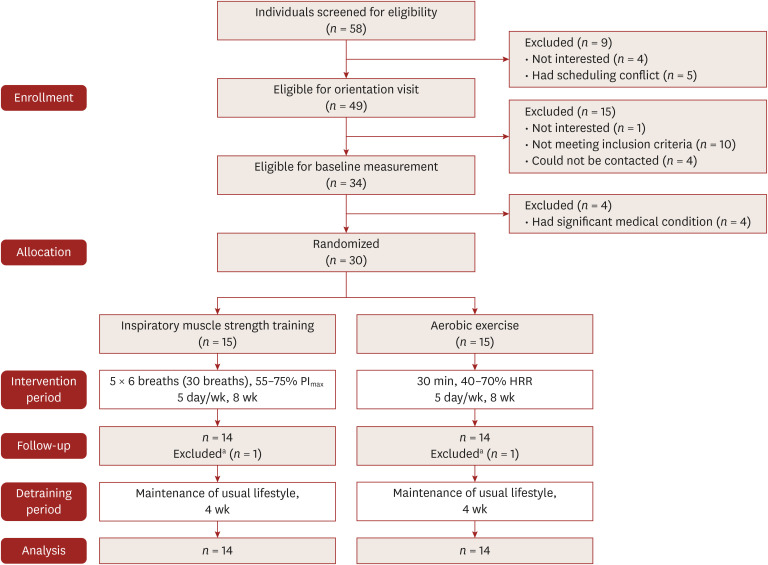
Methods: Twenty-eight hypertensive patients (aged 61 ± 7 years) were randomly assigned to IMST (n = 14) and AE (n = 14) groups. The IMST performed 30 breaths/session at 75% of maximal inspiratory pressure (PImax), totaling about 8 minutes, 5 days/week. The AE group exercised at 70% of heart rate reserve for 30 minutes/session, 5 days/week. Both supervised interventions lasted 8 weeks, followed by a 4-week detraining period. Brachial and central systolic blood pressure (SBP) were taken at baseline, 8-week post-intervention, and post-detraining.
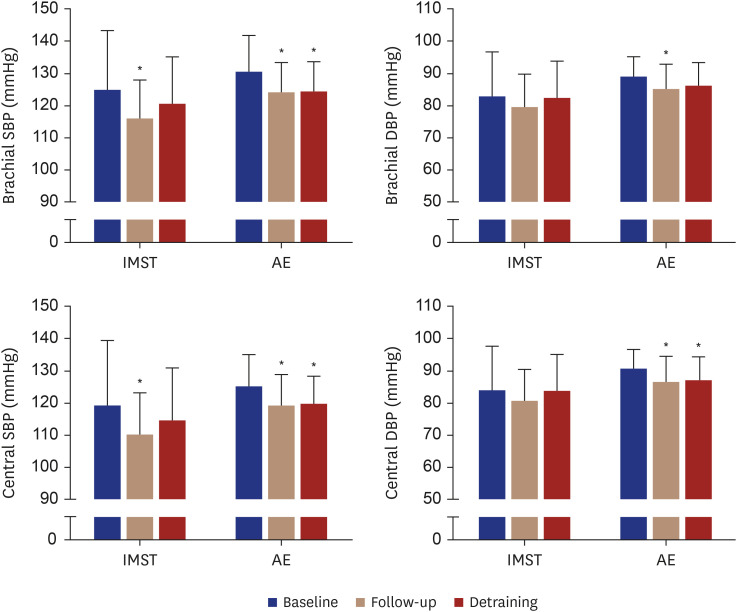
Results: The mean (standard deviation) change in brachial SBP from baseline to 8 week post-intervention significantly decreased in both the IMST group [-9.1 (12.1) mmHg, P = 0.01] and the AE group [-6.2 (7.2) mmHg, P = 0.01], with no significant difference between groups (P = 0.46). Central SBP also significantly reduced in the IMST group [-9.0 (11.9) mmHg, P = 0.01] and in the AE group [-5.7 (6.2) mmHg, P = 0.01], with no significant difference between groups (P = 0.37). However, the IMST group did not show significant persistence in SBP reduction, whereas the AE group did.
Conclusions: Both IMST and AE effectively reduced brachial and central BP after 8-week interventions in hypertensive patients. While IMST presents a time-efficient adjunctive option to AE, its long-term effectiveness remains uncertain.



 京公网安备 11010802042870号
京ICP备2023020795号-1
京公网安备 11010802042870号
京ICP备2023020795号-1

 分享
分享
 求助内容:
求助内容: 应助结果提醒方式:
 扫码关注我们
