Application of machine learning models to explore prognosis and cause of death in advanced intrahepatic cholangiocarcinoma patients undergoing chemotherapy.
Qin Zeng, Xin Wang, Jun Liu, Yiqing Jiang, Guili Cao, Ke Su, Xiaoqin Liu
{"title":"Application of machine learning models to explore prognosis and cause of death in advanced intrahepatic cholangiocarcinoma patients undergoing chemotherapy.","authors":"Qin Zeng, Xin Wang, Jun Liu, Yiqing Jiang, Guili Cao, Ke Su, Xiaoqin Liu","doi":"10.1007/s12672-025-02274-z","DOIUrl":null,"url":null,"abstract":"<p><strong>Background: </strong>This study was aimed at examining the causes of death (CODs) in patients with advanced intrahepatic cholangiocarcinoma (ICC) undergoing chemotherapy (CT). In addition, machine learning models were incorporated to predict the treatment outcomes of patients with advanced ICC and identify the factors most closely related to prognosis.</p><p><strong>Methods: </strong>A total of 5564 patients (CT group, 3632; non-CT group, 1932) were included in the Surveillance Epidemiology and End Results registries between 2000 and 2020. The CODs were compared between the two groups before and after the inverse probability of treatment weighting (IPTW). Furthermore, seven machine learning models were utilized as predictive tools to select variable features, aiming to assess the therapeutic effectiveness in patients with advanced ICC.</p><p><strong>Results: </strong>After IPTW, the CT group exhibited a lower cumulative incidence of cholangiocarcinoma-related deaths (30%, 49%, and 73% vs. 59%, 66%, and 73%; P < 0.001), secondary malignant neoplasms (8.5%, 13%, and 20% vs. 19%, 22%, and 24%; P < 0.001), and other CODs (1.8%, 2.9%, and 4.4% vs. 4.1%, 4.6%, and 5.4%; P < 0.001) at 0.5-, 1-, and 3- years than the non-CT group, whereas the cumulative incidence of cardiovascular diseases (P = 0.4) was comparable between the two groups. Of the seven machine learning models, the random forest model showed the highest predictive effectiveness. This model verified that variables such as CT, radiotherapy, tumor dimensions, sex, and distant metastasis were strongly correlated with the prognosis of advanced ICC.</p><p><strong>Conclusions: </strong>CT has improved the therapeutic efficacy of advanced ICC without significantly increasing other CODs. Furthermore, the analysis of various features using machine learning models has confirmed that the random forest model demonstrates the highest predictive performance.</p>","PeriodicalId":11148,"journal":{"name":"Discover. Oncology","volume":"16 1","pages":"490"},"PeriodicalIF":2.9000,"publicationDate":"2025-04-08","publicationTypes":"Journal Article","fieldsOfStudy":null,"isOpenAccess":false,"openAccessPdf":"https://www.ncbi.nlm.nih.gov/pmc/articles/PMC11978561/pdf/","citationCount":"0","resultStr":null,"platform":"Semanticscholar","paperid":null,"PeriodicalName":"Discover. Oncology","FirstCategoryId":"3","ListUrlMain":"https://doi.org/10.1007/s12672-025-02274-z","RegionNum":4,"RegionCategory":"医学","ArticlePicture":[],"TitleCN":null,"AbstractTextCN":null,"PMCID":null,"EPubDate":"","PubModel":"","JCR":"Q3","JCRName":"ENDOCRINOLOGY & METABOLISM","Score":null,"Total":0}
引用次数: 0
Abstract
Background: This study was aimed at examining the causes of death (CODs) in patients with advanced intrahepatic cholangiocarcinoma (ICC) undergoing chemotherapy (CT). In addition, machine learning models were incorporated to predict the treatment outcomes of patients with advanced ICC and identify the factors most closely related to prognosis.
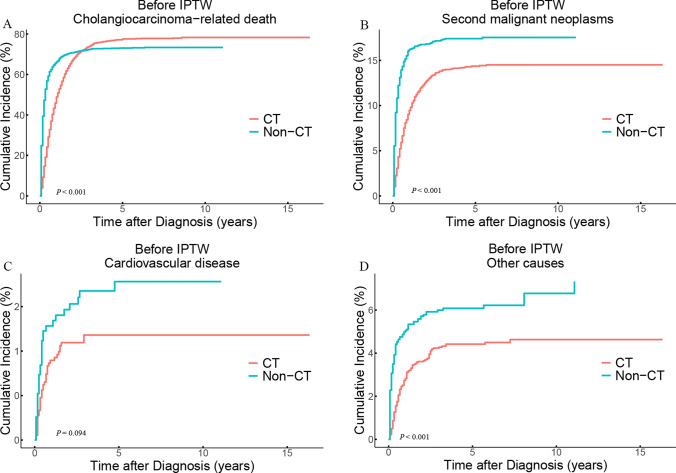
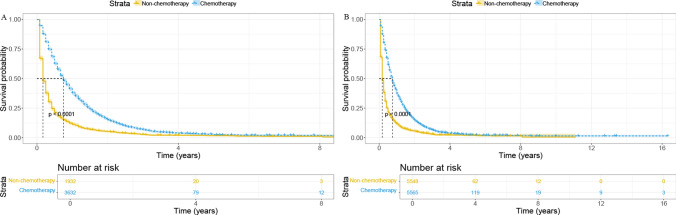
Methods: A total of 5564 patients (CT group, 3632; non-CT group, 1932) were included in the Surveillance Epidemiology and End Results registries between 2000 and 2020. The CODs were compared between the two groups before and after the inverse probability of treatment weighting (IPTW). Furthermore, seven machine learning models were utilized as predictive tools to select variable features, aiming to assess the therapeutic effectiveness in patients with advanced ICC.
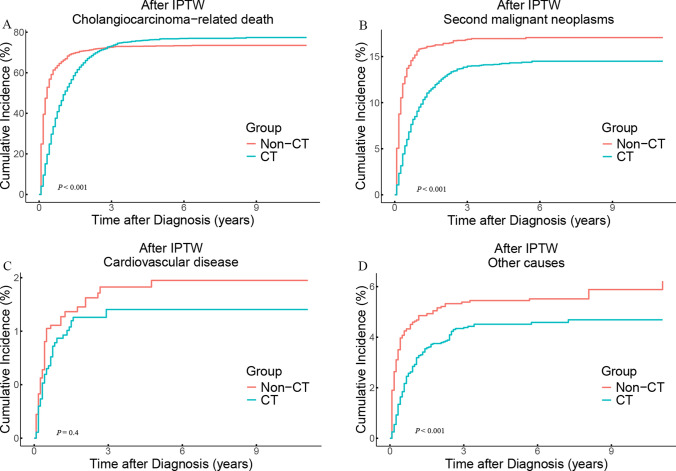
Results: After IPTW, the CT group exhibited a lower cumulative incidence of cholangiocarcinoma-related deaths (30%, 49%, and 73% vs. 59%, 66%, and 73%; P < 0.001), secondary malignant neoplasms (8.5%, 13%, and 20% vs. 19%, 22%, and 24%; P < 0.001), and other CODs (1.8%, 2.9%, and 4.4% vs. 4.1%, 4.6%, and 5.4%; P < 0.001) at 0.5-, 1-, and 3- years than the non-CT group, whereas the cumulative incidence of cardiovascular diseases (P = 0.4) was comparable between the two groups. Of the seven machine learning models, the random forest model showed the highest predictive effectiveness. This model verified that variables such as CT, radiotherapy, tumor dimensions, sex, and distant metastasis were strongly correlated with the prognosis of advanced ICC.
Conclusions: CT has improved the therapeutic efficacy of advanced ICC without significantly increasing other CODs. Furthermore, the analysis of various features using machine learning models has confirmed that the random forest model demonstrates the highest predictive performance.




 京公网安备 11010802042870号
京ICP备2023020795号-1
京公网安备 11010802042870号
京ICP备2023020795号-1

 分享
分享
 求助内容:
求助内容: 应助结果提醒方式:
 扫码关注我们
