Andrea Tur-Boned, Lars Louis Andersen, Rubén López-Bueno, Rodrigo Núñez-Cortés, Carlos Cruz-Montecinos, Luis Suso-Martí, Ana Polo-López, Joaquín Calatayud
{"title":"Beyond body mass index: the role of muscle strength in reducing mortality risk in older adults with severe obesity – multi-country cohort study","authors":"Andrea Tur-Boned, Lars Louis Andersen, Rubén López-Bueno, Rodrigo Núñez-Cortés, Carlos Cruz-Montecinos, Luis Suso-Martí, Ana Polo-López, Joaquín Calatayud","doi":"10.1038/s41430-025-01616-y","DOIUrl":null,"url":null,"abstract":"Since muscle strength is modifiable and handgrip strength is a reliable biomarker for strength and mortality, exploring its association with mortality in individuals with severe obesity could help identify protective thresholds. We aimed to examine the dose-response association between handgrip strength and mortality in adults with severe obesity. We retrieved data from the Survey of Health, Ageing and Retirement in Europe (SHARE). Handgrip strength was measured in participants with a body mass index (BMI) higher than 40 kg/m2. We used time-varying Cox proportional hazards regression to assess the association between handgrip strength and all-cause mortality risk. To account for potential non-linearity, we employed restricted cubic splines. We examined a total of 2229 adults (67.9% women; BMI of 43.8 kg/m2). We found an association between handgrip strength and mortality, showing a minimal and optimal dose for a reduced risk with 31 kg (HR 0.97, 95% CI, 0.96–0.99) and 36 kg (HR 0.90, 95% CI, 0.81–0.99), respectively. Additional sex-stratified analysis showed that lower than median levels of handgrip strength were gradually associated with increased risk in both men and women. The association between handgrip strength and all-cause mortality in European adults with severe obesity highlights practical thresholds for risk reduction, with 31 kg as the minimum and 36 kg as the optimal strength level. In both men and women, handgrip strength below the median was linked to a gradual increase in mortality risk, emphasizing the importance of maintaining adequate muscle strength to improve health outcomes.","PeriodicalId":11927,"journal":{"name":"European Journal of Clinical Nutrition","volume":"79 8","pages":"787-792"},"PeriodicalIF":3.3000,"publicationDate":"2025-04-08","publicationTypes":"Journal Article","fieldsOfStudy":null,"isOpenAccess":false,"openAccessPdf":"","citationCount":"0","resultStr":null,"platform":"Semanticscholar","paperid":null,"PeriodicalName":"European Journal of Clinical Nutrition","FirstCategoryId":"3","ListUrlMain":"https://www.nature.com/articles/s41430-025-01616-y","RegionNum":3,"RegionCategory":"医学","ArticlePicture":[],"TitleCN":null,"AbstractTextCN":null,"PMCID":null,"EPubDate":"","PubModel":"","JCR":"Q2","JCRName":"NUTRITION & DIETETICS","Score":null,"Total":0}
引用次数: 0
Abstract
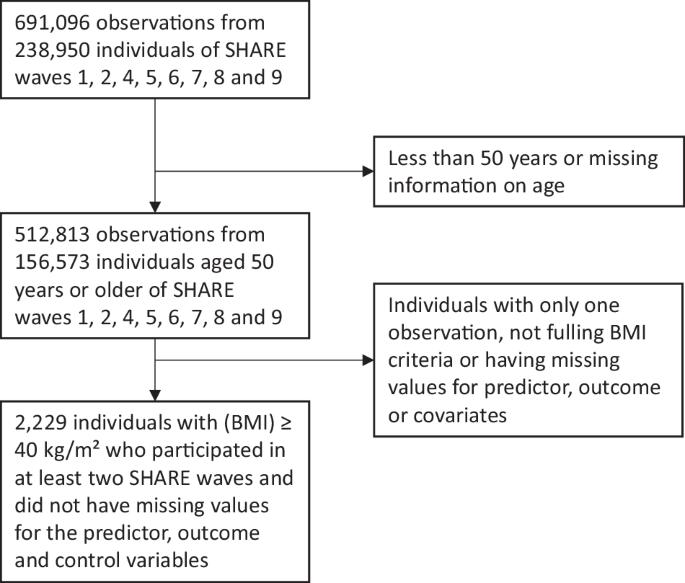
Since muscle strength is modifiable and handgrip strength is a reliable biomarker for strength and mortality, exploring its association with mortality in individuals with severe obesity could help identify protective thresholds. We aimed to examine the dose-response association between handgrip strength and mortality in adults with severe obesity. We retrieved data from the Survey of Health, Ageing and Retirement in Europe (SHARE). Handgrip strength was measured in participants with a body mass index (BMI) higher than 40 kg/m2. We used time-varying Cox proportional hazards regression to assess the association between handgrip strength and all-cause mortality risk. To account for potential non-linearity, we employed restricted cubic splines. We examined a total of 2229 adults (67.9% women; BMI of 43.8 kg/m2). We found an association between handgrip strength and mortality, showing a minimal and optimal dose for a reduced risk with 31 kg (HR 0.97, 95% CI, 0.96–0.99) and 36 kg (HR 0.90, 95% CI, 0.81–0.99), respectively. Additional sex-stratified analysis showed that lower than median levels of handgrip strength were gradually associated with increased risk in both men and women. The association between handgrip strength and all-cause mortality in European adults with severe obesity highlights practical thresholds for risk reduction, with 31 kg as the minimum and 36 kg as the optimal strength level. In both men and women, handgrip strength below the median was linked to a gradual increase in mortality risk, emphasizing the importance of maintaining adequate muscle strength to improve health outcomes.
期刊介绍:
The European Journal of Clinical Nutrition (EJCN) is an international, peer-reviewed journal covering all aspects of human and clinical nutrition. The journal welcomes original research, reviews, case reports and brief communications based on clinical, metabolic and epidemiological studies that describe methodologies, mechanisms, associations and benefits of nutritional interventions for clinical disease and health promotion.
Topics of interest include but are not limited to:
Nutrition and Health (including climate and ecological aspects)
Metabolism & Metabolomics
Genomics and personalized strategies in nutrition
Nutrition during the early life cycle
Health issues and nutrition in the elderly
Phenotyping in clinical nutrition
Nutrition in acute and chronic diseases
The double burden of ''malnutrition'': Under-nutrition and Obesity
Prevention of Non Communicable Diseases (NCD)




 京公网安备 11010802042870号
京ICP备2023020795号-1
京公网安备 11010802042870号
京ICP备2023020795号-1

 分享
分享
 求助内容:
求助内容: 应助结果提醒方式:
 扫码关注我们
