Tabia Henry Akintobi, Rhonda Holliday, LaShawn Hoffman, Latrice Rollins, Yvette Daniels, Howard Grant, Melissa Kottke
{"title":"Contextualizing barriers and facilitators to scaling community-engaged research transformation at a historically black medical school.","authors":"Tabia Henry Akintobi, Rhonda Holliday, LaShawn Hoffman, Latrice Rollins, Yvette Daniels, Howard Grant, Melissa Kottke","doi":"10.1017/cts.2025.32","DOIUrl":null,"url":null,"abstract":"<p><strong>Introduction: </strong>Morehouse School of Medicine (MSM) embodies an applied definition of community engagement advanced over four decades. The increased demand for community collaboration requires attention to the <i>institutional contexts</i> supporting community-engaged research. MSM partnered with the University of New Mexico Center for Participatory Research for the Engage for Equity (E2) PLUS Project to assess, ideate, and consider existing and recommended institutional supports for community-engaged research.</p><p><strong>Methods: </strong>MSM assembled a community-campus Champion Team. The team coordinated virtual workshops with 18 community and academic research partners, facilitated four interviews of executive leaders and two focus groups (researchers/research staff and patients/community members, respectively) moderated by UNM-CPR. Analyses of the transcripts were conducted using an inductive and deductive process. Once the themes were identified, the qualitative summaries were shared with the Champion Team to verify and discuss implications for action and institutional improvements.</p><p><strong>Results: </strong>Institutional strengths and opportunities for systemic change were aligned with equity indicators (power and control, decision-making, and influence) and contextual factors (history, trust, and relationship building) of The continuum of community engagement in research. Institutional advances include community-engagement added as the fourth pillar of the institution's strategic plan. Action strategies include 1) development a research navigation system to address community-campus research partnership administrative challenges and 2) an academy to build the capacities of community/patient partners to <i>independently</i> acquire, manage, and sustain grants and negotiate equity in dissemination of research.</p><p><strong>Conclusions: </strong>MSM has leveraged E2 PLUS to identify systems improvements necessary to ensure that community/patient-centered research and partnerships are amplified and sustained.</p>","PeriodicalId":15529,"journal":{"name":"Journal of Clinical and Translational Science","volume":"9 1","pages":"e57"},"PeriodicalIF":2.0000,"publicationDate":"2025-03-24","publicationTypes":"Journal Article","fieldsOfStudy":null,"isOpenAccess":false,"openAccessPdf":"https://www.ncbi.nlm.nih.gov/pmc/articles/PMC11975764/pdf/","citationCount":"0","resultStr":null,"platform":"Semanticscholar","paperid":null,"PeriodicalName":"Journal of Clinical and Translational Science","FirstCategoryId":"1085","ListUrlMain":"https://doi.org/10.1017/cts.2025.32","RegionNum":0,"RegionCategory":null,"ArticlePicture":[],"TitleCN":null,"AbstractTextCN":null,"PMCID":null,"EPubDate":"2025/1/1 0:00:00","PubModel":"eCollection","JCR":"Q3","JCRName":"MEDICINE, RESEARCH & EXPERIMENTAL","Score":null,"Total":0}
引用次数: 0
Abstract
Introduction: Morehouse School of Medicine (MSM) embodies an applied definition of community engagement advanced over four decades. The increased demand for community collaboration requires attention to the institutional contexts supporting community-engaged research. MSM partnered with the University of New Mexico Center for Participatory Research for the Engage for Equity (E2) PLUS Project to assess, ideate, and consider existing and recommended institutional supports for community-engaged research.
Methods: MSM assembled a community-campus Champion Team. The team coordinated virtual workshops with 18 community and academic research partners, facilitated four interviews of executive leaders and two focus groups (researchers/research staff and patients/community members, respectively) moderated by UNM-CPR. Analyses of the transcripts were conducted using an inductive and deductive process. Once the themes were identified, the qualitative summaries were shared with the Champion Team to verify and discuss implications for action and institutional improvements.
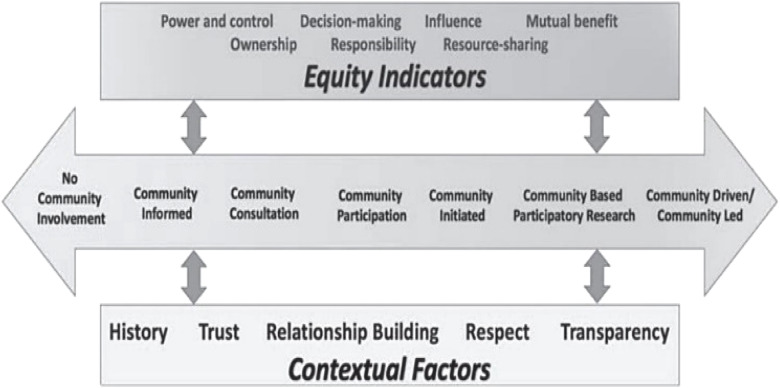
Results: Institutional strengths and opportunities for systemic change were aligned with equity indicators (power and control, decision-making, and influence) and contextual factors (history, trust, and relationship building) of The continuum of community engagement in research. Institutional advances include community-engagement added as the fourth pillar of the institution's strategic plan. Action strategies include 1) development a research navigation system to address community-campus research partnership administrative challenges and 2) an academy to build the capacities of community/patient partners to independently acquire, manage, and sustain grants and negotiate equity in dissemination of research.
Conclusions: MSM has leveraged E2 PLUS to identify systems improvements necessary to ensure that community/patient-centered research and partnerships are amplified and sustained.





 京公网安备 11010802042870号
京ICP备2023020795号-1
京公网安备 11010802042870号
京ICP备2023020795号-1

 分享
分享
 求助内容:
求助内容: 应助结果提醒方式:
 扫码关注我们
