Developing the engage for equity institutional multi-sector survey: Assessing academic institutional culture and climate for community-based participatory research (CBPR).
Elizabeth Dickson, Alena Kuhlemeier, Prajakta Adsul, Shannon Sanchez-Youngman, Katie Myers, Tabia Henry Akintobi, Lisa G Rosas, Jason A Mendoza, John Oetzel, Paige Castro-Reyes, Christina Alaniz, Belkis Jacquez, Nina Wallerstein
{"title":"Developing the engage for equity institutional multi-sector survey: Assessing academic institutional culture and climate for community-based participatory research (CBPR).","authors":"Elizabeth Dickson, Alena Kuhlemeier, Prajakta Adsul, Shannon Sanchez-Youngman, Katie Myers, Tabia Henry Akintobi, Lisa G Rosas, Jason A Mendoza, John Oetzel, Paige Castro-Reyes, Christina Alaniz, Belkis Jacquez, Nina Wallerstein","doi":"10.1017/cts.2025.20","DOIUrl":null,"url":null,"abstract":"<p><strong>Introduction: </strong>Community-engaged research/community-based participatory research/patient-engaged research (CEnR/CBPR/PEnR) are increasingly recognized as important approaches for addressing health equity. However, there is limited support for CEnR/CBPR/PEnR within Academic Health Centers (AHCs). It is important for AHCs to measure and monitor the context, process, and policies in support for CEnR/CBPR/PEnR. The <i>Engage for Equity (E2)</i> team developed the first Institutional Multi-Sector Survey (IMSS) instrument to assess and explore CEnR/CBPR/PEnR-related practices at three AHCs.</p><p><strong>Methods: </strong>Working with \"champion teams\" consisting of academic leaders, researchers, and patient/community partners at each AHC, we developed the IMSS to assess the following domains: institutional mission, vision, and values; CEnR/CBPR/PEnR policies/practices; community processes/structures; function of formal community advisory boards; climate/culture for CEnR/CBPR; perceptions of institutional leadership for CEnR/CBPR/PEnR. The survey was piloted to a convenience sample of CEnR/CBPR/PEnR participants at each AHC site.</p><p><strong>Results: </strong>A sample aggregated across all sites consisting of community (<i>n</i> = 49) and academic (<i>n</i> = 50) participants perceived high levels of advocacy for CEnR/CBPR/PEnR among their AHC research teams. Participants indicated that institutional leadership supported CEnR/CBPR/PEnR in principle, but resources to build CEnR/CBPR/PEnR capacity at their respective institutions were lacking. Differences in responses from community and academic partners are summarized.</p><p><strong>Conclusions: </strong>While limited by survey length and question adaptation, the findings contribute to identification of institutional barriers and facilitators to CEnR/CBPR/PEnR in AHCs. These findings are critically important to support and improve CEnR/CBPR/PEnR practice in academic institutions and to elevate community partner voices and needs for advancing community and patient partners' research.</p>","PeriodicalId":15529,"journal":{"name":"Journal of Clinical and Translational Science","volume":"9 1","pages":"e44"},"PeriodicalIF":2.0000,"publicationDate":"2025-02-05","publicationTypes":"Journal Article","fieldsOfStudy":null,"isOpenAccess":false,"openAccessPdf":"https://www.ncbi.nlm.nih.gov/pmc/articles/PMC11975786/pdf/","citationCount":"0","resultStr":null,"platform":"Semanticscholar","paperid":null,"PeriodicalName":"Journal of Clinical and Translational Science","FirstCategoryId":"1085","ListUrlMain":"https://doi.org/10.1017/cts.2025.20","RegionNum":0,"RegionCategory":null,"ArticlePicture":[],"TitleCN":null,"AbstractTextCN":null,"PMCID":null,"EPubDate":"2025/1/1 0:00:00","PubModel":"eCollection","JCR":"Q3","JCRName":"MEDICINE, RESEARCH & EXPERIMENTAL","Score":null,"Total":0}
引用次数: 0
Abstract
Introduction: Community-engaged research/community-based participatory research/patient-engaged research (CEnR/CBPR/PEnR) are increasingly recognized as important approaches for addressing health equity. However, there is limited support for CEnR/CBPR/PEnR within Academic Health Centers (AHCs). It is important for AHCs to measure and monitor the context, process, and policies in support for CEnR/CBPR/PEnR. The Engage for Equity (E2) team developed the first Institutional Multi-Sector Survey (IMSS) instrument to assess and explore CEnR/CBPR/PEnR-related practices at three AHCs.
Methods: Working with "champion teams" consisting of academic leaders, researchers, and patient/community partners at each AHC, we developed the IMSS to assess the following domains: institutional mission, vision, and values; CEnR/CBPR/PEnR policies/practices; community processes/structures; function of formal community advisory boards; climate/culture for CEnR/CBPR; perceptions of institutional leadership for CEnR/CBPR/PEnR. The survey was piloted to a convenience sample of CEnR/CBPR/PEnR participants at each AHC site.
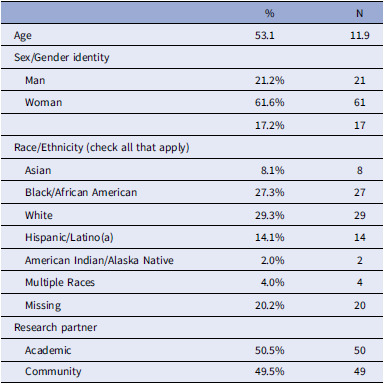
Results: A sample aggregated across all sites consisting of community (n = 49) and academic (n = 50) participants perceived high levels of advocacy for CEnR/CBPR/PEnR among their AHC research teams. Participants indicated that institutional leadership supported CEnR/CBPR/PEnR in principle, but resources to build CEnR/CBPR/PEnR capacity at their respective institutions were lacking. Differences in responses from community and academic partners are summarized.
Conclusions: While limited by survey length and question adaptation, the findings contribute to identification of institutional barriers and facilitators to CEnR/CBPR/PEnR in AHCs. These findings are critically important to support and improve CEnR/CBPR/PEnR practice in academic institutions and to elevate community partner voices and needs for advancing community and patient partners' research.






 京公网安备 11010802042870号
京ICP备2023020795号-1
京公网安备 11010802042870号
京ICP备2023020795号-1

 分享
分享
 求助内容:
求助内容: 应助结果提醒方式:
 扫码关注我们
