{"title":"Promoting Health Literacy With Human-in-the-Loop Video Understandability Classification of YouTube Videos: Development and Evaluation Study.","authors":"Xiao Liu, Anjana Susarla, Rema Padman","doi":"10.2196/56080","DOIUrl":null,"url":null,"abstract":"<p><strong>Background: </strong>An estimated 93% of adults in the United States access the internet, with up to 80% looking for health information. However, only 12% of US adults are proficient enough in health literacy to interpret health information and make informed health care decisions meaningfully. With the vast amount of health information available in multimedia formats on social media platforms such as YouTube and Facebook, there is an urgent need and a unique opportunity to design an automated approach to curate online health information using multiple criteria to meet the health literacy needs of a diverse population.</p><p><strong>Objective: </strong>This study aimed to develop an automated approach to assessing the understandability of patient educational videos according to the Patient Education Materials Assessment Tool (PEMAT) guidelines and evaluating the impact of video understandability on viewer engagement. We also offer insights for content creators and health care organizations on how to improve engagement with these educational videos on user-generated content platforms.</p><p><strong>Methods: </strong>We developed a human-in-the-loop, augmented intelligence approach that explicitly focused on the human-algorithm interaction, combining PEMAT-based patient education constructs mapped to features extracted from the videos, annotations of the videos by domain experts, and cotraining methods from machine learning to assess the understandability of videos on diabetes and classify them. We further examined the impact of understandability on several dimensions of viewer engagement with the videos.</p><p><strong>Results: </strong>We collected 9873 YouTube videos on diabetes using search keywords extracted from a patient-oriented forum and reviewed by a medical expert. Our machine learning methods achieved a weighted precision of 0.84, a weighted recall of 0.79, and an F<sub>1</sub>-score of 0.81 in classifying video understandability and could effectively identify patient educational videos that medical experts would like to recommend for patients. Videos rated as highly understandable had an average higher view count (average treatment effect [ATE]=2.55; P<.001), like count (ATE=2.95; P<.001), and comment count (ATE=3.10; P<.001) than less understandable videos. In addition, in a user study, 4 medical experts recommended 72% (144/200) of the top 10 videos ranked by understandability compared to 40% (80/200) of the top 10 videos ranked by YouTube's default algorithm for 20 ramdomly selected search keywords.</p><p><strong>Conclusions: </strong>We developed a human-in-the-loop, scalable algorithm to assess the understandability of health information on YouTube. Our method optimally combines expert input with algorithmic support, enhancing engagement and aiding medical experts in recommending educational content. This solution also guides health care organizations in creating effective patient education materials for underserved health topics.</p>","PeriodicalId":16337,"journal":{"name":"Journal of Medical Internet Research","volume":"27 ","pages":"e56080"},"PeriodicalIF":6.0000,"publicationDate":"2025-04-08","publicationTypes":"Journal Article","fieldsOfStudy":null,"isOpenAccess":false,"openAccessPdf":"https://www.ncbi.nlm.nih.gov/pmc/articles/PMC11984000/pdf/","citationCount":"0","resultStr":null,"platform":"Semanticscholar","paperid":null,"PeriodicalName":"Journal of Medical Internet Research","FirstCategoryId":"3","ListUrlMain":"https://doi.org/10.2196/56080","RegionNum":2,"RegionCategory":"医学","ArticlePicture":[],"TitleCN":null,"AbstractTextCN":null,"PMCID":null,"EPubDate":"","PubModel":"","JCR":"Q1","JCRName":"HEALTH CARE SCIENCES & SERVICES","Score":null,"Total":0}
引用次数: 0
Abstract
Background: An estimated 93% of adults in the United States access the internet, with up to 80% looking for health information. However, only 12% of US adults are proficient enough in health literacy to interpret health information and make informed health care decisions meaningfully. With the vast amount of health information available in multimedia formats on social media platforms such as YouTube and Facebook, there is an urgent need and a unique opportunity to design an automated approach to curate online health information using multiple criteria to meet the health literacy needs of a diverse population.
Objective: This study aimed to develop an automated approach to assessing the understandability of patient educational videos according to the Patient Education Materials Assessment Tool (PEMAT) guidelines and evaluating the impact of video understandability on viewer engagement. We also offer insights for content creators and health care organizations on how to improve engagement with these educational videos on user-generated content platforms.
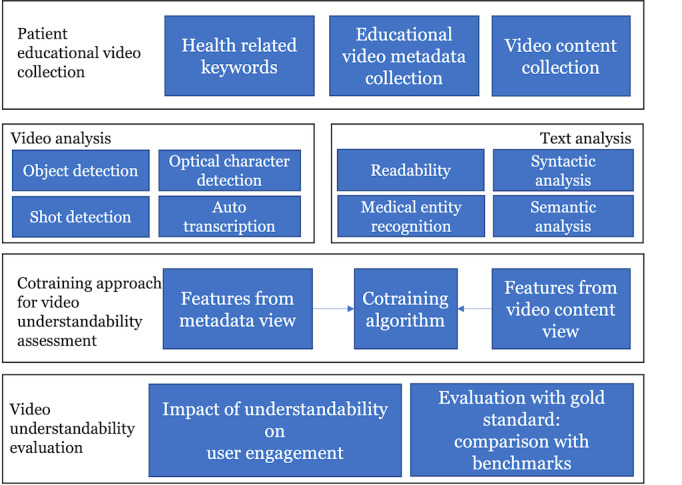
Methods: We developed a human-in-the-loop, augmented intelligence approach that explicitly focused on the human-algorithm interaction, combining PEMAT-based patient education constructs mapped to features extracted from the videos, annotations of the videos by domain experts, and cotraining methods from machine learning to assess the understandability of videos on diabetes and classify them. We further examined the impact of understandability on several dimensions of viewer engagement with the videos.
Results: We collected 9873 YouTube videos on diabetes using search keywords extracted from a patient-oriented forum and reviewed by a medical expert. Our machine learning methods achieved a weighted precision of 0.84, a weighted recall of 0.79, and an F1-score of 0.81 in classifying video understandability and could effectively identify patient educational videos that medical experts would like to recommend for patients. Videos rated as highly understandable had an average higher view count (average treatment effect [ATE]=2.55; P<.001), like count (ATE=2.95; P<.001), and comment count (ATE=3.10; P<.001) than less understandable videos. In addition, in a user study, 4 medical experts recommended 72% (144/200) of the top 10 videos ranked by understandability compared to 40% (80/200) of the top 10 videos ranked by YouTube's default algorithm for 20 ramdomly selected search keywords.
Conclusions: We developed a human-in-the-loop, scalable algorithm to assess the understandability of health information on YouTube. Our method optimally combines expert input with algorithmic support, enhancing engagement and aiding medical experts in recommending educational content. This solution also guides health care organizations in creating effective patient education materials for underserved health topics.
期刊介绍:
The Journal of Medical Internet Research (JMIR) is a highly respected publication in the field of health informatics and health services. With a founding date in 1999, JMIR has been a pioneer in the field for over two decades.
As a leader in the industry, the journal focuses on digital health, data science, health informatics, and emerging technologies for health, medicine, and biomedical research. It is recognized as a top publication in these disciplines, ranking in the first quartile (Q1) by Impact Factor.
Notably, JMIR holds the prestigious position of being ranked #1 on Google Scholar within the "Medical Informatics" discipline.





 京公网安备 11010802042870号
京ICP备2023020795号-1
京公网安备 11010802042870号
京ICP备2023020795号-1

 分享
分享
 求助内容:
求助内容: 应助结果提醒方式:
 扫码关注我们
