Eva Blondeel, Sam Ernst, Felix De Vuyst, Ákos Diósdi, Cláudio Pinheiro, Diogo Estêvão, Pekka Rappu, Robin Boiy, Sándor Dedeyne, Ligia Craciun, Vera Goossens, Jonas Dehairs, Tânia Cruz, Dominique Audenaert, Wim Ceelen, Michael Linnebacher, Tom Boterberg, Jo Vandesompele, Pieter Mestdagh, Johan Swinnen, Jyrki Heino, Peter Horvath, Maria José Oliveira, An Hendrix, Pieter Demetter, Olivier De Wever
{"title":"Sequential orthogonal assays for longitudinal and endpoint characterization of three-dimensional spheroids","authors":"Eva Blondeel, Sam Ernst, Felix De Vuyst, Ákos Diósdi, Cláudio Pinheiro, Diogo Estêvão, Pekka Rappu, Robin Boiy, Sándor Dedeyne, Ligia Craciun, Vera Goossens, Jonas Dehairs, Tânia Cruz, Dominique Audenaert, Wim Ceelen, Michael Linnebacher, Tom Boterberg, Jo Vandesompele, Pieter Mestdagh, Johan Swinnen, Jyrki Heino, Peter Horvath, Maria José Oliveira, An Hendrix, Pieter Demetter, Olivier De Wever","doi":"10.1038/s41596-025-01150-y","DOIUrl":null,"url":null,"abstract":"Spheroids are reaggregated multicellular three-dimensional structures generated from cells or cell cultures of healthy as well as pathological tissue. Basic and translational spheroid application across academia and industry have led to the development of multiple setups and analysis methods, which mostly lack the modularity to maximally phenotype spheroids. Here we present the self-assembly of single-cell suspensions into spheroids by the liquid overlay method, followed by a modular framework for a multifaceted phenotyping of spheroids. Cell seeding, supernatant handling and compound administration are elaborated by both manual and automated procedures. The phenotyping modules contain a suite of orthogonal assays to analyze spheroids longitudinally and/or at an endpoint. Longitudinal analyses include morphometry with or without spheroid or cell state specific information and supernatant evaluation (nutrient consumption and metabolite/cytokine production). Spheroids can also be used as a starting point to monitor single and collective cell migration and invasion. At an endpoint, spheroids are lysed, fixed or dissociated into single cells. Endpoint analyses allow the investigation of molecular content, single-cell composition and state and architecture with spatial cell and subcellular specific information. Each module addresses time requirements and quality control indicators to support reproducibility. The presented complementary techniques can be readily adopted by researchers experienced in cell culture and basic molecular biology. We anticipate that this modular protocol will advance the application of three-dimensional biology by providing scalable and complementary methods. The authors present a protocol for the self-assembly of single-cell suspensions into spheroids by the liquid overlay method, followed by a modular framework of orthogonal assays to phenotype spheroids both longitudinally and at an endpoint.","PeriodicalId":18901,"journal":{"name":"Nature Protocols","volume":"20 10","pages":"2899-2941"},"PeriodicalIF":16.0000,"publicationDate":"2025-04-08","publicationTypes":"Journal Article","fieldsOfStudy":null,"isOpenAccess":false,"openAccessPdf":"","citationCount":"0","resultStr":null,"platform":"Semanticscholar","paperid":null,"PeriodicalName":"Nature Protocols","FirstCategoryId":"99","ListUrlMain":"https://www.nature.com/articles/s41596-025-01150-y","RegionNum":1,"RegionCategory":"生物学","ArticlePicture":[],"TitleCN":null,"AbstractTextCN":null,"PMCID":null,"EPubDate":"","PubModel":"","JCR":"Q1","JCRName":"BIOCHEMICAL RESEARCH METHODS","Score":null,"Total":0}
引用次数: 0
Abstract
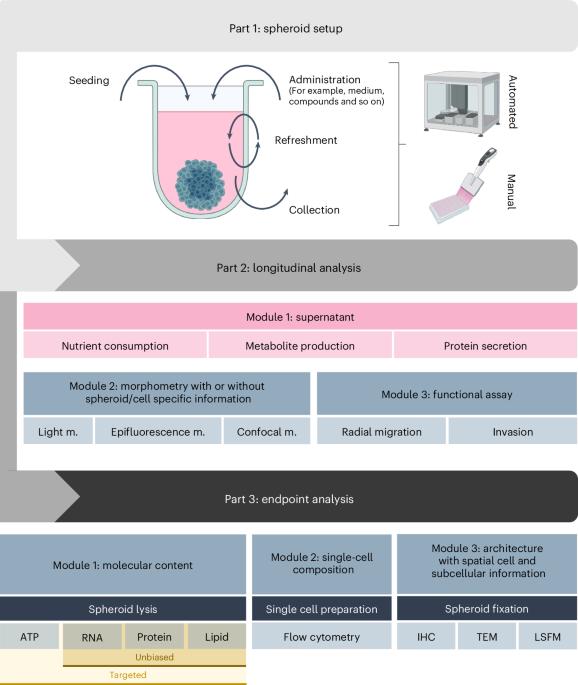
Spheroids are reaggregated multicellular three-dimensional structures generated from cells or cell cultures of healthy as well as pathological tissue. Basic and translational spheroid application across academia and industry have led to the development of multiple setups and analysis methods, which mostly lack the modularity to maximally phenotype spheroids. Here we present the self-assembly of single-cell suspensions into spheroids by the liquid overlay method, followed by a modular framework for a multifaceted phenotyping of spheroids. Cell seeding, supernatant handling and compound administration are elaborated by both manual and automated procedures. The phenotyping modules contain a suite of orthogonal assays to analyze spheroids longitudinally and/or at an endpoint. Longitudinal analyses include morphometry with or without spheroid or cell state specific information and supernatant evaluation (nutrient consumption and metabolite/cytokine production). Spheroids can also be used as a starting point to monitor single and collective cell migration and invasion. At an endpoint, spheroids are lysed, fixed or dissociated into single cells. Endpoint analyses allow the investigation of molecular content, single-cell composition and state and architecture with spatial cell and subcellular specific information. Each module addresses time requirements and quality control indicators to support reproducibility. The presented complementary techniques can be readily adopted by researchers experienced in cell culture and basic molecular biology. We anticipate that this modular protocol will advance the application of three-dimensional biology by providing scalable and complementary methods. The authors present a protocol for the self-assembly of single-cell suspensions into spheroids by the liquid overlay method, followed by a modular framework of orthogonal assays to phenotype spheroids both longitudinally and at an endpoint.
期刊介绍:
Nature Protocols focuses on publishing protocols used to address significant biological and biomedical science research questions, including methods grounded in physics and chemistry with practical applications to biological problems. The journal caters to a primary audience of research scientists and, as such, exclusively publishes protocols with research applications. Protocols primarily aimed at influencing patient management and treatment decisions are not featured.
The specific techniques covered encompass a wide range, including but not limited to: Biochemistry, Cell biology, Cell culture, Chemical modification, Computational biology, Developmental biology, Epigenomics, Genetic analysis, Genetic modification, Genomics, Imaging, Immunology, Isolation, purification, and separation, Lipidomics, Metabolomics, Microbiology, Model organisms, Nanotechnology, Neuroscience, Nucleic-acid-based molecular biology, Pharmacology, Plant biology, Protein analysis, Proteomics, Spectroscopy, Structural biology, Synthetic chemistry, Tissue culture, Toxicology, and Virology.



 京公网安备 11010802042870号
京ICP备2023020795号-1
京公网安备 11010802042870号
京ICP备2023020795号-1

 分享
分享
 求助内容:
求助内容: 应助结果提醒方式:
 扫码关注我们
