Bo Ling, Yaguang Wang, Huaze Dong, Hongqi Chen and Lun Wang
{"title":"Enzyme-triggered aggregation of upconversion nanoparticles for targeted photodynamic therapy via NIR irradiation†","authors":"Bo Ling, Yaguang Wang, Huaze Dong, Hongqi Chen and Lun Wang","doi":"10.1039/D4NA01050G","DOIUrl":null,"url":null,"abstract":"<p >A core–shell–shell nanoplatform responsive to alkaline phosphatase (ALP) was developed for efficient tumor targeting and near-infrared (NIR)-activated photodynamic therapy (PDT). Specifically, UCNP@SiO<small><sub>2</sub></small>-Bodipy@FFYp was synthesized by encapsulating upconversion nanoparticles (UCNPs) within a silica shell, embedding bodipy derivatives as photosensitizers, and covalently attaching a phosphorylated peptide (FFYp). Förster resonance energy transfer (FRET) from the UCNP emission at 550 nm to bodipy facilitated reactive oxygen species (ROS) generation upon NIR excitation. In the tumor microenvironment, ALP-triggered dephosphorylation converted UCNP@SiO<small><sub>2</sub></small>-Bodipy@FFYp into the more hydrophobic UCNP@SiO<small><sub>2</sub></small>-Bodipy@FFY, thereby promoting tumor cell uptake and tumor-specific accumulation. By leveraging this ALP-responsive targeting strategy alongside the deep-tissue penetration of NIR light, significant tumor growth inhibition was achieved both <em>in vitro</em> and <em>in vivo</em>. Notably, after 15 days of treatment in Balb/c mice bearing HeLa tumors, the tumor volume was reduced by over 95%. Taken together, these results highlight the promise of UCNP@SiO<small><sub>2</sub></small>-Bodipy@FFYp as a tumor-responsive nanoplatform for highly effective, targeted PDT in cancer therapy.</p>","PeriodicalId":18806,"journal":{"name":"Nanoscale Advances","volume":" 10","pages":" 3068-3076"},"PeriodicalIF":4.6000,"publicationDate":"2025-04-07","publicationTypes":"Journal Article","fieldsOfStudy":null,"isOpenAccess":false,"openAccessPdf":"https://www.ncbi.nlm.nih.gov/pmc/articles/PMC11974261/pdf/","citationCount":"0","resultStr":null,"platform":"Semanticscholar","paperid":null,"PeriodicalName":"Nanoscale Advances","FirstCategoryId":"88","ListUrlMain":"https://pubs.rsc.org/en/content/articlelanding/2025/na/d4na01050g","RegionNum":3,"RegionCategory":"材料科学","ArticlePicture":[],"TitleCN":null,"AbstractTextCN":null,"PMCID":null,"EPubDate":"","PubModel":"","JCR":"Q2","JCRName":"CHEMISTRY, MULTIDISCIPLINARY","Score":null,"Total":0}
引用次数: 0
Abstract
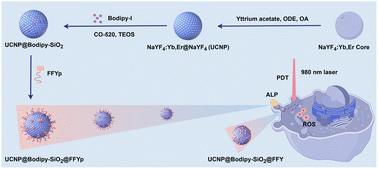
A core–shell–shell nanoplatform responsive to alkaline phosphatase (ALP) was developed for efficient tumor targeting and near-infrared (NIR)-activated photodynamic therapy (PDT). Specifically, UCNP@SiO2-Bodipy@FFYp was synthesized by encapsulating upconversion nanoparticles (UCNPs) within a silica shell, embedding bodipy derivatives as photosensitizers, and covalently attaching a phosphorylated peptide (FFYp). Förster resonance energy transfer (FRET) from the UCNP emission at 550 nm to bodipy facilitated reactive oxygen species (ROS) generation upon NIR excitation. In the tumor microenvironment, ALP-triggered dephosphorylation converted UCNP@SiO2-Bodipy@FFYp into the more hydrophobic UCNP@SiO2-Bodipy@FFY, thereby promoting tumor cell uptake and tumor-specific accumulation. By leveraging this ALP-responsive targeting strategy alongside the deep-tissue penetration of NIR light, significant tumor growth inhibition was achieved both in vitro and in vivo. Notably, after 15 days of treatment in Balb/c mice bearing HeLa tumors, the tumor volume was reduced by over 95%. Taken together, these results highlight the promise of UCNP@SiO2-Bodipy@FFYp as a tumor-responsive nanoplatform for highly effective, targeted PDT in cancer therapy.



 京公网安备 11010802042870号
京ICP备2023020795号-1
京公网安备 11010802042870号
京ICP备2023020795号-1

 分享
分享
 求助内容:
求助内容: 应助结果提醒方式:
 扫码关注我们
