{"title":"Survival Analysis of Minimally Invasive Mitral Valve Surgery Versus Conventional Median Sternotomy in the United States.","authors":"Pongsaya Saipia, Songphol Tungjitviboonkun","doi":"10.7759/cureus.81859","DOIUrl":null,"url":null,"abstract":"<p><strong>Background: </strong>Minimally invasive mitral valve surgery (MiMVS), particularly via right mini-thoracotomy, has gained popularity as an alternative to median sternotomy, potentially reducing surgical trauma and recovery time. However, recent data on its surgical outcomes remain limited. To provide updated insights while minimizing selection bias, we analyzed elective patients undergoing mitral valve surgery, comparing MiMVS and sternotomy in terms of survival, operative times, and perioperative complications.</p><p><strong>Methods: </strong>We conducted a single-center retrospective cohort study that included patients who underwent mitral valve surgery between 2015 and 2024. Patients were stratified into MiMVS or sternotomy groups. Kaplan-Meier survival curves and log-rank tests assessed survival, while propensity score matching (PSM) minimized selection bias.</p><p><strong>Results: </strong>Among 422 patients (319 MiMVS, 103 sternotomy), the MiMVS group had a shorter hospital stay (5.0 vs. 8.0 days, p < 0.01) and lower postoperative bleeding (3.9% vs. 9%). Median cross-clamp and cardiopulmonary bypass (CPB) times were shorter in MiMVS (76 vs. 94 min, p < 0.01; and 114 vs. 140 min, p < 0.01, respectively). Survival analysis showed no significant difference between groups (log-rank p = 0.07) after PSM. The adjusted hazard ratio for mortality in MiMVS versus sternotomy was 0.30 (95% CI: 0.08-1.12, p = 0.07). However, mitral replacement was associated with a significantly higher mortality risk than mitral repair (HR 5.22, 95% CI: 1.26-21.61, p = 0.04). In-hospital mortality was comparable (1.9% for sternotomy vs. 0.6% for MiMVS, p = 0.25). Reoperation rates at five and 10 years were lower in MiMVS (1.7% vs. 2.1% at five years and 1.7% vs. 3.2% at 10 years).</p><p><strong>Conclusions: </strong>While MiMVS offers advantages such as shorter hospital stays and lower postoperative bleeding rates, no statistically significant difference in overall survival was found compared to sternotomy. However, a trend toward improved survival with MiMVS was observed. Notably, mitral valve replacement was associated with a significantly higher mortality risk than mitral repair, emphasizing the importance of prioritizing repair whenever feasible.</p>","PeriodicalId":93960,"journal":{"name":"Cureus","volume":"17 4","pages":"e81859"},"PeriodicalIF":1.3000,"publicationDate":"2025-04-07","publicationTypes":"Journal Article","fieldsOfStudy":null,"isOpenAccess":false,"openAccessPdf":"https://www.ncbi.nlm.nih.gov/pmc/articles/PMC11976183/pdf/","citationCount":"0","resultStr":null,"platform":"Semanticscholar","paperid":null,"PeriodicalName":"Cureus","FirstCategoryId":"1085","ListUrlMain":"https://doi.org/10.7759/cureus.81859","RegionNum":0,"RegionCategory":null,"ArticlePicture":[],"TitleCN":null,"AbstractTextCN":null,"PMCID":null,"EPubDate":"2025/4/1 0:00:00","PubModel":"eCollection","JCR":"Q3","JCRName":"MEDICINE, GENERAL & INTERNAL","Score":null,"Total":0}
引用次数: 0
Abstract
Background: Minimally invasive mitral valve surgery (MiMVS), particularly via right mini-thoracotomy, has gained popularity as an alternative to median sternotomy, potentially reducing surgical trauma and recovery time. However, recent data on its surgical outcomes remain limited. To provide updated insights while minimizing selection bias, we analyzed elective patients undergoing mitral valve surgery, comparing MiMVS and sternotomy in terms of survival, operative times, and perioperative complications.
Methods: We conducted a single-center retrospective cohort study that included patients who underwent mitral valve surgery between 2015 and 2024. Patients were stratified into MiMVS or sternotomy groups. Kaplan-Meier survival curves and log-rank tests assessed survival, while propensity score matching (PSM) minimized selection bias.
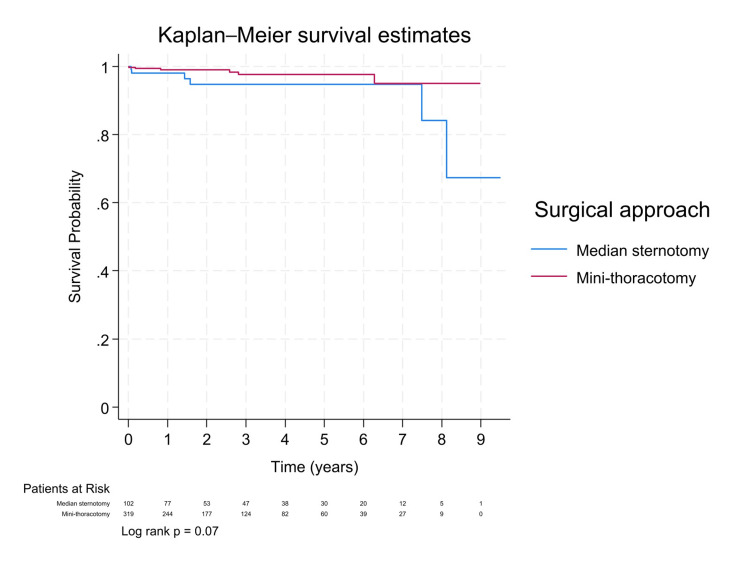
Results: Among 422 patients (319 MiMVS, 103 sternotomy), the MiMVS group had a shorter hospital stay (5.0 vs. 8.0 days, p < 0.01) and lower postoperative bleeding (3.9% vs. 9%). Median cross-clamp and cardiopulmonary bypass (CPB) times were shorter in MiMVS (76 vs. 94 min, p < 0.01; and 114 vs. 140 min, p < 0.01, respectively). Survival analysis showed no significant difference between groups (log-rank p = 0.07) after PSM. The adjusted hazard ratio for mortality in MiMVS versus sternotomy was 0.30 (95% CI: 0.08-1.12, p = 0.07). However, mitral replacement was associated with a significantly higher mortality risk than mitral repair (HR 5.22, 95% CI: 1.26-21.61, p = 0.04). In-hospital mortality was comparable (1.9% for sternotomy vs. 0.6% for MiMVS, p = 0.25). Reoperation rates at five and 10 years were lower in MiMVS (1.7% vs. 2.1% at five years and 1.7% vs. 3.2% at 10 years).
Conclusions: While MiMVS offers advantages such as shorter hospital stays and lower postoperative bleeding rates, no statistically significant difference in overall survival was found compared to sternotomy. However, a trend toward improved survival with MiMVS was observed. Notably, mitral valve replacement was associated with a significantly higher mortality risk than mitral repair, emphasizing the importance of prioritizing repair whenever feasible.





 京公网安备 11010802042870号
京ICP备2023020795号-1
京公网安备 11010802042870号
京ICP备2023020795号-1

 分享
分享

 求助内容:
求助内容: 应助结果提醒方式:
 扫码关注我们
