{"title":"The Influence of Lifestyle Behaviors and Body Mass Index Changes on Long-term Outcomes After Gastric Cancer Surgery: A Population-Based Cohort Study.","authors":"Ju-Hee Lee, Jiyeong Kim, Dong-Gyu Lee","doi":"10.5230/jgc.2025.25.e18","DOIUrl":null,"url":null,"abstract":"<p><strong>Purpose: </strong>The present study investigated the impact of lifestyle behaviors and body mass index (BMI) on late recurrence, gastric remnant cancer (GRC), and long-term survival after curative gastrectomy.</p><p><strong>Materials and methods: </strong>This retrospective study utilized data from the Korean National Health Insurance claims database. Among 71,014 patients with gastric cancer who underwent curative gastrectomy between January 2009 and December 2012, 23,359 remained cancer-free for five years. Of these, 7,735 patients with health examination data within 2 years before surgery and 5 years after surgery were analyzed for lifestyle behaviors, including smoking, alcohol consumption, and physical activity. Multivariable analysis was used to evaluate the independent effects of these factors and changes in BMI on late recurrence, GRC, and long-term survival.</p><p><strong>Results: </strong>Late recurrence or GRC occurred among 628 patients (8.1%). Older age (≥60 years) and total gastrectomy were identified as risk factors. Although lifestyle behaviors and BMI changes did not directly affect recurrence, they significantly affected mortality. In the total gastrectomy group, current underweight status (hazard ratio [HR], 1.586) was associated with increased mortality. Among the partial gastrectomy group, continued smoking (HR, 1.366) and current underweight status (HR, 1.915) increased mortality risk. Conversely, regular physical activity (starting: HR, 0.674; continuing: HR, 0.699) and postoperative overweight or obesity (BMI >25 kg/m²) (HR, 0.713) were associated with reduced mortality. Changes in alcohol consumption showed inconsistent effects between the partial and total gastrectomy groups.</p><p><strong>Conclusions: </strong>The long-term survival of post-gastrectomy patients improved with smoking cessation, regular physical activity, and maintenance of body weight.</p>","PeriodicalId":56072,"journal":{"name":"Journal of Gastric Cancer","volume":"25 2","pages":"356-369"},"PeriodicalIF":3.8000,"publicationDate":"2025-04-01","publicationTypes":"Journal Article","fieldsOfStudy":null,"isOpenAccess":false,"openAccessPdf":"https://www.ncbi.nlm.nih.gov/pmc/articles/PMC11982505/pdf/","citationCount":"0","resultStr":null,"platform":"Semanticscholar","paperid":null,"PeriodicalName":"Journal of Gastric Cancer","FirstCategoryId":"3","ListUrlMain":"https://doi.org/10.5230/jgc.2025.25.e18","RegionNum":4,"RegionCategory":"医学","ArticlePicture":[],"TitleCN":null,"AbstractTextCN":null,"PMCID":null,"EPubDate":"","PubModel":"","JCR":"Q2","JCRName":"GASTROENTEROLOGY & HEPATOLOGY","Score":null,"Total":0}
引用次数: 0
Abstract
Purpose: The present study investigated the impact of lifestyle behaviors and body mass index (BMI) on late recurrence, gastric remnant cancer (GRC), and long-term survival after curative gastrectomy.
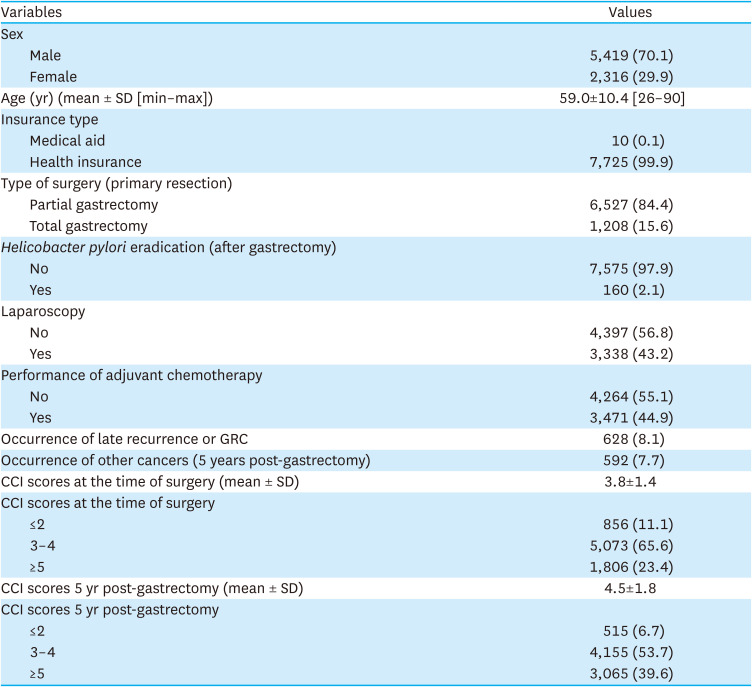
Materials and methods: This retrospective study utilized data from the Korean National Health Insurance claims database. Among 71,014 patients with gastric cancer who underwent curative gastrectomy between January 2009 and December 2012, 23,359 remained cancer-free for five years. Of these, 7,735 patients with health examination data within 2 years before surgery and 5 years after surgery were analyzed for lifestyle behaviors, including smoking, alcohol consumption, and physical activity. Multivariable analysis was used to evaluate the independent effects of these factors and changes in BMI on late recurrence, GRC, and long-term survival.
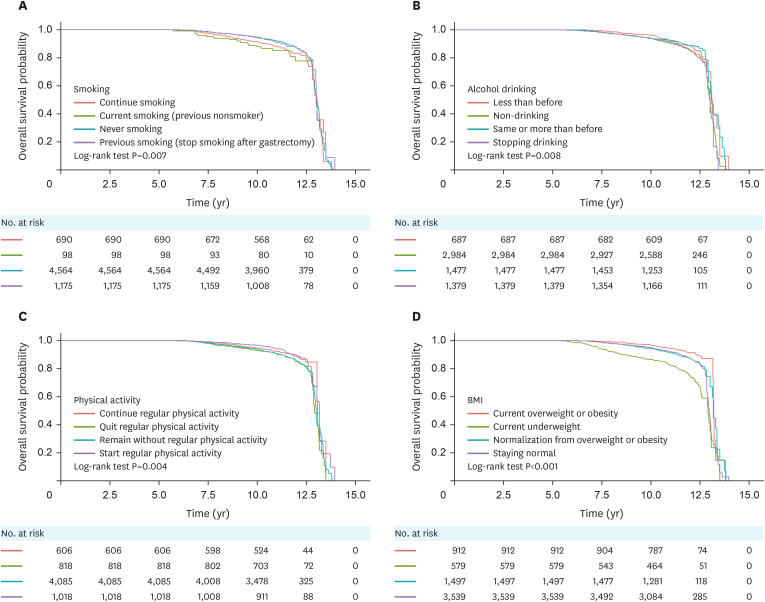
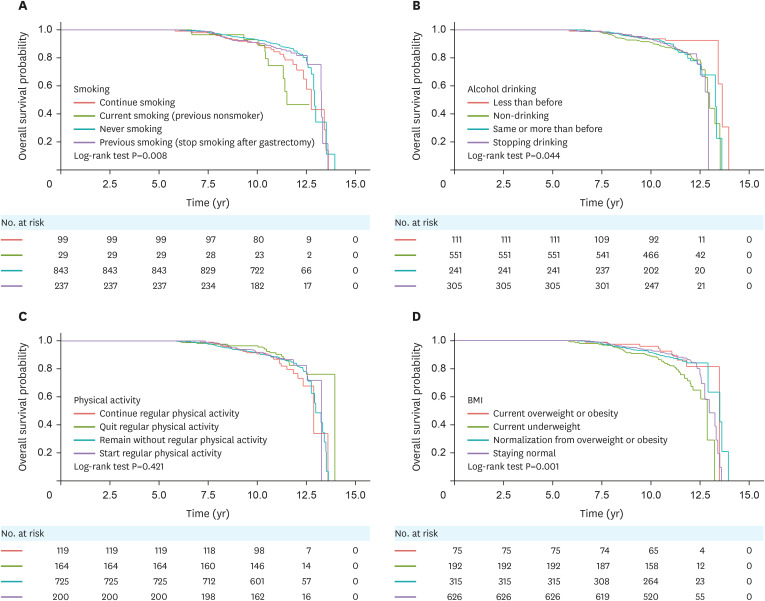
Results: Late recurrence or GRC occurred among 628 patients (8.1%). Older age (≥60 years) and total gastrectomy were identified as risk factors. Although lifestyle behaviors and BMI changes did not directly affect recurrence, they significantly affected mortality. In the total gastrectomy group, current underweight status (hazard ratio [HR], 1.586) was associated with increased mortality. Among the partial gastrectomy group, continued smoking (HR, 1.366) and current underweight status (HR, 1.915) increased mortality risk. Conversely, regular physical activity (starting: HR, 0.674; continuing: HR, 0.699) and postoperative overweight or obesity (BMI >25 kg/m²) (HR, 0.713) were associated with reduced mortality. Changes in alcohol consumption showed inconsistent effects between the partial and total gastrectomy groups.
Conclusions: The long-term survival of post-gastrectomy patients improved with smoking cessation, regular physical activity, and maintenance of body weight.
期刊介绍:
The Journal of Gastric Cancer (J Gastric Cancer) is an international peer-reviewed journal. Each issue carries high quality clinical and translational researches on gastric neoplasms. Editorial Board of J Gastric Cancer publishes original articles on pathophysiology, molecular oncology, diagnosis, treatment, and prevention of gastric cancer as well as articles on dietary control and improving the quality of life for gastric cancer patients. J Gastric Cancer includes case reports, review articles, how I do it articles, editorials, and letters to the editor.



 京公网安备 11010802042870号
京ICP备2023020795号-1
京公网安备 11010802042870号
京ICP备2023020795号-1

 分享
分享
 求助内容:
求助内容: 应助结果提醒方式:
 扫码关注我们
