Markus Kötzsche, Jan Egger, Andreas Dzierza, Liên Sabrina Reichel, Ivo Nischang, Anja Traeger, Dagmar Fischer and Kalina Peneva
{"title":"Making the negative positive – fluorination of indole as an efficient strategy to improve guanidinium-containing gene carriers†","authors":"Markus Kötzsche, Jan Egger, Andreas Dzierza, Liên Sabrina Reichel, Ivo Nischang, Anja Traeger, Dagmar Fischer and Kalina Peneva","doi":"10.1039/D4TB02529F","DOIUrl":null,"url":null,"abstract":"<p >The balance between hydrophilic and hydrophobic components plays an important role in polymeric delivery of nucleic acids. Besides using hydrophobic moieties in the polymer design, fluorination is a promising method to increase the hydrophobicity of polymers. To systematically investigate this effect, <em>N</em>-(2-(1<em>H</em>-indol-3-yl)ethyl)methacrylamide and three fluorinated analogues have been synthesized and copolymerized with 3-guanidinopropyl methacrylamide and 2-hydroxypropyl methacrylamide <em>via</em> an aqueous reversible addition–fragmentation chain transfer (aRAFT) polymerization. A library of eight terpolymers with 5 to 23 mol% of an indole analogue and molar mass about 20 kg mol<small><sup>−1</sup></small> showed comparably strong DNA binding starting at N/P 2 and formed polyplexes with hydrodynamic diameters around 100 nm. Additionally, no negative impact on biocompatibility was observed. Heparin release studies showed increased DNA binding strength with higher amounts of hydrophobic moieties, while fluorination exhibited similar effects as increasing the indole content. This was also important for pDNA transfection efficiency, where an optimum for DNA binding strength was unveiled. The rapid release and the excessive binding of DNA were identified as factors that negatively impacted transfection efficiency, both influenced by the amount of indole moieties and fluorination. On the other hand, the right degree of hydrophobicity was able to increase the transfection efficiency of the modified polymer by more than threefold. These findings highlight the role of hydrophobic moieties in nucleic acid delivery and provide valuable insights for future polymer design, suggesting that the strategic incorporation of fluorinated monomers can effectively fine-tune DNA interactions.</p>","PeriodicalId":83,"journal":{"name":"Journal of Materials Chemistry B","volume":" 21","pages":" 6066-6076"},"PeriodicalIF":6.1000,"publicationDate":"2025-03-25","publicationTypes":"Journal Article","fieldsOfStudy":null,"isOpenAccess":false,"openAccessPdf":"https://pubs.rsc.org/en/content/articlepdf/2025/tb/d4tb02529f?page=search","citationCount":"0","resultStr":null,"platform":"Semanticscholar","paperid":null,"PeriodicalName":"Journal of Materials Chemistry B","FirstCategoryId":"1","ListUrlMain":"https://pubs.rsc.org/en/content/articlelanding/2025/tb/d4tb02529f","RegionNum":3,"RegionCategory":"医学","ArticlePicture":[],"TitleCN":null,"AbstractTextCN":null,"PMCID":null,"EPubDate":"","PubModel":"","JCR":"Q1","JCRName":"MATERIALS SCIENCE, BIOMATERIALS","Score":null,"Total":0}
引用次数: 0
Abstract
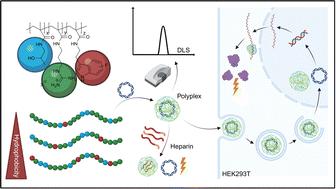
The balance between hydrophilic and hydrophobic components plays an important role in polymeric delivery of nucleic acids. Besides using hydrophobic moieties in the polymer design, fluorination is a promising method to increase the hydrophobicity of polymers. To systematically investigate this effect, N-(2-(1H-indol-3-yl)ethyl)methacrylamide and three fluorinated analogues have been synthesized and copolymerized with 3-guanidinopropyl methacrylamide and 2-hydroxypropyl methacrylamide via an aqueous reversible addition–fragmentation chain transfer (aRAFT) polymerization. A library of eight terpolymers with 5 to 23 mol% of an indole analogue and molar mass about 20 kg mol−1 showed comparably strong DNA binding starting at N/P 2 and formed polyplexes with hydrodynamic diameters around 100 nm. Additionally, no negative impact on biocompatibility was observed. Heparin release studies showed increased DNA binding strength with higher amounts of hydrophobic moieties, while fluorination exhibited similar effects as increasing the indole content. This was also important for pDNA transfection efficiency, where an optimum for DNA binding strength was unveiled. The rapid release and the excessive binding of DNA were identified as factors that negatively impacted transfection efficiency, both influenced by the amount of indole moieties and fluorination. On the other hand, the right degree of hydrophobicity was able to increase the transfection efficiency of the modified polymer by more than threefold. These findings highlight the role of hydrophobic moieties in nucleic acid delivery and provide valuable insights for future polymer design, suggesting that the strategic incorporation of fluorinated monomers can effectively fine-tune DNA interactions.
期刊介绍:
Journal of Materials Chemistry A, B & C cover high quality studies across all fields of materials chemistry. The journals focus on those theoretical or experimental studies that report new understanding, applications, properties and synthesis of materials. Journal of Materials Chemistry A, B & C are separated by the intended application of the material studied. Broadly, applications in energy and sustainability are of interest to Journal of Materials Chemistry A, applications in biology and medicine are of interest to Journal of Materials Chemistry B, and applications in optical, magnetic and electronic devices are of interest to Journal of Materials Chemistry C.Journal of Materials Chemistry B is a Transformative Journal and Plan S compliant. Example topic areas within the scope of Journal of Materials Chemistry B are listed below. This list is neither exhaustive nor exclusive:
Antifouling coatings
Biocompatible materials
Bioelectronics
Bioimaging
Biomimetics
Biomineralisation
Bionics
Biosensors
Diagnostics
Drug delivery
Gene delivery
Immunobiology
Nanomedicine
Regenerative medicine & Tissue engineering
Scaffolds
Soft robotics
Stem cells
Therapeutic devices




 京公网安备 11010802042870号
京ICP备2023020795号-1
京公网安备 11010802042870号
京ICP备2023020795号-1

 分享
分享
 求助内容:
求助内容: 应助结果提醒方式:
 扫码关注我们
