{"title":"Vegetable oil-derived functional polymers in biomedical applications: hurdles and possibilities","authors":"Shrinjay Ghosh and Santanu Ghosh","doi":"10.1039/D4TB02648A","DOIUrl":null,"url":null,"abstract":"<p >Over the past several years, renewable resource-based polymers have consistently attracted research attention from academia and industry as an alternative to petroleum-based polymers. Depletion of fuel reserves, the rising cost of petroleum products, and strict government regulations drive the search for alternative resources. Vegetable oils have been considered as one of the sustainable feedstocks considering their natural abundance, low cost, and ecological acceptance. Vegetable oils are used to generate various biobased functional polymers like polyester, polyamide, poly(ester amide)s, polyurethane, and photocurable resins. These polymers have demonstrated a wide range of applications, including coating materials, fire retardants, and adhesives, and have also been explored in biomedical research. This review provides a comprehensive discussion on developing various polymers derived from vegetable oils, which show promise in biomedical applications such as tissue engineering, drug delivery, antimicrobial, tissue adhesives, and biosensor applications. Additionally, the review highlights the challenges and future opportunities associated with these sustainably sourced biobased polymers.</p>","PeriodicalId":83,"journal":{"name":"Journal of Materials Chemistry B","volume":" 17","pages":" 4994-5022"},"PeriodicalIF":6.1000,"publicationDate":"2025-03-06","publicationTypes":"Journal Article","fieldsOfStudy":null,"isOpenAccess":false,"openAccessPdf":"","citationCount":"0","resultStr":null,"platform":"Semanticscholar","paperid":null,"PeriodicalName":"Journal of Materials Chemistry B","FirstCategoryId":"1","ListUrlMain":"https://pubs.rsc.org/en/content/articlelanding/2025/tb/d4tb02648a","RegionNum":3,"RegionCategory":"医学","ArticlePicture":[],"TitleCN":null,"AbstractTextCN":null,"PMCID":null,"EPubDate":"","PubModel":"","JCR":"Q1","JCRName":"MATERIALS SCIENCE, BIOMATERIALS","Score":null,"Total":0}
引用次数: 0
Abstract
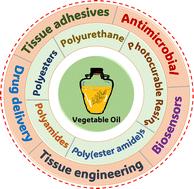
Over the past several years, renewable resource-based polymers have consistently attracted research attention from academia and industry as an alternative to petroleum-based polymers. Depletion of fuel reserves, the rising cost of petroleum products, and strict government regulations drive the search for alternative resources. Vegetable oils have been considered as one of the sustainable feedstocks considering their natural abundance, low cost, and ecological acceptance. Vegetable oils are used to generate various biobased functional polymers like polyester, polyamide, poly(ester amide)s, polyurethane, and photocurable resins. These polymers have demonstrated a wide range of applications, including coating materials, fire retardants, and adhesives, and have also been explored in biomedical research. This review provides a comprehensive discussion on developing various polymers derived from vegetable oils, which show promise in biomedical applications such as tissue engineering, drug delivery, antimicrobial, tissue adhesives, and biosensor applications. Additionally, the review highlights the challenges and future opportunities associated with these sustainably sourced biobased polymers.
期刊介绍:
Journal of Materials Chemistry A, B & C cover high quality studies across all fields of materials chemistry. The journals focus on those theoretical or experimental studies that report new understanding, applications, properties and synthesis of materials. Journal of Materials Chemistry A, B & C are separated by the intended application of the material studied. Broadly, applications in energy and sustainability are of interest to Journal of Materials Chemistry A, applications in biology and medicine are of interest to Journal of Materials Chemistry B, and applications in optical, magnetic and electronic devices are of interest to Journal of Materials Chemistry C.Journal of Materials Chemistry B is a Transformative Journal and Plan S compliant. Example topic areas within the scope of Journal of Materials Chemistry B are listed below. This list is neither exhaustive nor exclusive:
Antifouling coatings
Biocompatible materials
Bioelectronics
Bioimaging
Biomimetics
Biomineralisation
Bionics
Biosensors
Diagnostics
Drug delivery
Gene delivery
Immunobiology
Nanomedicine
Regenerative medicine & Tissue engineering
Scaffolds
Soft robotics
Stem cells
Therapeutic devices



 京公网安备 11010802042870号
京ICP备2023020795号-1
京公网安备 11010802042870号
京ICP备2023020795号-1

 分享
分享
 求助内容:
求助内容: 应助结果提醒方式:
 扫码关注我们
