Hualing Tian, Jiajia Li, Yanjun Cai, Xiang Yao and Zhi Su
{"title":"Dendrite-free, interfacially compatible Na2ZrCl6 composite halide solid-state electrolyte for solid-state sodium-ion batteries†","authors":"Hualing Tian, Jiajia Li, Yanjun Cai, Xiang Yao and Zhi Su","doi":"10.1039/D4TA07957D","DOIUrl":null,"url":null,"abstract":"<p >Low ionic conductivity and poor interfacial stability restrict the practical application of all-solid-state sodium-ion batteries (ASSSIBs). To solve these issues, a facile strategy involving the use of an inorganic–organic composite solid electrolyte (SE) composed of Na<small><sub>2</sub></small>ZrCl<small><sub>6</sub></small> and polyacrylonitrile (PAN) is proposed. The introduction of Na<small><sub>2</sub></small>ZrCl<small><sub>6</sub></small> results in a reduction in the crystallinity of PAN, which creates numerous pathways for Na<small><sup>+</sup></small> ions migration and significantly enhances the ionic conductivity of SE. When utilized in a Na‖Na symmetric cell, the Na<small><sub>2</sub></small>ZrCl<small><sub>6</sub></small>–PAN SE exhibited good interfacial stability, with no Na dendrite formation even after 5000 h of Na electroplating/stripping. In addition, non-<em>in situ</em> X-ray diffraction, X-ray photoelectron spectroscopy, and <em>in situ</em> AC impedance tests confirmed the favorable interfacial stability of the Na<small><sub>2</sub></small>ZrCl<small><sub>6</sub></small>–PAN SE in contact with Na metal and Na<small><sub>3</sub></small>V<small><sub>2</sub></small>(PO<small><sub>4</sub></small>)<small><sub>3</sub></small> (NVP). Furthermore, Na|Na<small><sub>2</sub></small>ZrCl<small><sub>6</sub></small>–PAN|NVP ASSSIBs exhibit outstanding electrochemical performance. The battery achieves an initial discharge capacity of 80.7 mA h g<small><sup>−1</sup></small> at 1 C, which remains at 69.2 mA h g<small><sup>−1</sup></small> after 500 cycles. Additionally, all-solid-state SIBs with a hard carbon (HC)|Na<small><sub>2</sub></small>ZrCl<small><sub>6</sub></small>–PAN|NVP ASSSIB configuration demonstrate excellent electrochemical cycling stability.</p>","PeriodicalId":82,"journal":{"name":"Journal of Materials Chemistry A","volume":" 20","pages":" 15178-15188"},"PeriodicalIF":9.5000,"publicationDate":"2025-04-10","publicationTypes":"Journal Article","fieldsOfStudy":null,"isOpenAccess":false,"openAccessPdf":"","citationCount":"0","resultStr":null,"platform":"Semanticscholar","paperid":null,"PeriodicalName":"Journal of Materials Chemistry A","FirstCategoryId":"88","ListUrlMain":"https://pubs.rsc.org/en/content/articlelanding/2025/ta/d4ta07957d","RegionNum":2,"RegionCategory":"材料科学","ArticlePicture":[],"TitleCN":null,"AbstractTextCN":null,"PMCID":null,"EPubDate":"","PubModel":"","JCR":"Q1","JCRName":"CHEMISTRY, PHYSICAL","Score":null,"Total":0}
引用次数: 0
Abstract
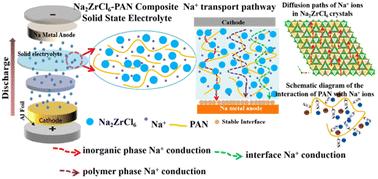
Low ionic conductivity and poor interfacial stability restrict the practical application of all-solid-state sodium-ion batteries (ASSSIBs). To solve these issues, a facile strategy involving the use of an inorganic–organic composite solid electrolyte (SE) composed of Na2ZrCl6 and polyacrylonitrile (PAN) is proposed. The introduction of Na2ZrCl6 results in a reduction in the crystallinity of PAN, which creates numerous pathways for Na+ ions migration and significantly enhances the ionic conductivity of SE. When utilized in a Na‖Na symmetric cell, the Na2ZrCl6–PAN SE exhibited good interfacial stability, with no Na dendrite formation even after 5000 h of Na electroplating/stripping. In addition, non-in situ X-ray diffraction, X-ray photoelectron spectroscopy, and in situ AC impedance tests confirmed the favorable interfacial stability of the Na2ZrCl6–PAN SE in contact with Na metal and Na3V2(PO4)3 (NVP). Furthermore, Na|Na2ZrCl6–PAN|NVP ASSSIBs exhibit outstanding electrochemical performance. The battery achieves an initial discharge capacity of 80.7 mA h g−1 at 1 C, which remains at 69.2 mA h g−1 after 500 cycles. Additionally, all-solid-state SIBs with a hard carbon (HC)|Na2ZrCl6–PAN|NVP ASSSIB configuration demonstrate excellent electrochemical cycling stability.
低离子电导率和界面稳定性差制约了全固态钠离子电池的实际应用。为了解决这些问题,提出了一种由Na2ZrCl6和聚丙烯腈(PAN)组成的无机-有机复合固体电解质(SE)的简便策略。Na2ZrCl6的引入降低了PAN的结晶度,为Na+的迁移创造了多种途径,显著提高了SE的离子电导率。Na2ZrCl6-PAN复合材料SE用于Na||Na对称半电池时,表现出良好的界面稳定性,即使经过4000 h的Na电镀和Na剥离,也没有形成Na枝晶。此外,非原位x射线衍射、x射线光电子能谱和原位交流阻抗测试证实了Na2ZrCl6-PAN SE在与Na金属和Na3V2(PO4)3 (NVP)接触时具有良好的界面稳定性。此外,Na|Na2ZrCl6-PAN|NVP表现出优异的电化学性能。电池在1℃时的初始放电容量为80.7 mA h - 1,循环500次后仍保持在69.2 mA h - 1。此外,具有硬碳(HC)|Na2ZrCl6-PAN|NVP结构的全固态SIBs表现出优异的电化学循环稳定性。
期刊介绍:
The Journal of Materials Chemistry A, B & C covers a wide range of high-quality studies in the field of materials chemistry, with each section focusing on specific applications of the materials studied. Journal of Materials Chemistry A emphasizes applications in energy and sustainability, including topics such as artificial photosynthesis, batteries, and fuel cells. Journal of Materials Chemistry B focuses on applications in biology and medicine, while Journal of Materials Chemistry C covers applications in optical, magnetic, and electronic devices. Example topic areas within the scope of Journal of Materials Chemistry A include catalysis, green/sustainable materials, sensors, and water treatment, among others.



 京公网安备 11010802042870号
京ICP备2023020795号-1
京公网安备 11010802042870号
京ICP备2023020795号-1

 分享
分享
 求助内容:
求助内容: 应助结果提醒方式:
 扫码关注我们
