{"title":"Water-stable MOFs and composites: a greener and sustainable approach for enhanced reactivity towards the electrochemical nitrate reduction reaction","authors":"Muhammad Sheraz Ahmad and Tahir Rasheed","doi":"10.1039/D4TA09189B","DOIUrl":null,"url":null,"abstract":"<p >The electrochemical nitrate reduction reaction (eNO<small><sub>3</sub></small><small><sup>−</sup></small> RR) is a promising strategy to mitigate nitrate pollution, which has become a critical environmental concern due to its harmful effects on water resources and ecosystems. Metal–organic frameworks (MOFs), known for their highly tunable structures, large surface areas, and exceptional porosity, have emerged as an affordable technology and a cost-effective solution for catalyzing the eNO<small><sub>3</sub></small><small><sup>−</sup></small> RR. However, the water stability of MOFs remains a major challenge in achieving efficient, durable NO<small><sub>3</sub></small><small><sup>−</sup></small> RR under aqueous conditions. Recent advancements in water-stable MOF (WS-MOF) based materials offer promising solutions to this problem, enabling robust performance in electrochemical applications. This review explores the design, synthesis, and application of WS-MOFs for the eNO<small><sub>3</sub></small><small><sup>−</sup></small> RR. Key strategies for enhancing water stability include the incorporation of hydrophobic ligands, post-synthetic modifications, and the development of MOF composites. The review examines the role of metal centers, such as transition metals (<em>e.g.</em>, Fe, Cu, Co, and Ni), and their interaction with organic linkers in promoting selective eNO<small><sub>3</sub></small><small><sup>−</sup></small> RR to environmentally benign products including nitrogen gas (N<small><sub>2</sub></small>) and ammonia (NH<small><sub>3</sub></small>). The integration of MOFs with conductive materials to improve electrical conductivity and catalytic performance is also discussed. In addition to reviewing recent progress in water-stable MOF catalysts for the eNO<small><sub>3</sub></small><small><sup>−</sup></small> RR, this review highlights challenges such as reaction selectivity, competitive side reactions, and long-term stability in electrochemical cells. Prospective directions for future research are outlined, including the development of more efficient catalysts, understanding reaction mechanisms at the molecular level, and scaling up MOF based eNO<small><sub>3</sub></small><small><sup>−</sup></small> RR systems for practical applications.</p>","PeriodicalId":82,"journal":{"name":"Journal of Materials Chemistry A","volume":" 22","pages":" 16309-16329"},"PeriodicalIF":9.5000,"publicationDate":"2025-04-09","publicationTypes":"Journal Article","fieldsOfStudy":null,"isOpenAccess":false,"openAccessPdf":"","citationCount":"0","resultStr":null,"platform":"Semanticscholar","paperid":null,"PeriodicalName":"Journal of Materials Chemistry A","FirstCategoryId":"88","ListUrlMain":"https://pubs.rsc.org/en/content/articlelanding/2025/ta/d4ta09189b","RegionNum":2,"RegionCategory":"材料科学","ArticlePicture":[],"TitleCN":null,"AbstractTextCN":null,"PMCID":null,"EPubDate":"","PubModel":"","JCR":"Q1","JCRName":"CHEMISTRY, PHYSICAL","Score":null,"Total":0}
引用次数: 0
Abstract
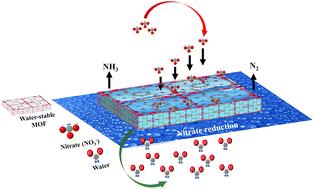
The electrochemical nitrate reduction reaction (eNO3− RR) is a promising strategy to mitigate nitrate pollution, which has become a critical environmental concern due to its harmful effects on water resources and ecosystems. Metal–organic frameworks (MOFs), known for their highly tunable structures, large surface areas, and exceptional porosity, have emerged as an affordable technology and a cost-effective solution for catalyzing the eNO3− RR. However, the water stability of MOFs remains a major challenge in achieving efficient, durable NO3− RR under aqueous conditions. Recent advancements in water-stable MOF (WS-MOF) based materials offer promising solutions to this problem, enabling robust performance in electrochemical applications. This review explores the design, synthesis, and application of WS-MOFs for the eNO3− RR. Key strategies for enhancing water stability include the incorporation of hydrophobic ligands, post-synthetic modifications, and the development of MOF composites. The review examines the role of metal centers, such as transition metals (e.g., Fe, Cu, Co, and Ni), and their interaction with organic linkers in promoting selective eNO3− RR to environmentally benign products including nitrogen gas (N2) and ammonia (NH3). The integration of MOFs with conductive materials to improve electrical conductivity and catalytic performance is also discussed. In addition to reviewing recent progress in water-stable MOF catalysts for the eNO3− RR, this review highlights challenges such as reaction selectivity, competitive side reactions, and long-term stability in electrochemical cells. Prospective directions for future research are outlined, including the development of more efficient catalysts, understanding reaction mechanisms at the molecular level, and scaling up MOF based eNO3− RR systems for practical applications.
期刊介绍:
The Journal of Materials Chemistry A, B & C covers a wide range of high-quality studies in the field of materials chemistry, with each section focusing on specific applications of the materials studied. Journal of Materials Chemistry A emphasizes applications in energy and sustainability, including topics such as artificial photosynthesis, batteries, and fuel cells. Journal of Materials Chemistry B focuses on applications in biology and medicine, while Journal of Materials Chemistry C covers applications in optical, magnetic, and electronic devices. Example topic areas within the scope of Journal of Materials Chemistry A include catalysis, green/sustainable materials, sensors, and water treatment, among others.



 京公网安备 11010802042870号
京ICP备2023020795号-1
京公网安备 11010802042870号
京ICP备2023020795号-1

 分享
分享
 求助内容:
求助内容: 应助结果提醒方式:
 扫码关注我们
