Robust integration of p-MXene ink with a bacterial cellulose-reinforced polymer enables dynamic interaction of superior electromagnetic shielding and sensing†
Danyu Liu, Pan Xue, Jingli Zhang, Yingjia Tong, Yixuan Zhang, Yajing Yu, Qingda Zhang, Mengfei Huang, Yiheng Gao, Jie Li, Qufu Wei and Pengfei Lv
{"title":"Robust integration of p-MXene ink with a bacterial cellulose-reinforced polymer enables dynamic interaction of superior electromagnetic shielding and sensing†","authors":"Danyu Liu, Pan Xue, Jingli Zhang, Yingjia Tong, Yixuan Zhang, Yajing Yu, Qingda Zhang, Mengfei Huang, Yiheng Gao, Jie Li, Qufu Wei and Pengfei Lv","doi":"10.1039/D5TA01796C","DOIUrl":null,"url":null,"abstract":"<p >The rapid development of intelligent wearable devices and health monitoring equipment demands bio-based materials that integrate multiple functions with enhanced durability. Herein, this work is a first attempt to develop flexible electromagnetic shielding and stress–strain sensing based on a composite of a polydopamine (PDA) modified-MXene (p-MXene) film with a waterborne polyurethane (WPU)/bacterial cellulose (BC) film. The durable p-MXene@WPU/BC composite films are found to demonstrate excellent mechanical properties (370 MPa) and stable interfacial adhesion, attributed to the interlocking network structure between WPU and BC and the strong hydrogen bonding between the p-MXene layer and WPU/BC layer. The resultant composite film displays remarkable mechanosensing performance, facilitating the accurate and reliable detection of human physiological signals. Importantly, the prepared composite film could effectively reflect and absorb electromagnetic waves through the high conductivity of the p-MXene layer and the staggered nanonetwork structure of the WPU/BC layer, thus achieving a shielding effect of up to 72 dB. As proof-of-concept illustrations, it is noteworthy that the electromagnetic shielding efficacy displays a dynamic interaction with the strain sensing performance during the stretching process, which is primarily attributed to the moderating effect of the efficient attachment and parallel-aligned structure of p-MXene nanosheets. This synergistic mechanism enables adaptive multifunctionality, where electromagnetic shielding capabilities dynamically modulate in response to material strain states. The research herein can offer new perspectives on the development of advanced bio-based multiple functional materials and their application in dynamic perceptual interaction and smart wearables.</p>","PeriodicalId":82,"journal":{"name":"Journal of Materials Chemistry A","volume":" 18","pages":" 12900-12910"},"PeriodicalIF":9.5000,"publicationDate":"2025-04-10","publicationTypes":"Journal Article","fieldsOfStudy":null,"isOpenAccess":false,"openAccessPdf":"","citationCount":"0","resultStr":null,"platform":"Semanticscholar","paperid":null,"PeriodicalName":"Journal of Materials Chemistry A","FirstCategoryId":"88","ListUrlMain":"https://pubs.rsc.org/en/content/articlelanding/2025/ta/d5ta01796c","RegionNum":2,"RegionCategory":"材料科学","ArticlePicture":[],"TitleCN":null,"AbstractTextCN":null,"PMCID":null,"EPubDate":"","PubModel":"","JCR":"Q1","JCRName":"CHEMISTRY, PHYSICAL","Score":null,"Total":0}
引用次数: 0
Abstract
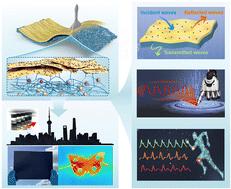
The rapid development of intelligent wearable devices and health monitoring equipment demands bio-based materials that integrate multiple functions with enhanced durability. Herein, this work is a first attempt to develop flexible electromagnetic shielding and stress–strain sensing based on a composite of a polydopamine (PDA) modified-MXene (p-MXene) film with a waterborne polyurethane (WPU)/bacterial cellulose (BC) film. The durable p-MXene@WPU/BC composite films are found to demonstrate excellent mechanical properties (370 MPa) and stable interfacial adhesion, attributed to the interlocking network structure between WPU and BC and the strong hydrogen bonding between the p-MXene layer and WPU/BC layer. The resultant composite film displays remarkable mechanosensing performance, facilitating the accurate and reliable detection of human physiological signals. Importantly, the prepared composite film could effectively reflect and absorb electromagnetic waves through the high conductivity of the p-MXene layer and the staggered nanonetwork structure of the WPU/BC layer, thus achieving a shielding effect of up to 72 dB. As proof-of-concept illustrations, it is noteworthy that the electromagnetic shielding efficacy displays a dynamic interaction with the strain sensing performance during the stretching process, which is primarily attributed to the moderating effect of the efficient attachment and parallel-aligned structure of p-MXene nanosheets. This synergistic mechanism enables adaptive multifunctionality, where electromagnetic shielding capabilities dynamically modulate in response to material strain states. The research herein can offer new perspectives on the development of advanced bio-based multiple functional materials and their application in dynamic perceptual interaction and smart wearables.
期刊介绍:
The Journal of Materials Chemistry A, B & C covers a wide range of high-quality studies in the field of materials chemistry, with each section focusing on specific applications of the materials studied. Journal of Materials Chemistry A emphasizes applications in energy and sustainability, including topics such as artificial photosynthesis, batteries, and fuel cells. Journal of Materials Chemistry B focuses on applications in biology and medicine, while Journal of Materials Chemistry C covers applications in optical, magnetic, and electronic devices. Example topic areas within the scope of Journal of Materials Chemistry A include catalysis, green/sustainable materials, sensors, and water treatment, among others.



 京公网安备 11010802042870号
京ICP备2023020795号-1
京公网安备 11010802042870号
京ICP备2023020795号-1

 分享
分享
 求助内容:
求助内容: 应助结果提醒方式:
 扫码关注我们
