Kelly Brown, Amy Farmer, Sabina Gurung, Matthew J. Baker, Ruth Board and Neil T. Hunt
{"title":"Machine-learning based classification of 2D-IR liquid biopsies enables stratification of melanoma relapse risk†","authors":"Kelly Brown, Amy Farmer, Sabina Gurung, Matthew J. Baker, Ruth Board and Neil T. Hunt","doi":"10.1039/D5SC01526J","DOIUrl":null,"url":null,"abstract":"<p >Non-linear laser spectroscopy methods such as two-dimensional infrared (2D-IR) produce large, information-rich datasets, while developments in laser technology have brought substantial increases in data collection rates. This combination of data depth and quantity creates the opportunity to unite advanced data science approaches, such as Machine Learning (ML), with 2D-IR to reveal insights that surpass those from established data interpretation methods. To demonstrate this, we show that ML and 2D-IR spectroscopy can classify blood serum samples collected from patients with melanoma according to diagnostically-relevant groupings. Using just 20 μL samples, 2D-IR measures ‘protein amide I fingerprints’, which reflect the protein profile of blood serum. A hyphenated Partial Least Squares-Support Vector Machine (PLS-SVM) model was able to classify 2D-protein fingerprints taken from 40 patients with melanoma according to the presence, absence or later development of metastatic disease. Area under the receiver operating characteristic curve (AUROC) values of 0.75 and 0.86 were obtained when identifying samples from patients who were radiologically cancer free and with metastatic disease respectively. The model was also able to classify (AUROC = 0.80) samples from a third group of patients who were radiologically cancer-free at the point of testing but would go on to develop metastatic disease within five years. This ability to identify post-treatment patients at higher risk of relapse from a spectroscopic measurement of biofluid protein content shows the potential for hybrid 2D-IR-ML analyses and raises the prospect of a new route to an optical blood-based test capable of risk stratification for melanoma patients.</p>","PeriodicalId":9909,"journal":{"name":"Chemical Science","volume":" 19","pages":" 8394-8404"},"PeriodicalIF":7.4000,"publicationDate":"2025-04-07","publicationTypes":"Journal Article","fieldsOfStudy":null,"isOpenAccess":false,"openAccessPdf":"https://pubs.rsc.org/en/content/articlepdf/2025/sc/d5sc01526j?page=search","citationCount":"0","resultStr":null,"platform":"Semanticscholar","paperid":null,"PeriodicalName":"Chemical Science","FirstCategoryId":"92","ListUrlMain":"https://pubs.rsc.org/en/content/articlelanding/2025/sc/d5sc01526j","RegionNum":1,"RegionCategory":"化学","ArticlePicture":[],"TitleCN":null,"AbstractTextCN":null,"PMCID":null,"EPubDate":"","PubModel":"","JCR":"Q1","JCRName":"CHEMISTRY, MULTIDISCIPLINARY","Score":null,"Total":0}
引用次数: 0
Abstract
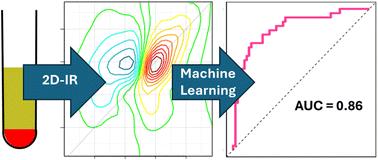
Non-linear laser spectroscopy methods such as two-dimensional infrared (2D-IR) produce large, information-rich datasets, while developments in laser technology have brought substantial increases in data collection rates. This combination of data depth and quantity creates the opportunity to unite advanced data science approaches, such as Machine Learning (ML), with 2D-IR to reveal insights that surpass those from established data interpretation methods. To demonstrate this, we show that ML and 2D-IR spectroscopy can classify blood serum samples collected from patients with melanoma according to diagnostically-relevant groupings. Using just 20 μL samples, 2D-IR measures ‘protein amide I fingerprints’, which reflect the protein profile of blood serum. A hyphenated Partial Least Squares-Support Vector Machine (PLS-SVM) model was able to classify 2D-protein fingerprints taken from 40 patients with melanoma according to the presence, absence or later development of metastatic disease. Area under the receiver operating characteristic curve (AUROC) values of 0.75 and 0.86 were obtained when identifying samples from patients who were radiologically cancer free and with metastatic disease respectively. The model was also able to classify (AUROC = 0.80) samples from a third group of patients who were radiologically cancer-free at the point of testing but would go on to develop metastatic disease within five years. This ability to identify post-treatment patients at higher risk of relapse from a spectroscopic measurement of biofluid protein content shows the potential for hybrid 2D-IR-ML analyses and raises the prospect of a new route to an optical blood-based test capable of risk stratification for melanoma patients.
期刊介绍:
Chemical Science is a journal that encompasses various disciplines within the chemical sciences. Its scope includes publishing ground-breaking research with significant implications for its respective field, as well as appealing to a wider audience in related areas. To be considered for publication, articles must showcase innovative and original advances in their field of study and be presented in a manner that is understandable to scientists from diverse backgrounds. However, the journal generally does not publish highly specialized research.






 京公网安备 11010802042870号
京ICP备2023020795号-1
京公网安备 11010802042870号
京ICP备2023020795号-1

 分享
分享
 求助内容:
求助内容: 应助结果提醒方式:
 扫码关注我们
