Tomomasa Yamasaki;Zhehui Wang;Tao Luo;Niangjun Chen;Bo Wang
{"title":"RBFleX-NAS: Training-Free Neural Architecture Search Using Radial Basis Function Kernel and Hyperparameter Detection","authors":"Tomomasa Yamasaki;Zhehui Wang;Tao Luo;Niangjun Chen;Bo Wang","doi":"10.1109/TNNLS.2025.3552693","DOIUrl":null,"url":null,"abstract":"Neural architecture search (NAS) is an automated technique to design optimal neural network architectures for a specific workload. Conventionally, evaluating candidate networks in NAS involves extensive training, which requires significant time and computational resources. To address this, training-free NAS has been proposed to expedite network evaluation with minimal search time. However, state-of-the-art training-free NAS algorithms struggle to precisely distinguish well-performing networks from poorly performing networks, resulting in inaccurate performance predictions and consequently suboptimal top-one network accuracy. Moreover, they are less effective in activation function exploration. To tackle the challenges, this article proposes RBFleX-NAS, a novel training-free NAS framework that accounts for both activation outputs and input features of the last layer with a radial basis function (RBF) kernel. We also present a detection algorithm to identify optimal hyperparameters using the obtained activation outputs and input feature maps. We verify the efficacy of RBFleX-NAS over a variety of NAS benchmarks. RBFleX-NAS significantly outperforms state-of-the-art training-free NAS methods in terms of top-one accuracy, achieving this with short search time in NAS-Bench-201 and NAS-Bench-SSS. In addition, it demonstrates a higher Kendall correlation compared to layer-based training-free NAS algorithms. Furthermore, we propose the neural network activation function benchmark (NAFBee), a new activation design space that extends the activation type to encompass various commonly used functions. In this extended design space, RBFleX-NAS demonstrates its superiority by accurately identifying the best-performing network during activation function search, providing a significant advantage over other NAS algorithms.","PeriodicalId":13303,"journal":{"name":"IEEE transactions on neural networks and learning systems","volume":"36 6","pages":"10057-10071"},"PeriodicalIF":8.9000,"publicationDate":"2025-04-09","publicationTypes":"Journal Article","fieldsOfStudy":null,"isOpenAccess":false,"openAccessPdf":"","citationCount":"0","resultStr":null,"platform":"Semanticscholar","paperid":null,"PeriodicalName":"IEEE transactions on neural networks and learning systems","FirstCategoryId":"94","ListUrlMain":"https://ieeexplore.ieee.org/document/10959729/","RegionNum":1,"RegionCategory":"计算机科学","ArticlePicture":[],"TitleCN":null,"AbstractTextCN":null,"PMCID":null,"EPubDate":"","PubModel":"","JCR":"Q1","JCRName":"COMPUTER SCIENCE, ARTIFICIAL INTELLIGENCE","Score":null,"Total":0}
引用次数: 0
Abstract
Neural architecture search (NAS) is an automated technique to design optimal neural network architectures for a specific workload. Conventionally, evaluating candidate networks in NAS involves extensive training, which requires significant time and computational resources. To address this, training-free NAS has been proposed to expedite network evaluation with minimal search time. However, state-of-the-art training-free NAS algorithms struggle to precisely distinguish well-performing networks from poorly performing networks, resulting in inaccurate performance predictions and consequently suboptimal top-one network accuracy. Moreover, they are less effective in activation function exploration. To tackle the challenges, this article proposes RBFleX-NAS, a novel training-free NAS framework that accounts for both activation outputs and input features of the last layer with a radial basis function (RBF) kernel. We also present a detection algorithm to identify optimal hyperparameters using the obtained activation outputs and input feature maps. We verify the efficacy of RBFleX-NAS over a variety of NAS benchmarks. RBFleX-NAS significantly outperforms state-of-the-art training-free NAS methods in terms of top-one accuracy, achieving this with short search time in NAS-Bench-201 and NAS-Bench-SSS. In addition, it demonstrates a higher Kendall correlation compared to layer-based training-free NAS algorithms. Furthermore, we propose the neural network activation function benchmark (NAFBee), a new activation design space that extends the activation type to encompass various commonly used functions. In this extended design space, RBFleX-NAS demonstrates its superiority by accurately identifying the best-performing network during activation function search, providing a significant advantage over other NAS algorithms.
期刊介绍:
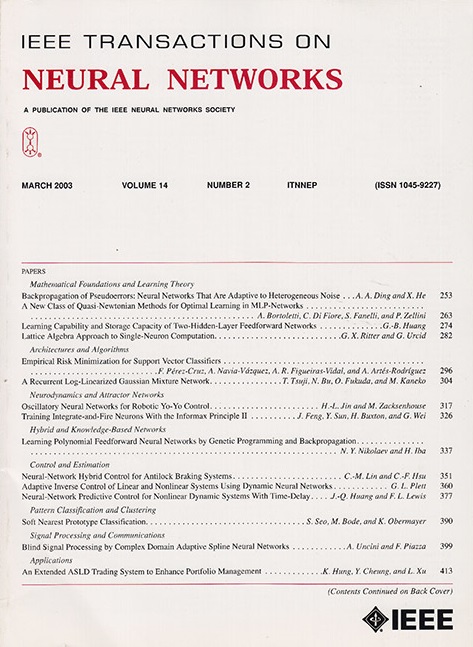
The focus of IEEE Transactions on Neural Networks and Learning Systems is to present scholarly articles discussing the theory, design, and applications of neural networks as well as other learning systems. The journal primarily highlights technical and scientific research in this domain.



 京公网安备 11010802042870号
京ICP备2023020795号-1
京公网安备 11010802042870号
京ICP备2023020795号-1

 分享
分享
 求助内容:
求助内容: 应助结果提醒方式:
 扫码关注我们
