Hui Li, Wenqi Zheng, Xinyi Liu, Jiashi Li, Lianbing Wen, Fujie Tang and Wei-Tao Liu
{"title":"Auto-dissociation of atmospheric water on TiO2: insights from sum-frequency spectroscopy of Ti–O vibrations†","authors":"Hui Li, Wenqi Zheng, Xinyi Liu, Jiashi Li, Lianbing Wen, Fujie Tang and Wei-Tao Liu","doi":"10.1039/D5CP00400D","DOIUrl":null,"url":null,"abstract":"<p >The dissociation of water on TiO<small><sub>2</sub></small> surfaces, marked by the presence of TiOH groups, is pivotal for environmental and energy applications involving TiO<small><sub>2</sub></small>. Yet characterizing these surface groups has remained a challenge. Here, we employ <em>in situ</em> sum-frequency vibrational spectroscopy (SFVS) to unveil the vibrational signatures of surface TiOH and undercoordinated Ti–O groups in the Ti–O vibrational frequency range, offering a clear structural indicator of TiO<small><sub>2</sub></small> hydroxylation. Our findings confirm the spontaneous dissociation of water molecules on TiO<small><sub>2</sub></small> surfaces, a process significantly enhanced by structural defects such as oxygen vacancies. Through methanol titration experiments, we gain molecular-level insights into the adsorption/desorption dynamics, estimating a ∼70% TiOH coverage on amorphous TiO<small><sub>2</sub></small> under ambient conditions. This work not only deepens our understanding of TiO<small><sub>2</sub></small>/water interactions but also lays the groundwork for future SFVS investigations into these interfaces.</p>","PeriodicalId":99,"journal":{"name":"Physical Chemistry Chemical Physics","volume":" 19","pages":" 9991-9997"},"PeriodicalIF":2.9000,"publicationDate":"2025-04-10","publicationTypes":"Journal Article","fieldsOfStudy":null,"isOpenAccess":false,"openAccessPdf":"","citationCount":"0","resultStr":null,"platform":"Semanticscholar","paperid":null,"PeriodicalName":"Physical Chemistry Chemical Physics","FirstCategoryId":"92","ListUrlMain":"https://pubs.rsc.org/en/content/articlelanding/2025/cp/d5cp00400d","RegionNum":3,"RegionCategory":"化学","ArticlePicture":[],"TitleCN":null,"AbstractTextCN":null,"PMCID":null,"EPubDate":"","PubModel":"","JCR":"Q3","JCRName":"CHEMISTRY, PHYSICAL","Score":null,"Total":0}
引用次数: 0
Abstract
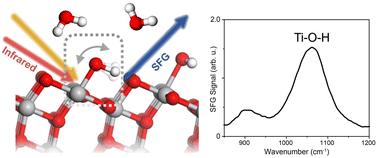
The dissociation of water on TiO2 surfaces, marked by the presence of TiOH groups, is pivotal for environmental and energy applications involving TiO2. Yet characterizing these surface groups has remained a challenge. Here, we employ in situ sum-frequency vibrational spectroscopy (SFVS) to unveil the vibrational signatures of surface TiOH and undercoordinated Ti–O groups in the Ti–O vibrational frequency range, offering a clear structural indicator of TiO2 hydroxylation. Our findings confirm the spontaneous dissociation of water molecules on TiO2 surfaces, a process significantly enhanced by structural defects such as oxygen vacancies. Through methanol titration experiments, we gain molecular-level insights into the adsorption/desorption dynamics, estimating a ∼70% TiOH coverage on amorphous TiO2 under ambient conditions. This work not only deepens our understanding of TiO2/water interactions but also lays the groundwork for future SFVS investigations into these interfaces.
期刊介绍:
Physical Chemistry Chemical Physics (PCCP) is an international journal co-owned by 19 physical chemistry and physics societies from around the world. This journal publishes original, cutting-edge research in physical chemistry, chemical physics and biophysical chemistry. To be suitable for publication in PCCP, articles must include significant innovation and/or insight into physical chemistry; this is the most important criterion that reviewers and Editors will judge against when evaluating submissions.
The journal has a broad scope and welcomes contributions spanning experiment, theory, computation and data science. Topical coverage includes spectroscopy, dynamics, kinetics, statistical mechanics, thermodynamics, electrochemistry, catalysis, surface science, quantum mechanics, quantum computing and machine learning. Interdisciplinary research areas such as polymers and soft matter, materials, nanoscience, energy, surfaces/interfaces, and biophysical chemistry are welcomed if they demonstrate significant innovation and/or insight into physical chemistry. Joined experimental/theoretical studies are particularly appreciated when complementary and based on up-to-date approaches.




 京公网安备 11010802042870号
京ICP备2023020795号-1
京公网安备 11010802042870号
京ICP备2023020795号-1

 分享
分享
 求助内容:
求助内容: 应助结果提醒方式:
 扫码关注我们
