{"title":"Experimental study of the effect of particle collision on bubble dynamics behavior†","authors":"Xiaoxiang Li, Ying Zhang, Weichen Tang, Xin Chen and Fei Dong","doi":"10.1039/D5CP00938C","DOIUrl":null,"url":null,"abstract":"<p >Particle–bubble flows are commonly found in industrial processes such as mineral flotation, catalytic reactors, and fluidized beds. This study reports the behavior of particles colliding with adhered bubbles on surfaces, resulting in their detachment. The effects of particle diameter, particle collision velocity, and bubble height on bubble dynamics were investigated. To connect the three factors together, the Weber number of the particles was fitted with the different heights of bubbles to derive a critical detachment curve for bubbles at varying particle diameters. The results indicate that the detachment height of bubbles is inversely proportional to the collision velocity and diameter of the particles. Additionally, among these three factors, the primary force influencing the bubble detachment time is the capillary force of the particles.</p>","PeriodicalId":99,"journal":{"name":"Physical Chemistry Chemical Physics","volume":" 20","pages":" 10471-10481"},"PeriodicalIF":2.9000,"publicationDate":"2025-04-10","publicationTypes":"Journal Article","fieldsOfStudy":null,"isOpenAccess":false,"openAccessPdf":"","citationCount":"0","resultStr":null,"platform":"Semanticscholar","paperid":null,"PeriodicalName":"Physical Chemistry Chemical Physics","FirstCategoryId":"92","ListUrlMain":"https://pubs.rsc.org/en/content/articlelanding/2025/cp/d5cp00938c","RegionNum":3,"RegionCategory":"化学","ArticlePicture":[],"TitleCN":null,"AbstractTextCN":null,"PMCID":null,"EPubDate":"","PubModel":"","JCR":"Q3","JCRName":"CHEMISTRY, PHYSICAL","Score":null,"Total":0}
引用次数: 0
Abstract
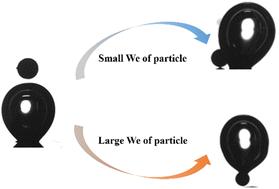
Particle–bubble flows are commonly found in industrial processes such as mineral flotation, catalytic reactors, and fluidized beds. This study reports the behavior of particles colliding with adhered bubbles on surfaces, resulting in their detachment. The effects of particle diameter, particle collision velocity, and bubble height on bubble dynamics were investigated. To connect the three factors together, the Weber number of the particles was fitted with the different heights of bubbles to derive a critical detachment curve for bubbles at varying particle diameters. The results indicate that the detachment height of bubbles is inversely proportional to the collision velocity and diameter of the particles. Additionally, among these three factors, the primary force influencing the bubble detachment time is the capillary force of the particles.
期刊介绍:
Physical Chemistry Chemical Physics (PCCP) is an international journal co-owned by 19 physical chemistry and physics societies from around the world. This journal publishes original, cutting-edge research in physical chemistry, chemical physics and biophysical chemistry. To be suitable for publication in PCCP, articles must include significant innovation and/or insight into physical chemistry; this is the most important criterion that reviewers and Editors will judge against when evaluating submissions.
The journal has a broad scope and welcomes contributions spanning experiment, theory, computation and data science. Topical coverage includes spectroscopy, dynamics, kinetics, statistical mechanics, thermodynamics, electrochemistry, catalysis, surface science, quantum mechanics, quantum computing and machine learning. Interdisciplinary research areas such as polymers and soft matter, materials, nanoscience, energy, surfaces/interfaces, and biophysical chemistry are welcomed if they demonstrate significant innovation and/or insight into physical chemistry. Joined experimental/theoretical studies are particularly appreciated when complementary and based on up-to-date approaches.




 京公网安备 11010802042870号
京ICP备2023020795号-1
京公网安备 11010802042870号
京ICP备2023020795号-1

 分享
分享
 求助内容:
求助内容: 应助结果提醒方式:
 扫码关注我们
