Fanghui Mi, Ying Ou, Rui Luo, Shixian Wang, Zhijun Zhang, Chunwen Sun, Zhaoxiang Wang and Yurui Gao
{"title":"Microscopic insights into the ring-opening reaction of ethylene carbonate on LiCoO2 by on-the-fly machine learning molecular dynamics†","authors":"Fanghui Mi, Ying Ou, Rui Luo, Shixian Wang, Zhijun Zhang, Chunwen Sun, Zhaoxiang Wang and Yurui Gao","doi":"10.1039/D5TA01193K","DOIUrl":null,"url":null,"abstract":"<p >The cathode–electrolyte interface plays a crucial role in determining the structural stability, electrochemical behavior and cycling performance of Li-ion batteries (LIBs). However, the dynamic structural evolution and microscopic reaction mechanisms at the interface remain poorly understood. Here, we provide a microscopic picture of the dynamic structure and the initial dynamics of the ring-opening reaction of ethylene carbonate (EC) at the EC–LiCoO<small><sub>2</sub></small> interface, one of the most commonly used battery systems, identifying two distinct mechanisms for the initial EC decomposition reactions, based on on-the-fly machine learning accelerated molecular dynamics simulations. Explicit solvent modeling reveals various binding configurations of EC, with multiple binding sites and orientations, which tend to influence its reactivity at the interface. Notably, the interaction between the carbonyl carbon of EC and the oxygen sites on the LiCoO<small><sub>2</sub></small> (104) facet is strongly correlated with ring-opening of the bound EC. At 300 K, the C–O (ether O) bond of the EC molecules can be cleaved by a nucleophilic attack from the surface oxygen of LiCoO<small><sub>2</sub></small>, leading to ring opening. In the absence of additional chemical species, spontaneous ring closure is usually observed on the stoichiometric LiCoO<small><sub>2</sub></small> surface, presenting a dynamic equilibrium between transient ring-opening and self-healing for the adsorbed EC molecules at the interface. Furthermore, a prolonged ring-opened state of EC was observed, facilitated by Li<small><sup>+</sup></small> ion extraction from the stoichiometric LiCoO<small><sub>2</sub></small>, with an intermediate process of Co<small><sup>3+</sup></small> oxidation to Co<small><sup>4+</sup></small>. A greater Li<small><sup>+</sup></small> deficiency in the substrate was found to further promote EC ring opening. These findings not only provide fundamental insights into electrode–electrolyte interfacial reactions but also offer guidance for the efficient design of LIBs with enhanced stability and electrochemical/cycling performance.</p>","PeriodicalId":82,"journal":{"name":"Journal of Materials Chemistry A","volume":" 20","pages":" 15213-15221"},"PeriodicalIF":9.5000,"publicationDate":"2025-04-10","publicationTypes":"Journal Article","fieldsOfStudy":null,"isOpenAccess":false,"openAccessPdf":"","citationCount":"0","resultStr":null,"platform":"Semanticscholar","paperid":null,"PeriodicalName":"Journal of Materials Chemistry A","FirstCategoryId":"88","ListUrlMain":"https://pubs.rsc.org/en/content/articlelanding/2025/ta/d5ta01193k","RegionNum":2,"RegionCategory":"材料科学","ArticlePicture":[],"TitleCN":null,"AbstractTextCN":null,"PMCID":null,"EPubDate":"","PubModel":"","JCR":"Q1","JCRName":"CHEMISTRY, PHYSICAL","Score":null,"Total":0}
引用次数: 0
Abstract
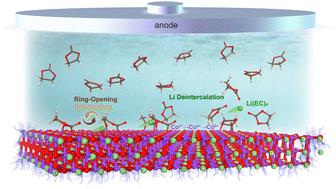
The cathode–electrolyte interface plays a crucial role in determining the structural stability, electrochemical behavior and cycling performance of Li-ion batteries (LIBs). However, the dynamic structural evolution and microscopic reaction mechanisms at the interface remain poorly understood. Here, we provide a microscopic picture of the dynamic structure and the initial dynamics of the ring-opening reaction of ethylene carbonate (EC) at the EC–LiCoO2 interface, one of the most commonly used battery systems, identifying two distinct mechanisms for the initial EC decomposition reactions, based on on-the-fly machine learning accelerated molecular dynamics simulations. Explicit solvent modeling reveals various binding configurations of EC, with multiple binding sites and orientations, which tend to influence its reactivity at the interface. Notably, the interaction between the carbonyl carbon of EC and the oxygen sites on the LiCoO2 (104) facet is strongly correlated with ring-opening of the bound EC. At 300 K, the C–O (ether O) bond of the EC molecules can be cleaved by a nucleophilic attack from the surface oxygen of LiCoO2, leading to ring opening. In the absence of additional chemical species, spontaneous ring closure is usually observed on the stoichiometric LiCoO2 surface, presenting a dynamic equilibrium between transient ring-opening and self-healing for the adsorbed EC molecules at the interface. Furthermore, a prolonged ring-opened state of EC was observed, facilitated by Li+ ion extraction from the stoichiometric LiCoO2, with an intermediate process of Co3+ oxidation to Co4+. A greater Li+ deficiency in the substrate was found to further promote EC ring opening. These findings not only provide fundamental insights into electrode–electrolyte interfacial reactions but also offer guidance for the efficient design of LIBs with enhanced stability and electrochemical/cycling performance.
期刊介绍:
The Journal of Materials Chemistry A, B & C covers a wide range of high-quality studies in the field of materials chemistry, with each section focusing on specific applications of the materials studied. Journal of Materials Chemistry A emphasizes applications in energy and sustainability, including topics such as artificial photosynthesis, batteries, and fuel cells. Journal of Materials Chemistry B focuses on applications in biology and medicine, while Journal of Materials Chemistry C covers applications in optical, magnetic, and electronic devices. Example topic areas within the scope of Journal of Materials Chemistry A include catalysis, green/sustainable materials, sensors, and water treatment, among others.



 京公网安备 11010802042870号
京ICP备2023020795号-1
京公网安备 11010802042870号
京ICP备2023020795号-1

 分享
分享
 求助内容:
求助内容: 应助结果提醒方式:
 扫码关注我们
