Yecheng Shen, Yiming Wang, Chenhe Wang, Yimei Zhang, Shanghui Su, Yibo Hu, Yuxuan Zhu, Caiwei Zhang, Mengting Wang, Xiukun Ye, Guang-Peng Wu, Zaifei Ma, Haiming Zhu, Minmin Shi and Hongzheng Chen
{"title":"Chemical modification of a small-molecule acceptor with an adamantyl side chain for efficient and thermally stable organic solar cells†","authors":"Yecheng Shen, Yiming Wang, Chenhe Wang, Yimei Zhang, Shanghui Su, Yibo Hu, Yuxuan Zhu, Caiwei Zhang, Mengting Wang, Xiukun Ye, Guang-Peng Wu, Zaifei Ma, Haiming Zhu, Minmin Shi and Hongzheng Chen","doi":"10.1039/D5TA00483G","DOIUrl":null,"url":null,"abstract":"<p >Although a bulk heterojunction (BHJ) structure enables high power conversion efficiencies (PCEs) in organic solar cells (OSCs), the morphology of the donor:acceptor blend film is thermally unstable due to molecular diffusion of the two components, especially the small-molecule acceptor (SMA). Herein, distinct from the widely applied oligomerization or polymerization of SMAs, we reported a new and simple strategy involving the substitution of adamantyl, the rigid alkyl group, on the well-known SMA of Y6-BO to improve the thermal stability of OSCs. Through such molecular tailoring, two novel SMAs, BOAD and ADAD, which possessed one and two adamantyl side chains, respectively, were synthesized. As expected, the glass transition temperatures (<em>T</em><small><sub>g</sub></small>s) of ADAD and BOAD were elevated from 78 °C for Y6-BO to 98 °C and 123 °C, respectively. Consequently, after thermal treatment at 80 °C for 375 h, the BOAD-based OSC retained 61.3% of its initial efficiency, outperforming its Y6-BO-based counterpart (44.9%). In addition, the BOAD-based device achieved a high PCE of 17.13%, comparable to that of the Y6-BO-based device (16.98%). Our work provides a valuable reference for designing stable SMAs, advancing the commercialization of OSCs.</p>","PeriodicalId":82,"journal":{"name":"Journal of Materials Chemistry A","volume":" 20","pages":" 15232-15239"},"PeriodicalIF":9.5000,"publicationDate":"2025-04-10","publicationTypes":"Journal Article","fieldsOfStudy":null,"isOpenAccess":false,"openAccessPdf":"","citationCount":"0","resultStr":null,"platform":"Semanticscholar","paperid":null,"PeriodicalName":"Journal of Materials Chemistry A","FirstCategoryId":"88","ListUrlMain":"https://pubs.rsc.org/en/content/articlelanding/2025/ta/d5ta00483g","RegionNum":2,"RegionCategory":"材料科学","ArticlePicture":[],"TitleCN":null,"AbstractTextCN":null,"PMCID":null,"EPubDate":"","PubModel":"","JCR":"Q1","JCRName":"CHEMISTRY, PHYSICAL","Score":null,"Total":0}
引用次数: 0
Abstract
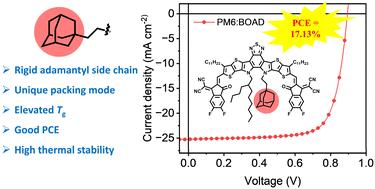
Although a bulk heterojunction (BHJ) structure enables high power conversion efficiencies (PCEs) in organic solar cells (OSCs), the morphology of the donor:acceptor blend film is thermally unstable due to molecular diffusion of the two components, especially the small-molecule acceptor (SMA). Herein, distinct from the widely applied oligomerization or polymerization of SMAs, we reported a new and simple strategy involving the substitution of adamantyl, the rigid alkyl group, on the well-known SMA of Y6-BO to improve the thermal stability of OSCs. Through such molecular tailoring, two novel SMAs, BOAD and ADAD, which possessed one and two adamantyl side chains, respectively, were synthesized. As expected, the glass transition temperatures (Tgs) of ADAD and BOAD were elevated from 78 °C for Y6-BO to 98 °C and 123 °C, respectively. Consequently, after thermal treatment at 80 °C for 375 h, the BOAD-based OSC retained 61.3% of its initial efficiency, outperforming its Y6-BO-based counterpart (44.9%). In addition, the BOAD-based device achieved a high PCE of 17.13%, comparable to that of the Y6-BO-based device (16.98%). Our work provides a valuable reference for designing stable SMAs, advancing the commercialization of OSCs.
期刊介绍:
The Journal of Materials Chemistry A, B & C covers a wide range of high-quality studies in the field of materials chemistry, with each section focusing on specific applications of the materials studied. Journal of Materials Chemistry A emphasizes applications in energy and sustainability, including topics such as artificial photosynthesis, batteries, and fuel cells. Journal of Materials Chemistry B focuses on applications in biology and medicine, while Journal of Materials Chemistry C covers applications in optical, magnetic, and electronic devices. Example topic areas within the scope of Journal of Materials Chemistry A include catalysis, green/sustainable materials, sensors, and water treatment, among others.



 京公网安备 11010802042870号
京ICP备2023020795号-1
京公网安备 11010802042870号
京ICP备2023020795号-1

 分享
分享
 求助内容:
求助内容: 应助结果提醒方式:
 扫码关注我们
