Wen-mei Chen, Lin Zou, Yan-hong Shao, Zong-cai Tu, Jun Liu
{"title":"Glycation of β-Lactoglobulin with different lengths sugar chains: Impacts on structure, allergenicity and flavor profile","authors":"Wen-mei Chen, Lin Zou, Yan-hong Shao, Zong-cai Tu, Jun Liu","doi":"10.1016/j.foodchem.2025.144299","DOIUrl":null,"url":null,"abstract":"This study aims to perform a comparative study on the structure, allergenicity and flavor profile of β-lactoglobulin (BLG)–galacto-oligosaccharides, maltose, maltotriose and maltopentaose conjugates formed by glycation. Glycation increased BLG's molecular weight, altered the conformational structures and secondary structure from α-helix and β-sheet to β-turn and unordered forms. K47, K83, K91, K135, K138 and K141 of BLG were glycated, destructing the antigen epitopes, leading to reducing the IgE/IgG binding capacity and the release of histamine and interleukin-6 in KU812 cells, with BLG-galacto-oligosaccharides and BLG-maltose showed the lowest allergenicity. Meanwhile, 36 volatile organic compounds (VOCs) were identified in the conjugates, among which 11 were key VOCs, including 2,3-Butanedione and 2-propanol-M, which were the most abundant in BLG-galacto-oligosaccharides and BLG-maltose and positively correlated with glycation levels. Overall, glycation of proteins by different lengths sugar chains influenced the epitope structures and glycation levels, altering allergenicity and the release of flavor compounds.","PeriodicalId":318,"journal":{"name":"Food Chemistry","volume":"39 1","pages":""},"PeriodicalIF":9.8000,"publicationDate":"2025-04-10","publicationTypes":"Journal Article","fieldsOfStudy":null,"isOpenAccess":false,"openAccessPdf":"","citationCount":"0","resultStr":null,"platform":"Semanticscholar","paperid":null,"PeriodicalName":"Food Chemistry","FirstCategoryId":"97","ListUrlMain":"https://doi.org/10.1016/j.foodchem.2025.144299","RegionNum":1,"RegionCategory":"农林科学","ArticlePicture":[],"TitleCN":null,"AbstractTextCN":null,"PMCID":null,"EPubDate":"","PubModel":"","JCR":"Q1","JCRName":"CHEMISTRY, APPLIED","Score":null,"Total":0}
引用次数: 0
Abstract
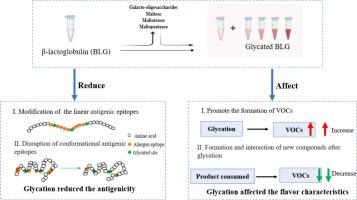
This study aims to perform a comparative study on the structure, allergenicity and flavor profile of β-lactoglobulin (BLG)–galacto-oligosaccharides, maltose, maltotriose and maltopentaose conjugates formed by glycation. Glycation increased BLG's molecular weight, altered the conformational structures and secondary structure from α-helix and β-sheet to β-turn and unordered forms. K47, K83, K91, K135, K138 and K141 of BLG were glycated, destructing the antigen epitopes, leading to reducing the IgE/IgG binding capacity and the release of histamine and interleukin-6 in KU812 cells, with BLG-galacto-oligosaccharides and BLG-maltose showed the lowest allergenicity. Meanwhile, 36 volatile organic compounds (VOCs) were identified in the conjugates, among which 11 were key VOCs, including 2,3-Butanedione and 2-propanol-M, which were the most abundant in BLG-galacto-oligosaccharides and BLG-maltose and positively correlated with glycation levels. Overall, glycation of proteins by different lengths sugar chains influenced the epitope structures and glycation levels, altering allergenicity and the release of flavor compounds.
期刊介绍:
Food Chemistry publishes original research papers dealing with the advancement of the chemistry and biochemistry of foods or the analytical methods/ approach used. All papers should focus on the novelty of the research carried out.




 京公网安备 11010802042870号
京ICP备2023020795号-1
京公网安备 11010802042870号
京ICP备2023020795号-1

 分享
分享
 求助内容:
求助内容: 应助结果提醒方式:
 扫码关注我们
