Qian Chen, Guizhu Feng, Yan Shen, Xiang Li, Qiqi Pei, Hanying Wang, Li Tian, Yuanyuan Cao, Jing Wu, Hailong Yang, Lixian Mu
{"title":"An Anionic Cathelicidin Exerts Antimelanoma Effects in Mice by Promoting Pyroptosis","authors":"Qian Chen, Guizhu Feng, Yan Shen, Xiang Li, Qiqi Pei, Hanying Wang, Li Tian, Yuanyuan Cao, Jing Wu, Hailong Yang, Lixian Mu","doi":"10.1021/acs.jmedchem.5c00281","DOIUrl":null,"url":null,"abstract":"While cationic antimicrobial peptides (AMPs) are extensively studied for antitumor effects, anionic AMPs remain underexplored. Notably, no amphibian-derived anionic cathelicidins with antitumor activity have been reported. This study identifies Boma-CATH, a novel anionic cathelicidin (net charge–3) from <i>Bombina maxima</i> skin, which suppresses melanoma growth in mice and triggers pyroptosis-like morphological changes in A375 cells via the NLRP3/Caspase-1/GSDMD pathway. Further investigation revealed that ROS played a crucial role in promoting pyroptosis, as NAC (ROS scavenger) and Ac-YVAD-cmk (Caspase-1 inhibitor) reversed cell death and reduced LDH/IL-1β release in vitro and in vivo. GSDMD knockdown further validated its role. Additionally, Boma-CATH inhibited A375 cell proliferation, migration, and invasion, demonstrating dual antitumor mechanisms: pyroptosis induction and metastasis suppression. Importantly, Boma-CATH caused no adverse effects in mice, highlighting its therapeutic safety. These findings position Boma-CATH as a promising melanoma treatment and expand the mechanistic understanding of anionic AMPs in oncology.","PeriodicalId":46,"journal":{"name":"Journal of Medicinal Chemistry","volume":"25 1","pages":""},"PeriodicalIF":6.8000,"publicationDate":"2025-04-10","publicationTypes":"Journal Article","fieldsOfStudy":null,"isOpenAccess":false,"openAccessPdf":"","citationCount":"0","resultStr":null,"platform":"Semanticscholar","paperid":null,"PeriodicalName":"Journal of Medicinal Chemistry","FirstCategoryId":"3","ListUrlMain":"https://doi.org/10.1021/acs.jmedchem.5c00281","RegionNum":1,"RegionCategory":"医学","ArticlePicture":[],"TitleCN":null,"AbstractTextCN":null,"PMCID":null,"EPubDate":"","PubModel":"","JCR":"Q1","JCRName":"CHEMISTRY, MEDICINAL","Score":null,"Total":0}
引用次数: 0
Abstract
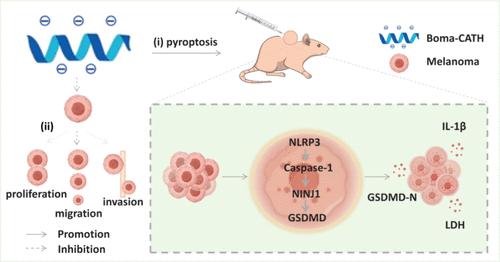
While cationic antimicrobial peptides (AMPs) are extensively studied for antitumor effects, anionic AMPs remain underexplored. Notably, no amphibian-derived anionic cathelicidins with antitumor activity have been reported. This study identifies Boma-CATH, a novel anionic cathelicidin (net charge–3) from Bombina maxima skin, which suppresses melanoma growth in mice and triggers pyroptosis-like morphological changes in A375 cells via the NLRP3/Caspase-1/GSDMD pathway. Further investigation revealed that ROS played a crucial role in promoting pyroptosis, as NAC (ROS scavenger) and Ac-YVAD-cmk (Caspase-1 inhibitor) reversed cell death and reduced LDH/IL-1β release in vitro and in vivo. GSDMD knockdown further validated its role. Additionally, Boma-CATH inhibited A375 cell proliferation, migration, and invasion, demonstrating dual antitumor mechanisms: pyroptosis induction and metastasis suppression. Importantly, Boma-CATH caused no adverse effects in mice, highlighting its therapeutic safety. These findings position Boma-CATH as a promising melanoma treatment and expand the mechanistic understanding of anionic AMPs in oncology.
期刊介绍:
The Journal of Medicinal Chemistry is a prestigious biweekly peer-reviewed publication that focuses on the multifaceted field of medicinal chemistry. Since its inception in 1959 as the Journal of Medicinal and Pharmaceutical Chemistry, it has evolved to become a cornerstone in the dissemination of research findings related to the design, synthesis, and development of therapeutic agents.
The Journal of Medicinal Chemistry is recognized for its significant impact in the scientific community, as evidenced by its 2022 impact factor of 7.3. This metric reflects the journal's influence and the importance of its content in shaping the future of drug discovery and development. The journal serves as a vital resource for chemists, pharmacologists, and other researchers interested in the molecular mechanisms of drug action and the optimization of therapeutic compounds.



 京公网安备 11010802042870号
京ICP备2023020795号-1
京公网安备 11010802042870号
京ICP备2023020795号-1

 分享
分享
 求助内容:
求助内容: 应助结果提醒方式:
 扫码关注我们
