Mi Peng, Chengyu Li, Huaying Meng, Xuan Tang, Maolin Wang, Jie Zhang, Junzhong Xie, Qingxin Zhang, Fengya Tong, Hao Tian, Hao Wang, Lei Song, Hongyang Liu, Sheng Dai, Geng Sun, Ding Ma
{"title":"The Role of Convex Edge Site in Fully-Exposed Pt Cluster Catalyst for Hydrogen Production","authors":"Mi Peng, Chengyu Li, Huaying Meng, Xuan Tang, Maolin Wang, Jie Zhang, Junzhong Xie, Qingxin Zhang, Fengya Tong, Hao Tian, Hao Wang, Lei Song, Hongyang Liu, Sheng Dai, Geng Sun, Ding Ma","doi":"10.1002/anie.202424816","DOIUrl":null,"url":null,"abstract":"<p>Achieving a precise understanding of the active site structure has long been an ultimate goal in fundamental heterogeneous catalysis research, yet it remains exceptionally challenging in nanocluster catalysis. In Pt-catalyzed dehydrogenation reactions, such as cyclohexane dehydrogenation for liquid organic carriers (LOHC), previous efforts have provided valuable insights into the size effects of nanoclusters. However, the optimal geometry of the active sites has remained elusive and, at times, contradictory. In this study, we investigate the geometric effect and the active site structure in fully-exposed Pt clusters supported on ceria that exhibit superior activity in cyclohexane dehydrogenation (11.4 mol mol<sub>Pt</sub><sup>−</sup>¹ s<sup>−</sup>¹), characterized by small coordination numbers, high metal utilization efficiency, and abundant convex edge sites. Through a combination of experimental and theoretical approaches, we demonstrate that the convex edge sites predominant within the fully-exposed Pt clusters outperform other active structures (e.g., terrace sites, hollow sites, etc.) in dehydrogenation reactions. These convex edge sites are not only efficient in C─H activation but, more notably, are also resistant to detrimental carbonaceous intermediates, hence enabling high and long-lived H<sub>2</sub> production activity.</p>","PeriodicalId":125,"journal":{"name":"Angewandte Chemie International Edition","volume":"64 25","pages":""},"PeriodicalIF":16.9000,"publicationDate":"2025-04-10","publicationTypes":"Journal Article","fieldsOfStudy":null,"isOpenAccess":false,"openAccessPdf":"","citationCount":"0","resultStr":null,"platform":"Semanticscholar","paperid":null,"PeriodicalName":"Angewandte Chemie International Edition","FirstCategoryId":"92","ListUrlMain":"https://onlinelibrary.wiley.com/doi/10.1002/anie.202424816","RegionNum":1,"RegionCategory":"化学","ArticlePicture":[],"TitleCN":null,"AbstractTextCN":null,"PMCID":null,"EPubDate":"","PubModel":"","JCR":"Q1","JCRName":"CHEMISTRY, MULTIDISCIPLINARY","Score":null,"Total":0}
引用次数: 0
Abstract
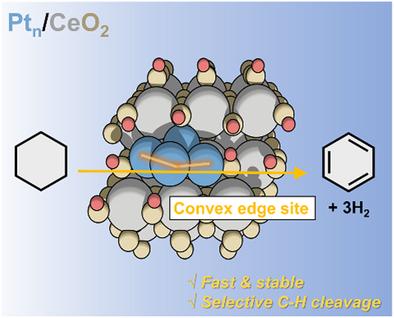
Achieving a precise understanding of the active site structure has long been an ultimate goal in fundamental heterogeneous catalysis research, yet it remains exceptionally challenging in nanocluster catalysis. In Pt-catalyzed dehydrogenation reactions, such as cyclohexane dehydrogenation for liquid organic carriers (LOHC), previous efforts have provided valuable insights into the size effects of nanoclusters. However, the optimal geometry of the active sites has remained elusive and, at times, contradictory. In this study, we investigate the geometric effect and the active site structure in fully-exposed Pt clusters supported on ceria that exhibit superior activity in cyclohexane dehydrogenation (11.4 mol molPt−¹ s−¹), characterized by small coordination numbers, high metal utilization efficiency, and abundant convex edge sites. Through a combination of experimental and theoretical approaches, we demonstrate that the convex edge sites predominant within the fully-exposed Pt clusters outperform other active structures (e.g., terrace sites, hollow sites, etc.) in dehydrogenation reactions. These convex edge sites are not only efficient in C─H activation but, more notably, are also resistant to detrimental carbonaceous intermediates, hence enabling high and long-lived H2 production activity.
期刊介绍:
Angewandte Chemie, a journal of the German Chemical Society (GDCh), maintains a leading position among scholarly journals in general chemistry with an impressive Impact Factor of 16.6 (2022 Journal Citation Reports, Clarivate, 2023). Published weekly in a reader-friendly format, it features new articles almost every day. Established in 1887, Angewandte Chemie is a prominent chemistry journal, offering a dynamic blend of Review-type articles, Highlights, Communications, and Research Articles on a weekly basis, making it unique in the field.



 京公网安备 11010802042870号
京ICP备2023020795号-1
京公网安备 11010802042870号
京ICP备2023020795号-1

 分享
分享
 求助内容:
求助内容: 应助结果提醒方式:
 扫码关注我们
