{"title":"Freeze-Tolerant and Transparent Eutectogel with High Conductivity and Long-Lasting Usability for Low-Grade Heat Harvesting","authors":"Yaolong Zhi, Maohua Li, Xuelei Ma, Xinyue Zhu, Jiakang Yuan, Yunhong Xin, Yu Fang and Junxia Peng*, ","doi":"10.1021/acsapm.5c00097","DOIUrl":null,"url":null,"abstract":"<p >Ionic hydrogels and ionogels have been widely utilized as ionic thermoelectric (iTE) materials for converting low-grade heat to usable electricity. However, developing iTE gels that possess environmental tolerance, long-lasting usability, and biofriendliness remains challenging. Herein, we present a highly transparent polymer eutectogel comprising a green eutectic solvent (ES) along with a lithium salt. This eutectogel exhibits a high ionic conductivity of 20.2 mS cm<sup>–1</sup> and an ionic Seebeck coefficient of 9.7 mV K<sup>–1</sup>. Thanks to the excellent freeze-resistant property of ES, the ionic conductivity can still reach 7.6 mS cm<sup>–1</sup> even at −20 °C. Additionally, the interaction between the polymer network and ES prevents crystallization within as-prepared eutectogel, instead resulting in a glass transition at −114 °C, slightly lower than a glass transition temperature of ES at −113 °C. Furthermore, as-prepared eutectogel demonstrates exceptional long-term solvent retention, showing no weight loss when exposed to an ambient environment (∼23 °C, ∼60% RH) for 7 days and maintaining 90% of its weight after being placed in an oven for 1 day (50 °C, ∼30% RH with strong air circulation). As-prepared eutectogel also shows excellent stability of TE performance over a wide range of relative humidity. The homemade device utilized as-prepared eutectogel shows the potential to directly power some small electronic devices (such as light-emitting diodes and timers) and to recover wasted heat generated by solar panels. Our results provide a foundation for the development of biofriendly TE gel-like materials that exhibit outstanding environmental tolerance and long-lasting usability.</p>","PeriodicalId":7,"journal":{"name":"ACS Applied Polymer Materials","volume":"7 7","pages":"4383–4393 4383–4393"},"PeriodicalIF":4.7000,"publicationDate":"2025-03-23","publicationTypes":"Journal Article","fieldsOfStudy":null,"isOpenAccess":false,"openAccessPdf":"","citationCount":"0","resultStr":null,"platform":"Semanticscholar","paperid":null,"PeriodicalName":"ACS Applied Polymer Materials","FirstCategoryId":"92","ListUrlMain":"https://pubs.acs.org/doi/10.1021/acsapm.5c00097","RegionNum":2,"RegionCategory":"化学","ArticlePicture":[],"TitleCN":null,"AbstractTextCN":null,"PMCID":null,"EPubDate":"","PubModel":"","JCR":"Q2","JCRName":"MATERIALS SCIENCE, MULTIDISCIPLINARY","Score":null,"Total":0}
引用次数: 0
Abstract
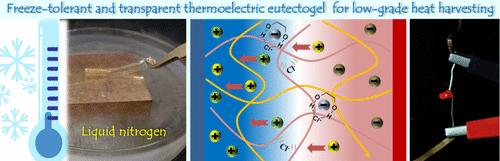
Ionic hydrogels and ionogels have been widely utilized as ionic thermoelectric (iTE) materials for converting low-grade heat to usable electricity. However, developing iTE gels that possess environmental tolerance, long-lasting usability, and biofriendliness remains challenging. Herein, we present a highly transparent polymer eutectogel comprising a green eutectic solvent (ES) along with a lithium salt. This eutectogel exhibits a high ionic conductivity of 20.2 mS cm–1 and an ionic Seebeck coefficient of 9.7 mV K–1. Thanks to the excellent freeze-resistant property of ES, the ionic conductivity can still reach 7.6 mS cm–1 even at −20 °C. Additionally, the interaction between the polymer network and ES prevents crystallization within as-prepared eutectogel, instead resulting in a glass transition at −114 °C, slightly lower than a glass transition temperature of ES at −113 °C. Furthermore, as-prepared eutectogel demonstrates exceptional long-term solvent retention, showing no weight loss when exposed to an ambient environment (∼23 °C, ∼60% RH) for 7 days and maintaining 90% of its weight after being placed in an oven for 1 day (50 °C, ∼30% RH with strong air circulation). As-prepared eutectogel also shows excellent stability of TE performance over a wide range of relative humidity. The homemade device utilized as-prepared eutectogel shows the potential to directly power some small electronic devices (such as light-emitting diodes and timers) and to recover wasted heat generated by solar panels. Our results provide a foundation for the development of biofriendly TE gel-like materials that exhibit outstanding environmental tolerance and long-lasting usability.
离子水凝胶和离子凝胶已被广泛用作离子热电(iTE)材料,用于将低品位热量转化为可用电力。然而,开发具有环境耐受性、长期可用性和生物友好性的离子热电凝胶仍然具有挑战性。在本文中,我们介绍了一种由绿色共晶溶剂(ES)和锂盐组成的高透明度聚合物共晶凝胶。这种共晶凝胶具有 20.2 mS cm-1 的高离子电导率和 9.7 mV K-1 的离子塞贝克系数。由于 ES 具有出色的抗冻性能,即使在零下 20 °C,离子电导率仍可达到 7.6 mS cm-1。此外,聚合物网络与 ES 之间的相互作用阻止了所制备的共晶凝胶内部的结晶,从而使其在 -114 °C 时发生玻璃化转变,略低于 ES 在 -113 °C 时的玻璃化转变温度。此外,照样制备的共晶凝胶还具有优异的长期溶剂保持性,在环境温度(23 °C,60% RH)下暴露 7 天后,其重量没有减少,而在烘箱中放置 1 天后(50 °C,30% RH,空气流通性强),其重量仍能保持 90%。制备的共晶凝胶在较大的相对湿度范围内也显示出极佳的 TE 性能稳定性。利用制备的共晶凝胶自制的装置具有直接为一些小型电子设备(如发光二极管和定时器)供电和回收太阳能电池板产生的废热的潜力。我们的研究成果为开发具有出色环境耐受性和持久可用性的生物友好型 TE 凝胶状材料奠定了基础。
期刊介绍:
ACS Applied Polymer Materials is an interdisciplinary journal publishing original research covering all aspects of engineering, chemistry, physics, and biology relevant to applications of polymers.
The journal is devoted to reports of new and original experimental and theoretical research of an applied nature that integrates fundamental knowledge in the areas of materials, engineering, physics, bioscience, polymer science and chemistry into important polymer applications. The journal is specifically interested in work that addresses relationships among structure, processing, morphology, chemistry, properties, and function as well as work that provide insights into mechanisms critical to the performance of the polymer for applications.



 京公网安备 11010802042870号
京ICP备2023020795号-1
京公网安备 11010802042870号
京ICP备2023020795号-1

 分享
分享
 求助内容:
求助内容: 应助结果提醒方式:
 扫码关注我们
