{"title":"Ultrathin and Breathable Silk-Protein Electronic Tattoos for Iontophoretic Transdermal Drug Delivery","authors":"Shalik Ram Joshi, Hyunji Lee, Soohoon Lee, Juwan Choi and Sunghwan Kim*, ","doi":"10.1021/acsapm.5c00164","DOIUrl":null,"url":null,"abstract":"<p >Transdermal drug delivery (TDD) is emerging as a favorable alternative to traditional oral and injectable drug administration routes, offering a noninvasive, pain-free option with controlled and sustainable drug delivery. However, developing a TDD patch that delivers drugs with a high efficiency while being skin-friendly is still challenging. Here, we report an ultrathin and breathable iontophoretic patch for TDD application. The ultrathin dye-loaded electronic tattoo (UDET) consists of silk nanofibers (SNFs) and graphene. Cationic rhodamine B (RB) and methylene blue (MB) model drugs are incorporated in SNFs. The UDETs can be seamlessly affixed to nonuniform and pliable pigskin. The performance of the iontophoretic system can be fine-tuned by adjusting the applied voltage and duration of the iontophoresis process. The UDET delivers the RB and MB model drugs into pigskin up to a depth of >800 μm under a bias voltage of 20 V within 2 h. Additionally, to evaluate the potential for real-world applications, the diffusion of Dextran molecules of varying molecular weights was examined. The penetration depth of low molecular weight Dextran (Dex-10,000) was significantly higher than that of high molecular weight Dextran (Dex-70,000), demonstrating the influence of molecular size on diffusion efficiency. Our results show the UDET patch’s controllable and efficient delivery capability as well as underscore the potential of UDETs in augmenting TDD through controlled electric fields. This feature would be pivotal for the delivery of therapeutics in scenarios where conventional methods may be inadequate.</p>","PeriodicalId":7,"journal":{"name":"ACS Applied Polymer Materials","volume":"7 7","pages":"4457–4467 4457–4467"},"PeriodicalIF":4.7000,"publicationDate":"2025-03-24","publicationTypes":"Journal Article","fieldsOfStudy":null,"isOpenAccess":false,"openAccessPdf":"","citationCount":"0","resultStr":null,"platform":"Semanticscholar","paperid":null,"PeriodicalName":"ACS Applied Polymer Materials","FirstCategoryId":"92","ListUrlMain":"https://pubs.acs.org/doi/10.1021/acsapm.5c00164","RegionNum":2,"RegionCategory":"化学","ArticlePicture":[],"TitleCN":null,"AbstractTextCN":null,"PMCID":null,"EPubDate":"","PubModel":"","JCR":"Q2","JCRName":"MATERIALS SCIENCE, MULTIDISCIPLINARY","Score":null,"Total":0}
引用次数: 0
Abstract
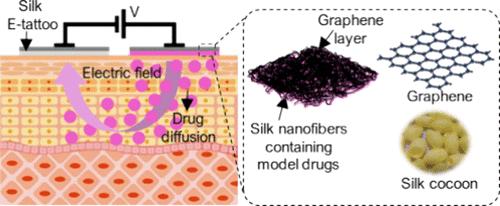
Transdermal drug delivery (TDD) is emerging as a favorable alternative to traditional oral and injectable drug administration routes, offering a noninvasive, pain-free option with controlled and sustainable drug delivery. However, developing a TDD patch that delivers drugs with a high efficiency while being skin-friendly is still challenging. Here, we report an ultrathin and breathable iontophoretic patch for TDD application. The ultrathin dye-loaded electronic tattoo (UDET) consists of silk nanofibers (SNFs) and graphene. Cationic rhodamine B (RB) and methylene blue (MB) model drugs are incorporated in SNFs. The UDETs can be seamlessly affixed to nonuniform and pliable pigskin. The performance of the iontophoretic system can be fine-tuned by adjusting the applied voltage and duration of the iontophoresis process. The UDET delivers the RB and MB model drugs into pigskin up to a depth of >800 μm under a bias voltage of 20 V within 2 h. Additionally, to evaluate the potential for real-world applications, the diffusion of Dextran molecules of varying molecular weights was examined. The penetration depth of low molecular weight Dextran (Dex-10,000) was significantly higher than that of high molecular weight Dextran (Dex-70,000), demonstrating the influence of molecular size on diffusion efficiency. Our results show the UDET patch’s controllable and efficient delivery capability as well as underscore the potential of UDETs in augmenting TDD through controlled electric fields. This feature would be pivotal for the delivery of therapeutics in scenarios where conventional methods may be inadequate.
期刊介绍:
ACS Applied Polymer Materials is an interdisciplinary journal publishing original research covering all aspects of engineering, chemistry, physics, and biology relevant to applications of polymers.
The journal is devoted to reports of new and original experimental and theoretical research of an applied nature that integrates fundamental knowledge in the areas of materials, engineering, physics, bioscience, polymer science and chemistry into important polymer applications. The journal is specifically interested in work that addresses relationships among structure, processing, morphology, chemistry, properties, and function as well as work that provide insights into mechanisms critical to the performance of the polymer for applications.



 京公网安备 11010802042870号
京ICP备2023020795号-1
京公网安备 11010802042870号
京ICP备2023020795号-1

 分享
分享
 求助内容:
求助内容: 应助结果提醒方式:
 扫码关注我们
