Xun Ouyang, Bei Huo, Shirun Peng, Minjun Xu, Dongmei Deng*, Yuanyuan Li* and Liqiang Luo*,
{"title":"Heterojunction CuS@Cu2MoS4 Nanocubes for Nonenzymatic Electrochemical Glucose Sensing","authors":"Xun Ouyang, Bei Huo, Shirun Peng, Minjun Xu, Dongmei Deng*, Yuanyuan Li* and Liqiang Luo*, ","doi":"10.1021/acsanm.5c00378","DOIUrl":null,"url":null,"abstract":"<p >Transition-metal sulfides exhibit significant potential as catalysts in the fields of photocatalysis, sensors, and supercapacitors. In this work, heterojunction CuS@Cu<sub>2</sub>MoS<sub>4</sub> nanocubes were synthesized through the strategy of template-assisted and hydrothermal approaches for nonenzymatic electrochemical glucose sensing. First, Cu<sub>2</sub>O nanocubes (NCs) were synthesized as the template, followed by surface sulfidation to form core–shell Cu<sub>2</sub>O@CuS NCs. Afterward, the Cu<sub>2</sub>O core was selectively etched, followed by one-step hydrothermal growth of Cu<sub>2</sub>MoS<sub>4</sub> on the CuS surface. In this way, heterojunction hollow core–shell CuS@Cu<sub>2</sub>MoS<sub>4</sub> NCs were synthesized. The hollow structure can enhance mass transport and provide additional active reaction sites, while the heterostructure between CuS and Cu<sub>2</sub>MoS<sub>4</sub> can amplify their synergistic effects, thereby improving conductivity and electrocatalytic activity. For analytical applications, the synthesized CuS@Cu<sub>2</sub>MoS<sub>4</sub> NCs exhibit extraordinary electrocatalytic activity toward glucose oxidation. Under optimized conditions, the CuS@Cu<sub>2</sub>MoS<sub>4</sub> NC-modified glassy carbon electrode demonstrates a broad linear response range from 0.002 to 23 mM for glucose determination, with a detection limit of 3.1 μM. In addition, real sample analysis reveals a recovery of 97.06–103.86%, indicating its promise for quantitative analysis in practical applications.</p>","PeriodicalId":6,"journal":{"name":"ACS Applied Nano Materials","volume":"8 14","pages":"7132–7139 7132–7139"},"PeriodicalIF":5.5000,"publicationDate":"2025-03-27","publicationTypes":"Journal Article","fieldsOfStudy":null,"isOpenAccess":false,"openAccessPdf":"","citationCount":"0","resultStr":null,"platform":"Semanticscholar","paperid":null,"PeriodicalName":"ACS Applied Nano Materials","FirstCategoryId":"88","ListUrlMain":"https://pubs.acs.org/doi/10.1021/acsanm.5c00378","RegionNum":2,"RegionCategory":"材料科学","ArticlePicture":[],"TitleCN":null,"AbstractTextCN":null,"PMCID":null,"EPubDate":"","PubModel":"","JCR":"Q2","JCRName":"MATERIALS SCIENCE, MULTIDISCIPLINARY","Score":null,"Total":0}
引用次数: 0
Abstract
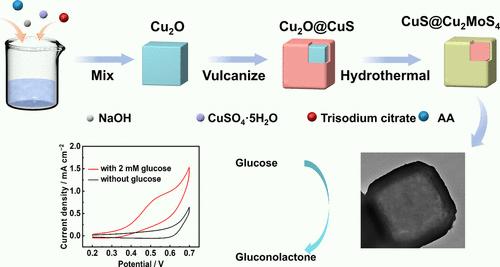
Transition-metal sulfides exhibit significant potential as catalysts in the fields of photocatalysis, sensors, and supercapacitors. In this work, heterojunction CuS@Cu2MoS4 nanocubes were synthesized through the strategy of template-assisted and hydrothermal approaches for nonenzymatic electrochemical glucose sensing. First, Cu2O nanocubes (NCs) were synthesized as the template, followed by surface sulfidation to form core–shell Cu2O@CuS NCs. Afterward, the Cu2O core was selectively etched, followed by one-step hydrothermal growth of Cu2MoS4 on the CuS surface. In this way, heterojunction hollow core–shell CuS@Cu2MoS4 NCs were synthesized. The hollow structure can enhance mass transport and provide additional active reaction sites, while the heterostructure between CuS and Cu2MoS4 can amplify their synergistic effects, thereby improving conductivity and electrocatalytic activity. For analytical applications, the synthesized CuS@Cu2MoS4 NCs exhibit extraordinary electrocatalytic activity toward glucose oxidation. Under optimized conditions, the CuS@Cu2MoS4 NC-modified glassy carbon electrode demonstrates a broad linear response range from 0.002 to 23 mM for glucose determination, with a detection limit of 3.1 μM. In addition, real sample analysis reveals a recovery of 97.06–103.86%, indicating its promise for quantitative analysis in practical applications.
期刊介绍:
ACS Applied Nano Materials is an interdisciplinary journal publishing original research covering all aspects of engineering, chemistry, physics and biology relevant to applications of nanomaterials. The journal is devoted to reports of new and original experimental and theoretical research of an applied nature that integrate knowledge in the areas of materials, engineering, physics, bioscience, and chemistry into important applications of nanomaterials.




 京公网安备 11010802042870号
京ICP备2023020795号-1
京公网安备 11010802042870号
京ICP备2023020795号-1

 分享
分享
 求助内容:
求助内容: 应助结果提醒方式:
 扫码关注我们
