Lightweight Polyimide Nanocomposites with 3D Cocarbonized MXene/Carbon Fiber Networks for Electromagnetic Interference Shielding and High-Temperature Stability
Nan Wang, Xiong Li, Wenjing Cao, Xiaohui Yang, Xinquan Zou, Yating Fang, Xue Shen, Qiong Li, Na Song, Tongle Xu* and Peng Ding*,
{"title":"Lightweight Polyimide Nanocomposites with 3D Cocarbonized MXene/Carbon Fiber Networks for Electromagnetic Interference Shielding and High-Temperature Stability","authors":"Nan Wang, Xiong Li, Wenjing Cao, Xiaohui Yang, Xinquan Zou, Yating Fang, Xue Shen, Qiong Li, Na Song, Tongle Xu* and Peng Ding*, ","doi":"10.1021/acsanm.5c00922","DOIUrl":null,"url":null,"abstract":"<p >The growing deployment of 5G communication systems has sharply escalated the demand for high-performance electromagnetic interference (EMI) shielding materials with outstanding thermal stability and efficiency. Carbon fiber (CF), recognized for its cost-effectiveness and environmental sustainability, has shown significant promise in the development of EMI shielding composites. Nevertheless, achieving a balance of lightweight structure, superior shielding efficiency, and thermal endurance remains a formidable challenge. In this study, a streamlined fabrication process was utilized to develop a multifunctional, lightweight nanocomposite. MXene was synthesized via in situ etching of the MAX phase with hydrofluoric (HF) acid, followed by the construction of a three-dimensional (3D) cocarbonized network comprising interconnected CF, MXene, and MXene-derived phases (CMXene) via a straightforward cocarbonization process. The polyimide (PI) matrix was uniformly infused into the porous framework using a precisely controlled impregnation technique, resulting in a PI-based nanocomposite with exceptional EMI shielding performance. At a filler content of 14.3 wt % and a thickness of 1.7 mm, the nanocomposite demonstrated an EMI shielding effectiveness (EMI SE) of 73.8 dB in the X-band ranging from 8.2 to 12.4 GHz, maintaining 63.3 dB even at high temperatures of 400 °C, reflecting an 85.8% retention rate. This ultralight nanocomposite, characterized by excellent EMI shielding efficiency and robust thermal stability, offers significant potential for advanced applications in electronic devices, such as battery management systems in energy vehicles and in-vehicle communication modules, to ensure system stability and prevent EMI-induced signal disruption.</p>","PeriodicalId":6,"journal":{"name":"ACS Applied Nano Materials","volume":"8 14","pages":"7347–7359 7347–7359"},"PeriodicalIF":5.5000,"publicationDate":"2025-03-28","publicationTypes":"Journal Article","fieldsOfStudy":null,"isOpenAccess":false,"openAccessPdf":"","citationCount":"0","resultStr":null,"platform":"Semanticscholar","paperid":null,"PeriodicalName":"ACS Applied Nano Materials","FirstCategoryId":"88","ListUrlMain":"https://pubs.acs.org/doi/10.1021/acsanm.5c00922","RegionNum":2,"RegionCategory":"材料科学","ArticlePicture":[],"TitleCN":null,"AbstractTextCN":null,"PMCID":null,"EPubDate":"","PubModel":"","JCR":"Q2","JCRName":"MATERIALS SCIENCE, MULTIDISCIPLINARY","Score":null,"Total":0}
引用次数: 0
Abstract
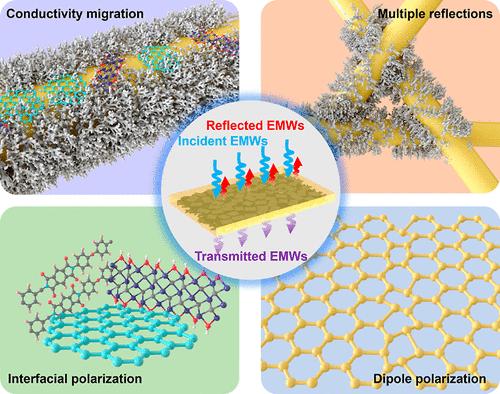
The growing deployment of 5G communication systems has sharply escalated the demand for high-performance electromagnetic interference (EMI) shielding materials with outstanding thermal stability and efficiency. Carbon fiber (CF), recognized for its cost-effectiveness and environmental sustainability, has shown significant promise in the development of EMI shielding composites. Nevertheless, achieving a balance of lightweight structure, superior shielding efficiency, and thermal endurance remains a formidable challenge. In this study, a streamlined fabrication process was utilized to develop a multifunctional, lightweight nanocomposite. MXene was synthesized via in situ etching of the MAX phase with hydrofluoric (HF) acid, followed by the construction of a three-dimensional (3D) cocarbonized network comprising interconnected CF, MXene, and MXene-derived phases (CMXene) via a straightforward cocarbonization process. The polyimide (PI) matrix was uniformly infused into the porous framework using a precisely controlled impregnation technique, resulting in a PI-based nanocomposite with exceptional EMI shielding performance. At a filler content of 14.3 wt % and a thickness of 1.7 mm, the nanocomposite demonstrated an EMI shielding effectiveness (EMI SE) of 73.8 dB in the X-band ranging from 8.2 to 12.4 GHz, maintaining 63.3 dB even at high temperatures of 400 °C, reflecting an 85.8% retention rate. This ultralight nanocomposite, characterized by excellent EMI shielding efficiency and robust thermal stability, offers significant potential for advanced applications in electronic devices, such as battery management systems in energy vehicles and in-vehicle communication modules, to ensure system stability and prevent EMI-induced signal disruption.
期刊介绍:
ACS Applied Nano Materials is an interdisciplinary journal publishing original research covering all aspects of engineering, chemistry, physics and biology relevant to applications of nanomaterials. The journal is devoted to reports of new and original experimental and theoretical research of an applied nature that integrate knowledge in the areas of materials, engineering, physics, bioscience, and chemistry into important applications of nanomaterials.



 京公网安备 11010802042870号
京ICP备2023020795号-1
京公网安备 11010802042870号
京ICP备2023020795号-1

 分享
分享
 求助内容:
求助内容: 应助结果提醒方式:
 扫码关注我们
