{"title":"Strategic alliances and corporate financialization","authors":"Xin Zhao , Meiju Feng , Jinmei Sun","doi":"10.1016/j.irfa.2025.104214","DOIUrl":null,"url":null,"abstract":"<div><div>Strategic alliances have restructured the business strategies of enterprises, and as a result, the way resources are allocated. This study analyses a sample of Chinese A-share listed companies from 2009 to 2021 from the perspective of corporate financial asset allocation, and adds strategic alliances in the research framework of corporate financialization. The results show that strategic alliances significantly inhibit the financialization of physical enterprises. The mechanism testing demonstrates that easing financing constraints, enhancing the competitive advantage of the main business, and alleviating agency problems are important channels by which strategic alliances to suppress corporate financialization. Additionally, the equity cooperation model and bilateral-contract-type strategic alliances significantly increase the inhibitory effect of strategic alliances on corporate financialization. For both speculative financial assets and value-preserving financial assets, strategic alliances can have a significant inhibitory effect. Strategic alliances can weaken the adverse effects of corporate financialization on capital investment and R&D investment. This study reveals the impact, mechanism, and economic consequences of strategic alliances on the financialization of physical enterprises, providing inspiration and reference for restraining the financialization of physical enterprises and achieving high-quality economic development in China.</div></div>","PeriodicalId":48226,"journal":{"name":"International Review of Financial Analysis","volume":"103 ","pages":"Article 104214"},"PeriodicalIF":9.8000,"publicationDate":"2025-07-01","publicationTypes":"Journal Article","fieldsOfStudy":null,"isOpenAccess":false,"openAccessPdf":"","citationCount":"0","resultStr":null,"platform":"Semanticscholar","paperid":null,"PeriodicalName":"International Review of Financial Analysis","FirstCategoryId":"96","ListUrlMain":"https://www.sciencedirect.com/science/article/pii/S1057521925003011","RegionNum":1,"RegionCategory":"经济学","ArticlePicture":[],"TitleCN":null,"AbstractTextCN":null,"PMCID":null,"EPubDate":"2025/3/30 0:00:00","PubModel":"Epub","JCR":"Q1","JCRName":"BUSINESS, FINANCE","Score":null,"Total":0}
引用次数: 0
Abstract
Strategic alliances have restructured the business strategies of enterprises, and as a result, the way resources are allocated. This study analyses a sample of Chinese A-share listed companies from 2009 to 2021 from the perspective of corporate financial asset allocation, and adds strategic alliances in the research framework of corporate financialization. The results show that strategic alliances significantly inhibit the financialization of physical enterprises. The mechanism testing demonstrates that easing financing constraints, enhancing the competitive advantage of the main business, and alleviating agency problems are important channels by which strategic alliances to suppress corporate financialization. Additionally, the equity cooperation model and bilateral-contract-type strategic alliances significantly increase the inhibitory effect of strategic alliances on corporate financialization. For both speculative financial assets and value-preserving financial assets, strategic alliances can have a significant inhibitory effect. Strategic alliances can weaken the adverse effects of corporate financialization on capital investment and R&D investment. This study reveals the impact, mechanism, and economic consequences of strategic alliances on the financialization of physical enterprises, providing inspiration and reference for restraining the financialization of physical enterprises and achieving high-quality economic development in China.
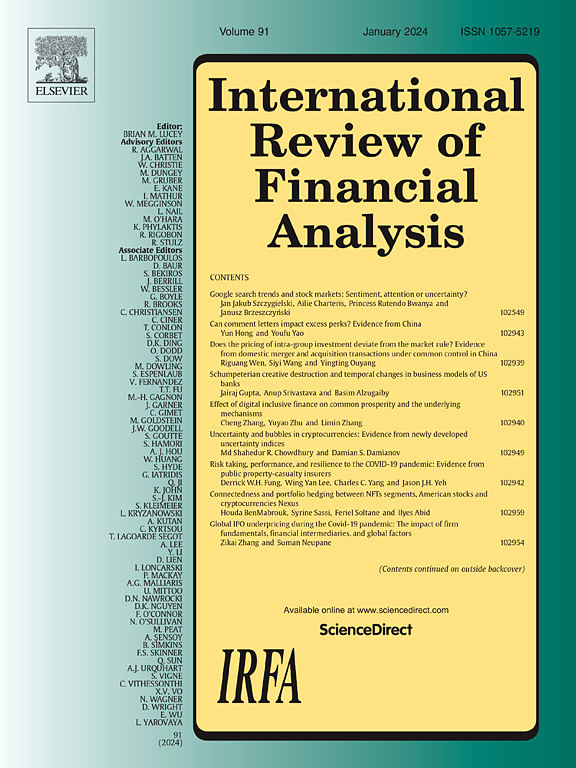
期刊介绍:
The International Review of Financial Analysis (IRFA) is an impartial refereed journal designed to serve as a platform for high-quality financial research. It welcomes a diverse range of financial research topics and maintains an unbiased selection process. While not limited to U.S.-centric subjects, IRFA, as its title suggests, is open to valuable research contributions from around the world.



 京公网安备 11010802042870号
京ICP备2023020795号-1
京公网安备 11010802042870号
京ICP备2023020795号-1

 分享
分享
 求助内容:
求助内容: 应助结果提醒方式:
 扫码关注我们
