Rosa Donadio , Ermenegilda Vitale , Giulia Costanzo , Luca Licciardi , Erika Fabbrizzi , Simonetta Fraschetti , Carmen Arena
{"title":"Assessing the resilience of the coralline macroalga Ellisolandia elongata in response to a prolonged low tide","authors":"Rosa Donadio , Ermenegilda Vitale , Giulia Costanzo , Luca Licciardi , Erika Fabbrizzi , Simonetta Fraschetti , Carmen Arena","doi":"10.1016/j.envres.2025.121579","DOIUrl":null,"url":null,"abstract":"<div><div><em>Ellisolandia elongata</em>, thriving in the low rocky shore intertidal zone, is an excellent model for investigating how coralline species handle multiple stressors. This study explores the adaptive mechanisms of an <em>E. elongata</em> population subjected to an unusual low tide event lasting about eleven days. We analyze structural and functional traits in submerged (<em>S</em>), exposed (<em>E</em>), and re-submerged (<em>R</em>) thalli after a prolonged low tide to identify the resilience strategy of this species. The extended low tide resulted in bleaching in 74 % of the local exposed population. Compared to <em>S</em> and <em>R</em> thalli, photosynthetic efficiency (quantum yield of PSII electron transport and maximum PSII photochemical efficiency) decreased in the <em>E</em> thalli, as well as the PSII-D1 protein and the photosynthetic pigment content. Conversely no difference in non-photochemical quenching was observed. The <em>E</em> thalli also exhibited lower concentrations of carbohydrates and antioxidant compounds (polyphenols, flavonoids, tannins, and overall antioxidant activity), suggesting the occurrence of oxidative stress that likely required the consumption of antioxidants for free radical scavenging. In the <em>R</em> thalli, photosynthetic activity, antioxidant levels, and pigment content recovered, indicating that <em>E. elongata</em> maintains its physiological integrity and photosystem functionality during desiccation by down-regulation of PSII photochemical efficiency and reduction of D1 protein and pigment synthesis. To face multiple stressors, antioxidant compounds are activated, enabling photosynthesis recovery after disturbance. Our results highlight the species' adaptability to tidal excursions and can help predict future changes in its distribution patterns, particularly under global warming scenarios.</div></div>","PeriodicalId":312,"journal":{"name":"Environmental Research","volume":"277 ","pages":"Article 121579"},"PeriodicalIF":7.7000,"publicationDate":"2025-07-15","publicationTypes":"Journal Article","fieldsOfStudy":null,"isOpenAccess":false,"openAccessPdf":"","citationCount":"0","resultStr":null,"platform":"Semanticscholar","paperid":null,"PeriodicalName":"Environmental Research","FirstCategoryId":"93","ListUrlMain":"https://www.sciencedirect.com/science/article/pii/S0013935125008308","RegionNum":2,"RegionCategory":"环境科学与生态学","ArticlePicture":[],"TitleCN":null,"AbstractTextCN":null,"PMCID":null,"EPubDate":"2025/4/9 0:00:00","PubModel":"Epub","JCR":"Q1","JCRName":"ENVIRONMENTAL SCIENCES","Score":null,"Total":0}
引用次数: 0
Abstract
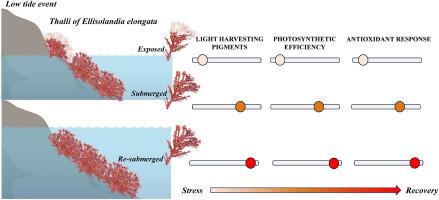
Ellisolandia elongata, thriving in the low rocky shore intertidal zone, is an excellent model for investigating how coralline species handle multiple stressors. This study explores the adaptive mechanisms of an E. elongata population subjected to an unusual low tide event lasting about eleven days. We analyze structural and functional traits in submerged (S), exposed (E), and re-submerged (R) thalli after a prolonged low tide to identify the resilience strategy of this species. The extended low tide resulted in bleaching in 74 % of the local exposed population. Compared to S and R thalli, photosynthetic efficiency (quantum yield of PSII electron transport and maximum PSII photochemical efficiency) decreased in the E thalli, as well as the PSII-D1 protein and the photosynthetic pigment content. Conversely no difference in non-photochemical quenching was observed. The E thalli also exhibited lower concentrations of carbohydrates and antioxidant compounds (polyphenols, flavonoids, tannins, and overall antioxidant activity), suggesting the occurrence of oxidative stress that likely required the consumption of antioxidants for free radical scavenging. In the R thalli, photosynthetic activity, antioxidant levels, and pigment content recovered, indicating that E. elongata maintains its physiological integrity and photosystem functionality during desiccation by down-regulation of PSII photochemical efficiency and reduction of D1 protein and pigment synthesis. To face multiple stressors, antioxidant compounds are activated, enabling photosynthesis recovery after disturbance. Our results highlight the species' adaptability to tidal excursions and can help predict future changes in its distribution patterns, particularly under global warming scenarios.
期刊介绍:
The Environmental Research journal presents a broad range of interdisciplinary research, focused on addressing worldwide environmental concerns and featuring innovative findings. Our publication strives to explore relevant anthropogenic issues across various environmental sectors, showcasing practical applications in real-life settings.



 京公网安备 11010802042870号
京ICP备2023020795号-1
京公网安备 11010802042870号
京ICP备2023020795号-1

 分享
分享
 求助内容:
求助内容: 应助结果提醒方式:
 扫码关注我们
