Minghui Chen , Lei An , Linxiu Zhang , Xiaozhou Xie , Kaiwei Wang , Tianqi Niu , Tianjun Ni , Qian Zhao , Dong Liu
{"title":"Ultra-thin Nb2O5 nanosheets construct 3D cross-linked architecture: Unraveling new coccine degradation pathways and toxicity changes","authors":"Minghui Chen , Lei An , Linxiu Zhang , Xiaozhou Xie , Kaiwei Wang , Tianqi Niu , Tianjun Ni , Qian Zhao , Dong Liu","doi":"10.1016/j.envres.2025.121571","DOIUrl":null,"url":null,"abstract":"<div><div>Photocatalytic technology offers a promising approach to address environmental and health challenges posed by the food colorant new coccine (NC). Nb<sub>2</sub>O<sub>5</sub> is a notable candidate due to its stability and environmental compatibility, but faces limitations such as limited active sites and rapid charge carrier recombination. In the present study, we report a novel Nb<sub>2</sub>O<sub>5</sub> catalyst featuring a three-dimensional (3D) cross-linked architecture constructed from ultra-thin nanosheets, with a catalyst thickness of less than 2 nm. This innovative structure offers an eminent superficial surface area combined with a substantial abundance of active sites, making it an efficient photocatalyst for the degradation of NC. The Nb<sub>2</sub>O<sub>5</sub> 3D catalyst demonstrated a remarkable degradation rate of 90.1 % for NC within just 30 min, accompanied by a rate constant of 73.5 × 10<sup>−3</sup> min<sup>−1</sup>. This performance significantly surpasses that of three alternative Nb<sub>2</sub>O<sub>5</sub> catalysts with varying morphologies (nanorods, nanoparticles, and nanospheres), which show rate constants more than seven times lower. Furthermore, we explore the degradation pathways associated with NC and provide a thorough examination of the toxicity changes occurring in its by-products. This work presents a promising framework for the development of advanced catalysts capable of effectively degrading NC, thereby contributing to the advancement of environmentally sustainable practices in the management of food colorants.</div></div>","PeriodicalId":312,"journal":{"name":"Environmental Research","volume":"277 ","pages":"Article 121571"},"PeriodicalIF":7.7000,"publicationDate":"2025-07-15","publicationTypes":"Journal Article","fieldsOfStudy":null,"isOpenAccess":false,"openAccessPdf":"","citationCount":"0","resultStr":null,"platform":"Semanticscholar","paperid":null,"PeriodicalName":"Environmental Research","FirstCategoryId":"93","ListUrlMain":"https://www.sciencedirect.com/science/article/pii/S0013935125008229","RegionNum":2,"RegionCategory":"环境科学与生态学","ArticlePicture":[],"TitleCN":null,"AbstractTextCN":null,"PMCID":null,"EPubDate":"2025/4/8 0:00:00","PubModel":"Epub","JCR":"Q1","JCRName":"ENVIRONMENTAL SCIENCES","Score":null,"Total":0}
引用次数: 0
Abstract
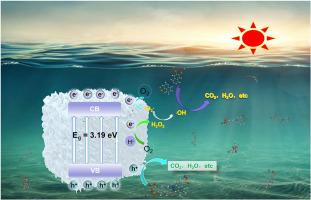
Photocatalytic technology offers a promising approach to address environmental and health challenges posed by the food colorant new coccine (NC). Nb2O5 is a notable candidate due to its stability and environmental compatibility, but faces limitations such as limited active sites and rapid charge carrier recombination. In the present study, we report a novel Nb2O5 catalyst featuring a three-dimensional (3D) cross-linked architecture constructed from ultra-thin nanosheets, with a catalyst thickness of less than 2 nm. This innovative structure offers an eminent superficial surface area combined with a substantial abundance of active sites, making it an efficient photocatalyst for the degradation of NC. The Nb2O5 3D catalyst demonstrated a remarkable degradation rate of 90.1 % for NC within just 30 min, accompanied by a rate constant of 73.5 × 10⁻³ min−1. This performance significantly surpasses that of three alternative Nb2O5 catalysts with varying morphologies (nanorods, nanoparticles, and nanospheres), which show rate constants more than seven times lower. Furthermore, we explore the degradation pathways associated with NC and provide a thorough examination of the toxicity changes occurring in its by-products. This work presents a promising framework for the development of advanced catalysts capable of effectively degrading NC, thereby contributing to the advancement of environmentally sustainable practices in the management of food colorants.
期刊介绍:
The Environmental Research journal presents a broad range of interdisciplinary research, focused on addressing worldwide environmental concerns and featuring innovative findings. Our publication strives to explore relevant anthropogenic issues across various environmental sectors, showcasing practical applications in real-life settings.



 京公网安备 11010802042870号
京ICP备2023020795号-1
京公网安备 11010802042870号
京ICP备2023020795号-1

 分享
分享
 求助内容:
求助内容: 应助结果提醒方式:
 扫码关注我们
