{"title":"Structural elucidation of the main coloured compounds of Justicia spicigera based on experimental and computational electronic features","authors":"Lucie Arberet , Lea-Maria Ibele , Alain Blond , Anne Michelin , Witold Nowik , Alain Tchapla , Federica Agostini , Christine Andraud , Sylvie Héron","doi":"10.1016/j.molstruc.2025.142281","DOIUrl":null,"url":null,"abstract":"<div><div>In continued efforts to characterise the dye extracted from <em>Justicia spicigera</em> leaves, the two main coloured compounds were isolated. In this study, a multi-analytical techniques characterisation of their structures was carried out by HRMS, NMR, vibrational (IR and Raman) and electronic (UV–Vis absorption and fluorescence) spectroscopies, completed by computational studies. Two unreported compounds from the phenoxazone (aka phenoxazine-3-one) family were identified, the 2-amino-7‑hydroxy-8‑methoxy-3H-phenoxazin-3-one, a positional isomer of the already described perisbivalvin B and the 2-N-(4‑hydroxy-γ-glutamyl)-7‑hydroxy-8‑methoxy-3H-phenoxazin-3-one. The simulated UV–Vis absorption and fluorescence spectra of the suggested structures showed good agreement with the experimental ones, supporting the structural elucidation and giving more insights into the chemistry of these compounds.</div></div>","PeriodicalId":16414,"journal":{"name":"Journal of Molecular Structure","volume":"1338 ","pages":"Article 142281"},"PeriodicalIF":4.9000,"publicationDate":"2025-08-25","publicationTypes":"Journal Article","fieldsOfStudy":null,"isOpenAccess":false,"openAccessPdf":"","citationCount":"0","resultStr":null,"platform":"Semanticscholar","paperid":null,"PeriodicalName":"Journal of Molecular Structure","FirstCategoryId":"92","ListUrlMain":"https://www.sciencedirect.com/science/article/pii/S0022286025009639","RegionNum":2,"RegionCategory":"化学","ArticlePicture":[],"TitleCN":null,"AbstractTextCN":null,"PMCID":null,"EPubDate":"2025/4/11 0:00:00","PubModel":"Epub","JCR":"Q2","JCRName":"CHEMISTRY, PHYSICAL","Score":null,"Total":0}
引用次数: 0
Abstract
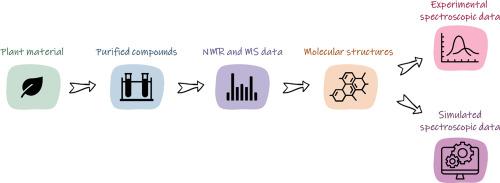
In continued efforts to characterise the dye extracted from Justicia spicigera leaves, the two main coloured compounds were isolated. In this study, a multi-analytical techniques characterisation of their structures was carried out by HRMS, NMR, vibrational (IR and Raman) and electronic (UV–Vis absorption and fluorescence) spectroscopies, completed by computational studies. Two unreported compounds from the phenoxazone (aka phenoxazine-3-one) family were identified, the 2-amino-7‑hydroxy-8‑methoxy-3H-phenoxazin-3-one, a positional isomer of the already described perisbivalvin B and the 2-N-(4‑hydroxy-γ-glutamyl)-7‑hydroxy-8‑methoxy-3H-phenoxazin-3-one. The simulated UV–Vis absorption and fluorescence spectra of the suggested structures showed good agreement with the experimental ones, supporting the structural elucidation and giving more insights into the chemistry of these compounds.
期刊介绍:
The Journal of Molecular Structure is dedicated to the publication of full-length articles and review papers, providing important new structural information on all types of chemical species including:
• Stable and unstable molecules in all types of environments (vapour, molecular beam, liquid, solution, liquid crystal, solid state, matrix-isolated, surface-absorbed etc.)
• Chemical intermediates
• Molecules in excited states
• Biological molecules
• Polymers.
The methods used may include any combination of spectroscopic and non-spectroscopic techniques, for example:
• Infrared spectroscopy (mid, far, near)
• Raman spectroscopy and non-linear Raman methods (CARS, etc.)
• Electronic absorption spectroscopy
• Optical rotatory dispersion and circular dichroism
• Fluorescence and phosphorescence techniques
• Electron spectroscopies (PES, XPS), EXAFS, etc.
• Microwave spectroscopy
• Electron diffraction
• NMR and ESR spectroscopies
• Mössbauer spectroscopy
• X-ray crystallography
• Charge Density Analyses
• Computational Studies (supplementing experimental methods)
We encourage publications combining theoretical and experimental approaches. The structural insights gained by the studies should be correlated with the properties, activity and/ or reactivity of the molecule under investigation and the relevance of this molecule and its implications should be discussed.





 京公网安备 11010802042870号
京ICP备2023020795号-1
京公网安备 11010802042870号
京ICP备2023020795号-1

 分享
分享
 求助内容:
求助内容: 应助结果提醒方式:
 扫码关注我们
