Soybean protein isolate versus sheep whey protein: A detailed comparison of their chemical composition, gastrointestinal digestion and fermentation properties
Haoyan Zhu , Xinwei Tian , Zhengwei Tan , Xingbin Yang , Yan Zhao
{"title":"Soybean protein isolate versus sheep whey protein: A detailed comparison of their chemical composition, gastrointestinal digestion and fermentation properties","authors":"Haoyan Zhu , Xinwei Tian , Zhengwei Tan , Xingbin Yang , Yan Zhao","doi":"10.1016/j.foodchem.2025.144239","DOIUrl":null,"url":null,"abstract":"<div><div>Plant proteins are emerging as alternatives to animal proteins. This study compared the physicochemical properties and nutritional characteristics of soybean protein isolate (SPI) and sheep whey protein (SWP), which is gaining recognition for its nutritional benefits. SWP exhibited higher amino acid content, larger particle size, increased turbidity, and superior foaming and emulsification capacities compared to SPI (<em>p</em> < 0.05). In contrast, SPI demonstrated better emulsification stability. <em>In vitro</em>, gastrointestinal digestion showed that SPI achieved a higher degree of hydrolysis in both gastric and intestinal phases, although SWP had a faster initial hydrolysis rate. During gut microbiota fermentation, SWP produced significantly higher levels of short-chain fatty acids (SCFAs) than SPI (<em>p</em> < 0.05). Non-targeted metabolomics revealed distinct metabolic differences, particularly in amino acid metabolism, bile acid synthesis, and hormone biosynthesis. These findings suggest SWP is suitable for nutritional supplementation, while SPI is better for dairy-based alternatives.</div></div>","PeriodicalId":318,"journal":{"name":"Food Chemistry","volume":"483 ","pages":"Article 144239"},"PeriodicalIF":9.8000,"publicationDate":"2025-08-15","publicationTypes":"Journal Article","fieldsOfStudy":null,"isOpenAccess":false,"openAccessPdf":"","citationCount":"0","resultStr":null,"platform":"Semanticscholar","paperid":null,"PeriodicalName":"Food Chemistry","FirstCategoryId":"97","ListUrlMain":"https://www.sciencedirect.com/science/article/pii/S0308814625014906","RegionNum":1,"RegionCategory":"农林科学","ArticlePicture":[],"TitleCN":null,"AbstractTextCN":null,"PMCID":null,"EPubDate":"2025/4/10 0:00:00","PubModel":"Epub","JCR":"Q1","JCRName":"CHEMISTRY, APPLIED","Score":null,"Total":0}
引用次数: 0
Abstract
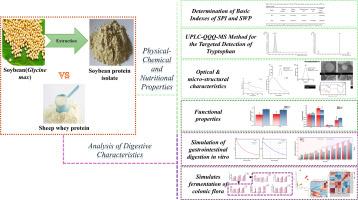
Plant proteins are emerging as alternatives to animal proteins. This study compared the physicochemical properties and nutritional characteristics of soybean protein isolate (SPI) and sheep whey protein (SWP), which is gaining recognition for its nutritional benefits. SWP exhibited higher amino acid content, larger particle size, increased turbidity, and superior foaming and emulsification capacities compared to SPI (p < 0.05). In contrast, SPI demonstrated better emulsification stability. In vitro, gastrointestinal digestion showed that SPI achieved a higher degree of hydrolysis in both gastric and intestinal phases, although SWP had a faster initial hydrolysis rate. During gut microbiota fermentation, SWP produced significantly higher levels of short-chain fatty acids (SCFAs) than SPI (p < 0.05). Non-targeted metabolomics revealed distinct metabolic differences, particularly in amino acid metabolism, bile acid synthesis, and hormone biosynthesis. These findings suggest SWP is suitable for nutritional supplementation, while SPI is better for dairy-based alternatives.
期刊介绍:
Food Chemistry publishes original research papers dealing with the advancement of the chemistry and biochemistry of foods or the analytical methods/ approach used. All papers should focus on the novelty of the research carried out.



 京公网安备 11010802042870号
京ICP备2023020795号-1
京公网安备 11010802042870号
京ICP备2023020795号-1

 分享
分享
 求助内容:
求助内容: 应助结果提醒方式:
 扫码关注我们
