{"title":"Synthesis of cobalt sulfide–NC composite catalyst assisted by polyaniline as nonprecious electrocatalyst for oxygen reduction reaction","authors":"Jae Sang Lee , Won Suk Jung","doi":"10.1016/j.mcat.2025.115107","DOIUrl":null,"url":null,"abstract":"<div><div>The scarce, expensive Pt is the preferred catalyst for the oxygen reduction reaction (ORR) in metal–air batteries or fuel cells. In this study, a composite catalyst consisting of cobalt sulfide and polyaniline (PANI) was utilized for optimal ORR kinetics. Cobalt sulfide catalysts were prepared at different temperatures, the optimal cobalt sulfide catalyst was coated with PANI, and the coated catalyst was annealed to form a core–shell cobalt sulfide@NC composite catalyst. Structural characterization was performed via X-ray diffraction (XRD) and Raman spectroscopy, scanning electron microscopy, and high-resolution transmission electron microscopy (HR-TEM) were conducted to characterize the catalyst morphology. CoS-160 exhibited a flower-like structure; CoS-180, containing Co<sub>9</sub>S<sub>8</sub>, exhibited both flower-like and sheet structures; and CoS-200 exhibited a sheet structure. With an increase in temperature, XRD and Raman spectroscopy verified the formation of Co<sub>9</sub>S<sub>8</sub>, serving as ORR active sites, in CoS-180 and CoS-200. HR-TEM indicated that the Co<sub>9</sub>S<sub>8</sub>-x@NC catalysts had a core–shell structure. Among them, Co<sub>9</sub>S<sub>8</sub>–180@NC had the highest graphitization degree, and total nitrogen, pyridinic N, graphitic N contents, resulting in the highest onset potential, limiting current density and the lowest Tafel slope for ORR in alkaline media among the catalysts. In an accelerated stress test, a performance degradation of less than 1 % was observed, and a chronoamperometry test demonstrated a current retention rate of 95.49 %.</div></div>","PeriodicalId":393,"journal":{"name":"Molecular Catalysis","volume":"580 ","pages":"Article 115107"},"PeriodicalIF":4.9000,"publicationDate":"2025-06-01","publicationTypes":"Journal Article","fieldsOfStudy":null,"isOpenAccess":false,"openAccessPdf":"","citationCount":"0","resultStr":null,"platform":"Semanticscholar","paperid":null,"PeriodicalName":"Molecular Catalysis","FirstCategoryId":"92","ListUrlMain":"https://www.sciencedirect.com/science/article/pii/S2468823125002937","RegionNum":2,"RegionCategory":"化学","ArticlePicture":[],"TitleCN":null,"AbstractTextCN":null,"PMCID":null,"EPubDate":"2025/4/10 0:00:00","PubModel":"Epub","JCR":"Q2","JCRName":"CHEMISTRY, PHYSICAL","Score":null,"Total":0}
引用次数: 0
Abstract
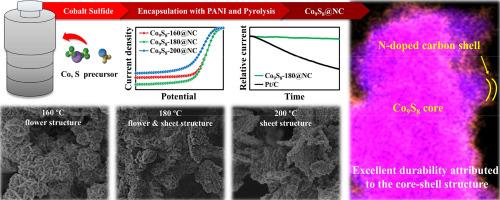
The scarce, expensive Pt is the preferred catalyst for the oxygen reduction reaction (ORR) in metal–air batteries or fuel cells. In this study, a composite catalyst consisting of cobalt sulfide and polyaniline (PANI) was utilized for optimal ORR kinetics. Cobalt sulfide catalysts were prepared at different temperatures, the optimal cobalt sulfide catalyst was coated with PANI, and the coated catalyst was annealed to form a core–shell cobalt sulfide@NC composite catalyst. Structural characterization was performed via X-ray diffraction (XRD) and Raman spectroscopy, scanning electron microscopy, and high-resolution transmission electron microscopy (HR-TEM) were conducted to characterize the catalyst morphology. CoS-160 exhibited a flower-like structure; CoS-180, containing Co9S8, exhibited both flower-like and sheet structures; and CoS-200 exhibited a sheet structure. With an increase in temperature, XRD and Raman spectroscopy verified the formation of Co9S8, serving as ORR active sites, in CoS-180 and CoS-200. HR-TEM indicated that the Co9S8-x@NC catalysts had a core–shell structure. Among them, Co9S8–180@NC had the highest graphitization degree, and total nitrogen, pyridinic N, graphitic N contents, resulting in the highest onset potential, limiting current density and the lowest Tafel slope for ORR in alkaline media among the catalysts. In an accelerated stress test, a performance degradation of less than 1 % was observed, and a chronoamperometry test demonstrated a current retention rate of 95.49 %.
期刊介绍:
Molecular Catalysis publishes full papers that are original, rigorous, and scholarly contributions examining the molecular and atomic aspects of catalytic activation and reaction mechanisms. The fields covered are:
Heterogeneous catalysis including immobilized molecular catalysts
Homogeneous catalysis including organocatalysis, organometallic catalysis and biocatalysis
Photo- and electrochemistry
Theoretical aspects of catalysis analyzed by computational methods




 京公网安备 11010802042870号
京ICP备2023020795号-1
京公网安备 11010802042870号
京ICP备2023020795号-1

 分享
分享
 求助内容:
求助内容: 应助结果提醒方式:
 扫码关注我们
