Yunya Guo , Jiexun Zheng , Shuqi Wang , Zilong Wang , Lixia Ling , Riguang Zhang , Heqin Guo , Debao Li , Baojun Wang
{"title":"A green strategy for CO2 cycloaddition: adjusting the charge distribution on MgO leads to mechanism reversal","authors":"Yunya Guo , Jiexun Zheng , Shuqi Wang , Zilong Wang , Lixia Ling , Riguang Zhang , Heqin Guo , Debao Li , Baojun Wang","doi":"10.1016/j.mcat.2025.115105","DOIUrl":null,"url":null,"abstract":"<div><div>The CO<sub>2</sub> cycloaddition with ethylene oxide (EO) to generate ethylene carbonate (EC) is a green method for converting exhaust gas into fine chemicals. However, pure MgO exhibits low EC yield under halogen-free and mild reaction conditions. This study explores EC generation on single-atom catalysts of MgO(100) surfaces loaded with Cu, Ag, Au, Zn, Na, K, Ca, Sr, Ba, Al, Ga and In through density functional theory (DFT) calculation. The results show that the mechanism reversal observed in the reaction pathway for EC generation and the role of CO₂ are attributed to changes in the electrons number obtained by EO and CO₂ co-adsorbed on the MgO(100) surfaces loaded with metals. For EC generation, surfaces loaded with Cu, Ag, Au, and Zn show a synergistic route where EO and CO₂ obtained fewer than 0.50 |e|. However, other surfaces have a stepwise pathway when this number exceeds 0.50. The participation of CO₂'s frontier orbitals in the reaction depends on the electrons obtained from the catalyst. On the Cu, Ag, Au, Zn, Na, and K-MgO(100) surfaces, CO₂ obtains fewer than 0.50 |e| and contributes LUMO orbitals, whereas on other surfaces, it obtains >0.50 |e| and contributes HOMO orbitals. Notably, the Cu-MgO(100) surface exhibits over 98 % EC selectivity at 1 atm and 298 K due to its weak alkalinity. It provides an ideal microenvironment that activates EO and CO<sub>2</sub>, replacing the role of halogens and offering a novel catalyst to significantly boost EC yield under halogen-free and mild reaction conditions.</div></div>","PeriodicalId":393,"journal":{"name":"Molecular Catalysis","volume":"580 ","pages":"Article 115105"},"PeriodicalIF":4.9000,"publicationDate":"2025-06-01","publicationTypes":"Journal Article","fieldsOfStudy":null,"isOpenAccess":false,"openAccessPdf":"","citationCount":"0","resultStr":null,"platform":"Semanticscholar","paperid":null,"PeriodicalName":"Molecular Catalysis","FirstCategoryId":"92","ListUrlMain":"https://www.sciencedirect.com/science/article/pii/S2468823125002913","RegionNum":2,"RegionCategory":"化学","ArticlePicture":[],"TitleCN":null,"AbstractTextCN":null,"PMCID":null,"EPubDate":"2025/4/10 0:00:00","PubModel":"Epub","JCR":"Q2","JCRName":"CHEMISTRY, PHYSICAL","Score":null,"Total":0}
引用次数: 0
Abstract
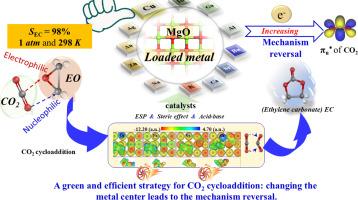
The CO2 cycloaddition with ethylene oxide (EO) to generate ethylene carbonate (EC) is a green method for converting exhaust gas into fine chemicals. However, pure MgO exhibits low EC yield under halogen-free and mild reaction conditions. This study explores EC generation on single-atom catalysts of MgO(100) surfaces loaded with Cu, Ag, Au, Zn, Na, K, Ca, Sr, Ba, Al, Ga and In through density functional theory (DFT) calculation. The results show that the mechanism reversal observed in the reaction pathway for EC generation and the role of CO₂ are attributed to changes in the electrons number obtained by EO and CO₂ co-adsorbed on the MgO(100) surfaces loaded with metals. For EC generation, surfaces loaded with Cu, Ag, Au, and Zn show a synergistic route where EO and CO₂ obtained fewer than 0.50 |e|. However, other surfaces have a stepwise pathway when this number exceeds 0.50. The participation of CO₂'s frontier orbitals in the reaction depends on the electrons obtained from the catalyst. On the Cu, Ag, Au, Zn, Na, and K-MgO(100) surfaces, CO₂ obtains fewer than 0.50 |e| and contributes LUMO orbitals, whereas on other surfaces, it obtains >0.50 |e| and contributes HOMO orbitals. Notably, the Cu-MgO(100) surface exhibits over 98 % EC selectivity at 1 atm and 298 K due to its weak alkalinity. It provides an ideal microenvironment that activates EO and CO2, replacing the role of halogens and offering a novel catalyst to significantly boost EC yield under halogen-free and mild reaction conditions.
期刊介绍:
Molecular Catalysis publishes full papers that are original, rigorous, and scholarly contributions examining the molecular and atomic aspects of catalytic activation and reaction mechanisms. The fields covered are:
Heterogeneous catalysis including immobilized molecular catalysts
Homogeneous catalysis including organocatalysis, organometallic catalysis and biocatalysis
Photo- and electrochemistry
Theoretical aspects of catalysis analyzed by computational methods




 京公网安备 11010802042870号
京ICP备2023020795号-1
京公网安备 11010802042870号
京ICP备2023020795号-1

 分享
分享
 求助内容:
求助内容: 应助结果提醒方式:
 扫码关注我们
