Ana M. Sandoval-Castellanos , Sun Qin , Li Ma , Fernando Ferreira , Brian Reid , Min Zhao
{"title":"Oxygen uptake at the ocular surface in diabetic animals is impaired in response to central corneal injury","authors":"Ana M. Sandoval-Castellanos , Sun Qin , Li Ma , Fernando Ferreira , Brian Reid , Min Zhao","doi":"10.1016/j.exer.2025.110384","DOIUrl":null,"url":null,"abstract":"<div><div>Poor wound healing is one of the most devastating complications in late-stage diabetic patients. The avascular cornea does not rely on circulation for its oxygen consumption, uptaking it mainly from the atmosphere. Previous studies demonstrated that oxygen uptake (O<sub>2</sub>U) in diabetic experimental animals and patients is significantly lower than in the non-diabetic condition. Our recent experiments show that upon wounding of the central cornea the O<sub>2</sub>U decreased across the ocular surface, followed by two increases at 6–24 h, and at 72 h, which appeared to be important for proper wound healing. It is however not known whether the two distinct O<sub>2</sub>U increases are maintained in diabetic ocular surface in response to corneal injury. In this study, we used an optic-fiber oxygen micro-sensor to measure O<sub>2</sub>U across the ocular surface of streptozotocin (STZ)- induced diabetic mice and age-matched control mice following injury to the central cornea. We found that the injury causes an immediate and substantial reduction of O<sub>2</sub>U across the ocular surface. O<sub>2</sub>U in non-diabetic corneas increases at 2–6 h post wounding (hpw), decreasing again before the second rise to peak at 72 hpw, especially at the limbus. O<sub>2</sub>U in the diabetic cornea decreases more markedly than that of non-diabetic control. This defective diabetic O<sub>2</sub>U persisted, precluding the two dynamic rises in O<sub>2</sub>U, leading to a failure in recovery. Altogether, our results suggest a previously unknown mechanism of a defective O<sub>2</sub>U response to injury in the diabetic ocular surface, which warrants further research and may lead to new therapeutic paths.</div></div>","PeriodicalId":12177,"journal":{"name":"Experimental eye research","volume":"255 ","pages":"Article 110384"},"PeriodicalIF":2.7000,"publicationDate":"2025-06-01","publicationTypes":"Journal Article","fieldsOfStudy":null,"isOpenAccess":false,"openAccessPdf":"","citationCount":"0","resultStr":null,"platform":"Semanticscholar","paperid":null,"PeriodicalName":"Experimental eye research","FirstCategoryId":"3","ListUrlMain":"https://www.sciencedirect.com/science/article/pii/S0014483525001551","RegionNum":2,"RegionCategory":"医学","ArticlePicture":[],"TitleCN":null,"AbstractTextCN":null,"PMCID":null,"EPubDate":"2025/4/9 0:00:00","PubModel":"Epub","JCR":"Q1","JCRName":"OPHTHALMOLOGY","Score":null,"Total":0}
引用次数: 0
Abstract
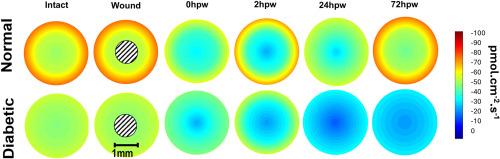
Poor wound healing is one of the most devastating complications in late-stage diabetic patients. The avascular cornea does not rely on circulation for its oxygen consumption, uptaking it mainly from the atmosphere. Previous studies demonstrated that oxygen uptake (O2U) in diabetic experimental animals and patients is significantly lower than in the non-diabetic condition. Our recent experiments show that upon wounding of the central cornea the O2U decreased across the ocular surface, followed by two increases at 6–24 h, and at 72 h, which appeared to be important for proper wound healing. It is however not known whether the two distinct O2U increases are maintained in diabetic ocular surface in response to corneal injury. In this study, we used an optic-fiber oxygen micro-sensor to measure O2U across the ocular surface of streptozotocin (STZ)- induced diabetic mice and age-matched control mice following injury to the central cornea. We found that the injury causes an immediate and substantial reduction of O2U across the ocular surface. O2U in non-diabetic corneas increases at 2–6 h post wounding (hpw), decreasing again before the second rise to peak at 72 hpw, especially at the limbus. O2U in the diabetic cornea decreases more markedly than that of non-diabetic control. This defective diabetic O2U persisted, precluding the two dynamic rises in O2U, leading to a failure in recovery. Altogether, our results suggest a previously unknown mechanism of a defective O2U response to injury in the diabetic ocular surface, which warrants further research and may lead to new therapeutic paths.
期刊介绍:
The primary goal of Experimental Eye Research is to publish original research papers on all aspects of experimental biology of the eye and ocular tissues that seek to define the mechanisms of normal function and/or disease. Studies of ocular tissues that encompass the disciplines of cell biology, developmental biology, genetics, molecular biology, physiology, biochemistry, biophysics, immunology or microbiology are most welcomed. Manuscripts that are purely clinical or in a surgical area of ophthalmology are not appropriate for submission to Experimental Eye Research and if received will be returned without review.




 京公网安备 11010802042870号
京ICP备2023020795号-1
京公网安备 11010802042870号
京ICP备2023020795号-1

 分享
分享
 求助内容:
求助内容: 应助结果提醒方式:
 扫码关注我们
