Wen-Ze Li, Fu-Yu Guo, Sheng Qu, Jing Li, Yi Ru, Xiao-Sa Zhang, Yu Liu and Jian Luan
{"title":"Fabrication of Cu-MOFs derived nanofiber membranes for efficient removal of environmental pollutants†","authors":"Wen-Ze Li, Fu-Yu Guo, Sheng Qu, Jing Li, Yi Ru, Xiao-Sa Zhang, Yu Liu and Jian Luan","doi":"10.1039/D5TC00293A","DOIUrl":null,"url":null,"abstract":"<p >Globally, one of the most significant environmental issues is water pollution caused by industrial waste. In this paper, two novel copper-based metal–organic frameworks (Cu-MOFs) were constructed using 1,4-naphthalene dicarboxylic acid (1,4-H<small><sub>2</sub></small>NDC) as the main ligand, along with <em>N</em>,<em>N</em>′-bis(pyridin-3-yl)cyclohexane-1,4-dicarboxamide (3-bcda) or <em>N</em>,<em>N</em>′-bis(3-pyridyl)adipamide (3-bpaa) as the secondary ligand using the hydrothermal method. Moreover, Cu-based derived materials (<strong>Cu-1-<em>X</em></strong> and <strong>Cu-2-<em>X</em></strong>, <em>X</em> = 600/800/1000) were prepared at different high temperatures using Cu-MOFs as the precursors. Furthermore, a series of homogeneous nanofiber membrane materials were prepared by sol–gel and electrospinning techniques using Cu-based derived materials. As a result, <strong>Cu-1-1000@PAN</strong> and <strong>Cu-2-1000@PAN</strong> catalysts exhibited high-efficiency photocatalytic degradation activity in the water purification process, especially for the photodegradation of gentian violet (GV), achieving degradation rates of 92.66% and 96.92%, respectively. Meanwhile, the degradation rate remained above 90% after five cycles. The pyrolysis temperature significantly impacted the photodegradation process by reducing the band gap and improving the degradation efficiency. This research presents an ecologically sustainable and practical solution for the removal of pollutants in water and the treatment of industrial wastewater.</p>","PeriodicalId":84,"journal":{"name":"Journal of Materials Chemistry C","volume":" 15","pages":" 7591-7602"},"PeriodicalIF":5.1000,"publicationDate":"2025-02-28","publicationTypes":"Journal Article","fieldsOfStudy":null,"isOpenAccess":false,"openAccessPdf":"","citationCount":"0","resultStr":null,"platform":"Semanticscholar","paperid":null,"PeriodicalName":"Journal of Materials Chemistry C","FirstCategoryId":"1","ListUrlMain":"https://pubs.rsc.org/en/content/articlelanding/2025/tc/d5tc00293a","RegionNum":2,"RegionCategory":"材料科学","ArticlePicture":[],"TitleCN":null,"AbstractTextCN":null,"PMCID":null,"EPubDate":"","PubModel":"","JCR":"Q2","JCRName":"MATERIALS SCIENCE, MULTIDISCIPLINARY","Score":null,"Total":0}
引用次数: 0
Abstract
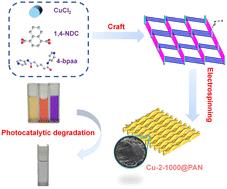
Globally, one of the most significant environmental issues is water pollution caused by industrial waste. In this paper, two novel copper-based metal–organic frameworks (Cu-MOFs) were constructed using 1,4-naphthalene dicarboxylic acid (1,4-H2NDC) as the main ligand, along with N,N′-bis(pyridin-3-yl)cyclohexane-1,4-dicarboxamide (3-bcda) or N,N′-bis(3-pyridyl)adipamide (3-bpaa) as the secondary ligand using the hydrothermal method. Moreover, Cu-based derived materials (Cu-1-X and Cu-2-X, X = 600/800/1000) were prepared at different high temperatures using Cu-MOFs as the precursors. Furthermore, a series of homogeneous nanofiber membrane materials were prepared by sol–gel and electrospinning techniques using Cu-based derived materials. As a result, Cu-1-1000@PAN and Cu-2-1000@PAN catalysts exhibited high-efficiency photocatalytic degradation activity in the water purification process, especially for the photodegradation of gentian violet (GV), achieving degradation rates of 92.66% and 96.92%, respectively. Meanwhile, the degradation rate remained above 90% after five cycles. The pyrolysis temperature significantly impacted the photodegradation process by reducing the band gap and improving the degradation efficiency. This research presents an ecologically sustainable and practical solution for the removal of pollutants in water and the treatment of industrial wastewater.
期刊介绍:
The Journal of Materials Chemistry is divided into three distinct sections, A, B, and C, each catering to specific applications of the materials under study:
Journal of Materials Chemistry A focuses primarily on materials intended for applications in energy and sustainability.
Journal of Materials Chemistry B specializes in materials designed for applications in biology and medicine.
Journal of Materials Chemistry C is dedicated to materials suitable for applications in optical, magnetic, and electronic devices.
Example topic areas within the scope of Journal of Materials Chemistry C are listed below. This list is neither exhaustive nor exclusive.
Bioelectronics
Conductors
Detectors
Dielectrics
Displays
Ferroelectrics
Lasers
LEDs
Lighting
Liquid crystals
Memory
Metamaterials
Multiferroics
Photonics
Photovoltaics
Semiconductors
Sensors
Single molecule conductors
Spintronics
Superconductors
Thermoelectrics
Topological insulators
Transistors



 京公网安备 11010802042870号
京ICP备2023020795号-1
京公网安备 11010802042870号
京ICP备2023020795号-1

 分享
分享
 求助内容:
求助内容: 应助结果提醒方式:
 扫码关注我们
