Junwei Zhou, Xiaohu Zhao, Yuanchen Jiang, Qingyuan Zhou, Yusheng He, Jiaxin Rui, Jianhui Sun and Kai Pan
{"title":"Optimizing CsPbBr3 nanowires for high-performance optoelectronics: focusing on blue shift and superfast kinetics through amine-rich synthesis†","authors":"Junwei Zhou, Xiaohu Zhao, Yuanchen Jiang, Qingyuan Zhou, Yusheng He, Jiaxin Rui, Jianhui Sun and Kai Pan","doi":"10.1039/D4TC05078A","DOIUrl":null,"url":null,"abstract":"<p >In this study, we successfully synthesized high-purity CsPbBr<small><sub>3</sub></small> perovskite nanocrystals (NCs) and nanowires (NWs) using a hot-injection method within an amine-rich environment, followed by a detailed analysis of their structural and optical properties. By carefully tuning the ratios of oleylamine (OAm) and octylamine (OctAm), as well as optimizing reaction temperature and time, we achieved enhanced morphology and photoluminescence characteristics of the products. The results indicate that increasing the amine content reduces the nanowire thickness and improves crystallinity, yielding NWs with an approximate diameter of 3 nm and NCs with a uniform size distribution of 9.7 ± 0.2 nm. X-ray diffraction (XRD) and high-resolution transmission electron microscopy (HRTEM) confirmed that the CsPbBr<small><sub>3</sub></small> nanostructures exhibit a pure orthorhombic phase. Photoluminescence (PL) and UV-vis absorption analyses revealed narrow emission peaks at 520 nm and 465 nm for NCs and NWs, respectively, with the NWs showing a pronounced blue shift and a primary exciton absorption peak at 450 nm, indicating a strong quantum confinement effect. Time-resolved photoluminescence spectroscopy (TRPL) measurements showed an average exciton lifetime of 15.29 ns for NWs, which is notably longer than the 10.55 ns observed for NCs. Femtosecond transient absorption spectroscopy (fs-TA) further demonstrated significant differences in ground-state bleach (GSB) dynamics between the nanostructures, with NWs reaching peak bleach at 9.32 ps compared to 6.16 ps for NCs. These findings highlight the slower carrier recombination rate in NWs, which enhances quantum confinement effects. This work provides both theoretical and experimental insights into the potential application of one-dimensional perovskite nanostructures in high-efficiency optoelectronic devices.</p>","PeriodicalId":84,"journal":{"name":"Journal of Materials Chemistry C","volume":" 15","pages":" 7664-7670"},"PeriodicalIF":5.1000,"publicationDate":"2025-03-13","publicationTypes":"Journal Article","fieldsOfStudy":null,"isOpenAccess":false,"openAccessPdf":"","citationCount":"0","resultStr":null,"platform":"Semanticscholar","paperid":null,"PeriodicalName":"Journal of Materials Chemistry C","FirstCategoryId":"1","ListUrlMain":"https://pubs.rsc.org/en/content/articlelanding/2025/tc/d4tc05078a","RegionNum":2,"RegionCategory":"材料科学","ArticlePicture":[],"TitleCN":null,"AbstractTextCN":null,"PMCID":null,"EPubDate":"","PubModel":"","JCR":"Q2","JCRName":"MATERIALS SCIENCE, MULTIDISCIPLINARY","Score":null,"Total":0}
引用次数: 0
Abstract
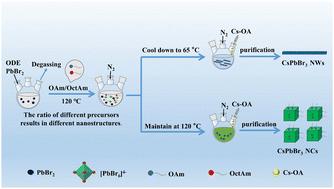
In this study, we successfully synthesized high-purity CsPbBr3 perovskite nanocrystals (NCs) and nanowires (NWs) using a hot-injection method within an amine-rich environment, followed by a detailed analysis of their structural and optical properties. By carefully tuning the ratios of oleylamine (OAm) and octylamine (OctAm), as well as optimizing reaction temperature and time, we achieved enhanced morphology and photoluminescence characteristics of the products. The results indicate that increasing the amine content reduces the nanowire thickness and improves crystallinity, yielding NWs with an approximate diameter of 3 nm and NCs with a uniform size distribution of 9.7 ± 0.2 nm. X-ray diffraction (XRD) and high-resolution transmission electron microscopy (HRTEM) confirmed that the CsPbBr3 nanostructures exhibit a pure orthorhombic phase. Photoluminescence (PL) and UV-vis absorption analyses revealed narrow emission peaks at 520 nm and 465 nm for NCs and NWs, respectively, with the NWs showing a pronounced blue shift and a primary exciton absorption peak at 450 nm, indicating a strong quantum confinement effect. Time-resolved photoluminescence spectroscopy (TRPL) measurements showed an average exciton lifetime of 15.29 ns for NWs, which is notably longer than the 10.55 ns observed for NCs. Femtosecond transient absorption spectroscopy (fs-TA) further demonstrated significant differences in ground-state bleach (GSB) dynamics between the nanostructures, with NWs reaching peak bleach at 9.32 ps compared to 6.16 ps for NCs. These findings highlight the slower carrier recombination rate in NWs, which enhances quantum confinement effects. This work provides both theoretical and experimental insights into the potential application of one-dimensional perovskite nanostructures in high-efficiency optoelectronic devices.
期刊介绍:
The Journal of Materials Chemistry is divided into three distinct sections, A, B, and C, each catering to specific applications of the materials under study:
Journal of Materials Chemistry A focuses primarily on materials intended for applications in energy and sustainability.
Journal of Materials Chemistry B specializes in materials designed for applications in biology and medicine.
Journal of Materials Chemistry C is dedicated to materials suitable for applications in optical, magnetic, and electronic devices.
Example topic areas within the scope of Journal of Materials Chemistry C are listed below. This list is neither exhaustive nor exclusive.
Bioelectronics
Conductors
Detectors
Dielectrics
Displays
Ferroelectrics
Lasers
LEDs
Lighting
Liquid crystals
Memory
Metamaterials
Multiferroics
Photonics
Photovoltaics
Semiconductors
Sensors
Single molecule conductors
Spintronics
Superconductors
Thermoelectrics
Topological insulators
Transistors



 京公网安备 11010802042870号
京ICP备2023020795号-1
京公网安备 11010802042870号
京ICP备2023020795号-1

 分享
分享
 求助内容:
求助内容: 应助结果提醒方式:
 扫码关注我们
