Manipulating the energy transfer path to achieve a high-efficiency red fluorescent OLED by using a novel interface sensitization layer and multiple reverse intersystem crossing (RISC) channels
Guangyuan Wang, Zhiqi Kou, Zeyu Jia, Zhenyong Guo, Xiangqiong Xie, Ruixing Wanghe and Zhu Ran
{"title":"Manipulating the energy transfer path to achieve a high-efficiency red fluorescent OLED by using a novel interface sensitization layer and multiple reverse intersystem crossing (RISC) channels","authors":"Guangyuan Wang, Zhiqi Kou, Zeyu Jia, Zhenyong Guo, Xiangqiong Xie, Ruixing Wanghe and Zhu Ran","doi":"10.1039/D5TC00344J","DOIUrl":null,"url":null,"abstract":"<p >In co-host sensitized fluorescent devices, the triplet energy loss caused by a conventional fluorescent dopant (CFD) in the emitting layer (EML) prevents further improvement in device efficiency performance. In this article, we fabricate a thermally activated delayed fluorescence-sensitized fluorescent (TSF) organic light-emitting diode (OLED) with a dual-layer EML, which consists of an interface sensitized layer (ISL) and a red fluorescent EML. This device achieves a separation effect between the exciton generation region and the energy utilization region, which can effectively reduce the triplet energy lost through a CFD (DCJTB). Energy is mainly transferred from the sensitizer to the CFD through Förster energy transfer (FET). Furthermore, we introduce a TADF material (DMAC-MPM) into the ISL to form three RISC channels, corresponding to DMAC-MPM, DMAC-MPM:PO-T2T and TCTA:PO-T2T. The multiple reverse intersystem crossing (RISC) channels can effectively improve the up-conversion rate of triplet excitons, while also reducing exciton quenching in the ISL. After optimizing the relative position and thickness of the sensitizer (DMAC-MPM:PO-T2T) and the CFD, we achieve the maximum EQE of 14.33% in TSF-OLED device C1, which is the highest efficiency achieved among those of the reported fluorescent devices using DCJTB. The efficiency roll-off performance has also been improved, reaching 12.20% at a luminance of 1000 cd m<small><sup>−2</sup></small>.</p>","PeriodicalId":84,"journal":{"name":"Journal of Materials Chemistry C","volume":" 15","pages":" 7815-7823"},"PeriodicalIF":5.1000,"publicationDate":"2025-03-05","publicationTypes":"Journal Article","fieldsOfStudy":null,"isOpenAccess":false,"openAccessPdf":"","citationCount":"0","resultStr":null,"platform":"Semanticscholar","paperid":null,"PeriodicalName":"Journal of Materials Chemistry C","FirstCategoryId":"1","ListUrlMain":"https://pubs.rsc.org/en/content/articlelanding/2025/tc/d5tc00344j","RegionNum":2,"RegionCategory":"材料科学","ArticlePicture":[],"TitleCN":null,"AbstractTextCN":null,"PMCID":null,"EPubDate":"","PubModel":"","JCR":"Q2","JCRName":"MATERIALS SCIENCE, MULTIDISCIPLINARY","Score":null,"Total":0}
引用次数: 0
Abstract
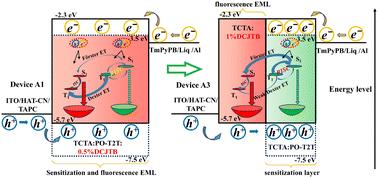
In co-host sensitized fluorescent devices, the triplet energy loss caused by a conventional fluorescent dopant (CFD) in the emitting layer (EML) prevents further improvement in device efficiency performance. In this article, we fabricate a thermally activated delayed fluorescence-sensitized fluorescent (TSF) organic light-emitting diode (OLED) with a dual-layer EML, which consists of an interface sensitized layer (ISL) and a red fluorescent EML. This device achieves a separation effect between the exciton generation region and the energy utilization region, which can effectively reduce the triplet energy lost through a CFD (DCJTB). Energy is mainly transferred from the sensitizer to the CFD through Förster energy transfer (FET). Furthermore, we introduce a TADF material (DMAC-MPM) into the ISL to form three RISC channels, corresponding to DMAC-MPM, DMAC-MPM:PO-T2T and TCTA:PO-T2T. The multiple reverse intersystem crossing (RISC) channels can effectively improve the up-conversion rate of triplet excitons, while also reducing exciton quenching in the ISL. After optimizing the relative position and thickness of the sensitizer (DMAC-MPM:PO-T2T) and the CFD, we achieve the maximum EQE of 14.33% in TSF-OLED device C1, which is the highest efficiency achieved among those of the reported fluorescent devices using DCJTB. The efficiency roll-off performance has also been improved, reaching 12.20% at a luminance of 1000 cd m−2.
期刊介绍:
The Journal of Materials Chemistry is divided into three distinct sections, A, B, and C, each catering to specific applications of the materials under study:
Journal of Materials Chemistry A focuses primarily on materials intended for applications in energy and sustainability.
Journal of Materials Chemistry B specializes in materials designed for applications in biology and medicine.
Journal of Materials Chemistry C is dedicated to materials suitable for applications in optical, magnetic, and electronic devices.
Example topic areas within the scope of Journal of Materials Chemistry C are listed below. This list is neither exhaustive nor exclusive.
Bioelectronics
Conductors
Detectors
Dielectrics
Displays
Ferroelectrics
Lasers
LEDs
Lighting
Liquid crystals
Memory
Metamaterials
Multiferroics
Photonics
Photovoltaics
Semiconductors
Sensors
Single molecule conductors
Spintronics
Superconductors
Thermoelectrics
Topological insulators
Transistors



 京公网安备 11010802042870号
京ICP备2023020795号-1
京公网安备 11010802042870号
京ICP备2023020795号-1

 分享
分享
 求助内容:
求助内容: 应助结果提醒方式:
 扫码关注我们
