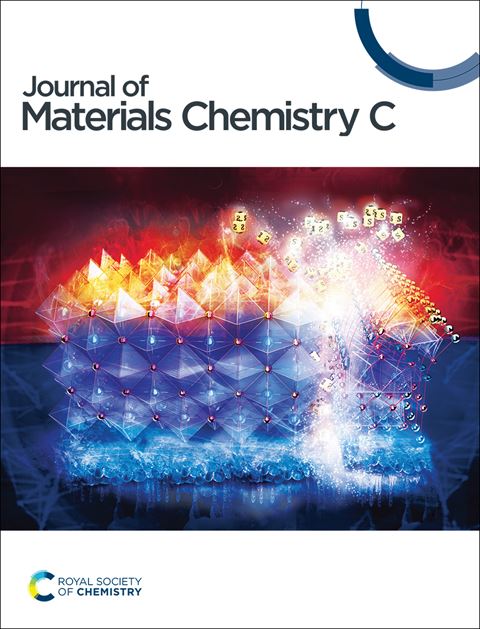
{"title":"First-principles study of metal and ligand substitution effects on EUV absorption and electron energy loss†","authors":"Florian Brette, Vishal Gupta and Geunsik Lee","doi":"10.1039/D5TC00441A","DOIUrl":null,"url":null,"abstract":"<p >Secondary electrons play a vital role in extreme ultraviolet lithography (EUV-L), as low-energy electrons (LEEs) induce the solubility switch of the photoresist <em>via</em> electron-induced reactions. However, optimizing EUV absorption at 92 eV and addressing the relatively long inelastic mean free path (IMFP) of LEEs, which can lead to pattern blurring, remain critical challenges. Here, first-principles calculations based on time-dependent density functional theory (TDDFT) are conducted to evaluate how chemical substitutions in metal and ligand sites affect both EUV absorption and the energy loss function (ELF) of LEEs in oxalate systems. Results highlight that atomic cross-sections alone are insufficient for optimizing photoabsorption, and electronic structure effects must be considered. Analysis of the ELF of LEEs reveals that iodine-containing systems exhibit a higher ELF at low energies, suggesting a reduced IMFP. Additionally, iodine incorporation shows potential to lower the band gap, which may further reduce the IMFP of LEEs in photoresists. These findings underscore the significance of electronic structure effects in EUV-L and demonstrate the value of first-principles calculations in optimizing photoabsorption and electron behavior for next-generation lithography applications.</p>","PeriodicalId":84,"journal":{"name":"Journal of Materials Chemistry C","volume":" 15","pages":" 7852-7865"},"PeriodicalIF":5.1000,"publicationDate":"2025-03-13","publicationTypes":"Journal Article","fieldsOfStudy":null,"isOpenAccess":false,"openAccessPdf":"https://pubs.rsc.org/en/content/articlepdf/2025/tc/d5tc00441a?page=search","citationCount":"0","resultStr":null,"platform":"Semanticscholar","paperid":null,"PeriodicalName":"Journal of Materials Chemistry C","FirstCategoryId":"1","ListUrlMain":"https://pubs.rsc.org/en/content/articlelanding/2025/tc/d5tc00441a","RegionNum":2,"RegionCategory":"材料科学","ArticlePicture":[],"TitleCN":null,"AbstractTextCN":null,"PMCID":null,"EPubDate":"","PubModel":"","JCR":"Q2","JCRName":"MATERIALS SCIENCE, MULTIDISCIPLINARY","Score":null,"Total":0}
引用次数: 0
Abstract
Secondary electrons play a vital role in extreme ultraviolet lithography (EUV-L), as low-energy electrons (LEEs) induce the solubility switch of the photoresist via electron-induced reactions. However, optimizing EUV absorption at 92 eV and addressing the relatively long inelastic mean free path (IMFP) of LEEs, which can lead to pattern blurring, remain critical challenges. Here, first-principles calculations based on time-dependent density functional theory (TDDFT) are conducted to evaluate how chemical substitutions in metal and ligand sites affect both EUV absorption and the energy loss function (ELF) of LEEs in oxalate systems. Results highlight that atomic cross-sections alone are insufficient for optimizing photoabsorption, and electronic structure effects must be considered. Analysis of the ELF of LEEs reveals that iodine-containing systems exhibit a higher ELF at low energies, suggesting a reduced IMFP. Additionally, iodine incorporation shows potential to lower the band gap, which may further reduce the IMFP of LEEs in photoresists. These findings underscore the significance of electronic structure effects in EUV-L and demonstrate the value of first-principles calculations in optimizing photoabsorption and electron behavior for next-generation lithography applications.
期刊介绍:
The Journal of Materials Chemistry is divided into three distinct sections, A, B, and C, each catering to specific applications of the materials under study:
Journal of Materials Chemistry A focuses primarily on materials intended for applications in energy and sustainability.
Journal of Materials Chemistry B specializes in materials designed for applications in biology and medicine.
Journal of Materials Chemistry C is dedicated to materials suitable for applications in optical, magnetic, and electronic devices.
Example topic areas within the scope of Journal of Materials Chemistry C are listed below. This list is neither exhaustive nor exclusive.
Bioelectronics
Conductors
Detectors
Dielectrics
Displays
Ferroelectrics
Lasers
LEDs
Lighting
Liquid crystals
Memory
Metamaterials
Multiferroics
Photonics
Photovoltaics
Semiconductors
Sensors
Single molecule conductors
Spintronics
Superconductors
Thermoelectrics
Topological insulators
Transistors




 京公网安备 11010802042870号
京ICP备2023020795号-1
京公网安备 11010802042870号
京ICP备2023020795号-1

 分享
分享
 求助内容:
求助内容: 应助结果提醒方式:
 扫码关注我们
